

An account executive resume gets read with a calculator. A sales leader takes your lines (closed, quota, percent, deal size, cycle, rank) and checks each one against the others, often in their head, before reading anything else. Most sample pages give you bullets to copy. This one gives you the checks, three labelled samples at SMB, mid-market and enterprise level whose math holds, and what to do about confidential numbers and on-target pay questions on application forms.
What a sales leader reads first
Three things, in this order: attainment by year with its denominator, deal size and cycle, then rank. The first says whether you hit. The second says whether your selling looks like theirs. The third says how you compare with people who had the same product and the same year.
Postings show the same priorities. We read 125 US account executive postings from 44 employers on public Greenhouse and Ashby boards on 9 November 2026. They were hand-picked and mostly software, capped at 10 per employer. Of those, 82 mentioned a track record, 71 mentioned quota and 21 used the word attainment. Our keyword count covers which other words recur.
Keep the bar in view, because hiring managers do. The Bridge Group's June 2026 report, from 158 B2B companies, puts 48% of reps at quota, down from 51% in 2024. RepVue's self-reported figure for account executives is 42%, from 35,635 ratings. So a plain 104% is in the half or so who made it. "Consistently exceeded quota" tells a reader less than one 96% with a reason beside it.
Quota lines that hold up
The pattern is short: Closed $[X] against a $[Y] quota in [period] ([Z]%). Every part can be checked. Here are the checks.
| Check | The math | What fails it |
|---|---|---|
| Percent | Closed divided by quota | "$1.4M on a $1.2M quota, 130%". That is 117% |
| Deal count | Closed divided by average deal | "$900K closed, $70K average, 40 deals". That is about 13 |
| Capacity | Deals against cycle length | 40 enterprise deals a year on a 9 month cycle, working alone |
| Quota to OTE | Quota divided by on-target pay | Bridge reports a median of 4.6 times. "$4M quota, $140K OTE" is 29 times, so expect a question |
| Rank | One person in a team of N is 1/N | "Top 1%" on a team of 12. First place is 8.3% |
| Repeat | Each year stated, not averaged | "120%+ every year" with no years. Fewer than half of reps reach 100% |
Even published samples slip. Huntr's account executive page prints a sample line, "Closed $4.2M against a $3.5M quota (121%)". The division gives 120%. It is a tiny miss on a template, and on your resume it is the kind of thing that makes a reader start checking everything else.
A few more habits keep lines defensible:
- Name the period and the plan year. "FY2025" beats "last year".
- Split new business from expansion if your quota did. A reader selling new logos wants to know how much of your number was handed to you.
- Prorate honestly. "9 months, prorated quota of $450K" is a stronger line than an annual figure you did not carry for a full year.
- Say so if it was a team number. Pooled quotas are common and fine, as long as the line does not read as yours alone.
- Keep the bad year. A two-year record with an 88% and a reason reads as real. A gap in the years reads as hiding.
Deal size, cycle and rank
Deal size and cycle let a manager place you, so give them in the same terms the job uses. RepVue's Q3 2025 index, from about 49,720 ratings at 249 companies, put mid-market average contract value above $67,000 and key accounts above $324,000, and it says sales cycles lengthened at every deal size. A 30 day seller and a 9 month seller are doing different jobs, and neither should hide it.
Rank needs a denominator, a measure and a period: "Ranked 5 of 26 mid-market AEs by closed-won in FY2025." Without those three it is decoration. President's Club works the same way. Say what it took, such as top 15% by attainment, if you know it.
Sample: SMB
All three samples are invented, built to show lines whose math works. Quotas are set near RepVue's on-target medians times Bridge's 4.6, so the scale reads as plausible: $140,000 for SMB, $180,000 for mid-market and $280,000 for enterprise.
Account Executive, SMB, payroll software company, 2024 to 2026
- Closed $716,800 in new ARR against a $640,000 quota in FY2025 (112%); 97% of $600,000 in FY2024.
- Signed 51 new customers in FY2025 at about $14,050 average contract value, median cycle 24 days.
- Ranked 3 of 18 SMB AEs by closed-won in FY2025.
- Sourced 38% of closed pipeline through my own outbound.
The check: $716,800 divided by $640,000 is 112%. Divided by 51 deals it is about $14,050. Fifty-one deals a year is one a week, which fits a 24 day cycle. Nothing here needs explaining.
Sample: mid-market
Account Executive, Mid-Market, logistics software company, 2023 to 2026
- Closed $896,400 against a $830,000 quota in FY2025 (108%); 94% of $760,000 in FY2024.
- Won 13 deals in FY2025 at about $69,000 average, median cycle 78 days, largest $162,000 across four business units.
- Ranked 5 of 26 mid-market AEs by closed-won in FY2025.
- Ran multi-stakeholder deals with finance and operations leads, forecast within 10% in three of four quarters.
The check: 13 deals at $69,000 is about $897,000. Thirteen wins on a 78 day cycle is about three winning deals open at any time, which one rep can run. The 94% year stays in, and it makes the 108% more believable.
Sample: enterprise
Enterprise Account Executive, security software company, 2021 to 2026
- Closed $1.57M in ACV against a $1.3M quota in FY2025 (121%); 88% of $1.2M in FY2024, when one $400K deal slipped into Q1.
- Won 6 deals in FY2025 at about $262,000 average, cycles of 7 to 11 months.
- Ranked 4 of 31 enterprise AEs in FY2025; President's Club, top 15% by attainment.
- Led deals through security review and procurement with CISO and CFO sponsors.
The check: $1.573M divided by $1.3M is 121%. Four of 31 is the top 13%, which fits the top 15% club. With six deals, one deal is about a sixth of the year, so an enterprise resume needs more than one year on the page. The FY2024 note says that plainly.
Confidential numbers
Your employer may treat revenue, quota dollars and customer names as confidential, so read what you signed. This is general information, not legal advice. Most of the time you can keep the proof and drop the sensitive part.
| Instead of | Write |
|---|---|
| "Closed $1.57M against a $1.3M quota" | "121% of a seven-figure annual quota in FY2025" |
| "Won Acme Bank's $400K contract" | "Won a $400K-plus contract with a top-20 US regional bank" |
| "Grew the Northeast region to $14M" | "Ranked 4 of 31 enterprise AEs by closed-won" |
Percentages and ranks tend to survive scrutiny because they do not expose company revenue. Leave out customer names you have no permission to use, and keep CRM exports and internal reports out of your application.
Keep your own pay statements, since those are yours. Be ready for verification, too, though the methods vary. Betts Recruiting says of asking for a W-2 that "it's usually not worth the risk", and that it "engages past employers to validate key metrics like commission attainment and quota consistency". So assume someone may call, and write only what your last manager would confirm.
On-target pay on forms
Forms ask less than you might fear. We read the application forms on 82 of those postings, from 27 employers on Greenhouse:
- 11 forms, at 4 employers, asked about pay in any form.
- 7 forms, at 4 employers, mentioned quota, mostly as a yes or no on years of quota-carrying experience.
- Only 3 forms, all at one employer, asked for your actual figure. Xometry's Account Executive II form asks "What was your recent sales quota and what was your percentage to goal last year?"
- The same form separates "What are your desired base salary expectations?" from "What is your desired total on-target earnings annually (base + commission)?"
So the resume carries your number, and the form mostly decides whether you pass a filter. When a form does ask about pay, the label tells you what to enter:
| The form says | Enter |
|---|---|
| "Desired salary" or "base salary expectations" | Base only. OTE in a base field makes you look far more expensive |
| "Total on-target earnings" | OTE |
| "Compensation expectations", free text | Both: base and on-target, as two figures |
| Recent quota and percent to goal | The same figures as your resume. If confidential, the percent and rough scale |
| What you earn now | Some states bar this. Colorado prohibits asking about pay history, and California says an employer "shall not" seek salary history but may ask your expectation |
For a sense of scale, RepVue's self-reported medians, updated 7 November 2026, are $75,000 base and $140,000 on-target for SMB account executives, $95,000 and $180,000 for mid-market, and $143,000 and $280,000 for enterprise. Bridge's 2024 report gave a 53:47 base to variable split on a $190,000 median. These lean toward software, so check them against the range in the posting itself. California requires employers with 15 or more staff to include a pay scale in postings, and Colorado requires compensation in all of them. Our guide to your desired salary covers how to choose the number.
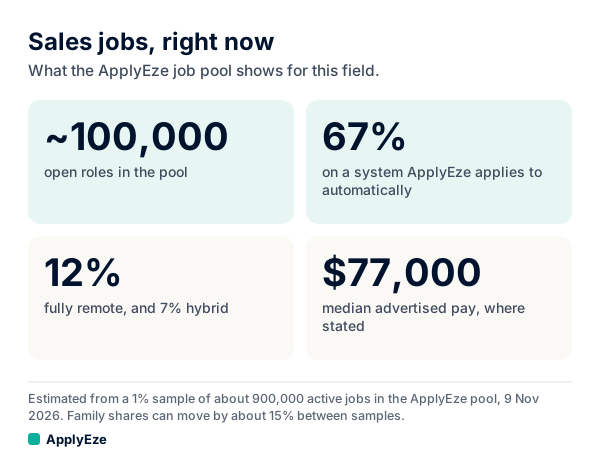
The $77,000 in that chart is the median advertised pay across all sales roles in the ApplyEze pool, roughly 100,000 open roles from a 1% sample, including roles far from software, and only postings that state pay. Roughly 12% are remote. It shows how wide the field is. For this job, use the RepVue medians above. If you are earlier in your career, getting into sales covers on-target math from the SDR level.
Why ApplyEze locks the figures
In sales the number is the resume, so this is what we would want to know about any tool that rewrites one. ApplyEze writes a resume for each posting from your own record. Your employers, job titles, dates, schools, degrees and certifications come from that record, and code rejects a rewrite that adds a figure, employer, school or credential your record does not hold. An audit of 84 sampled resumes on 4 November 2026 found 0 invented employers, dates, degrees or numbers.
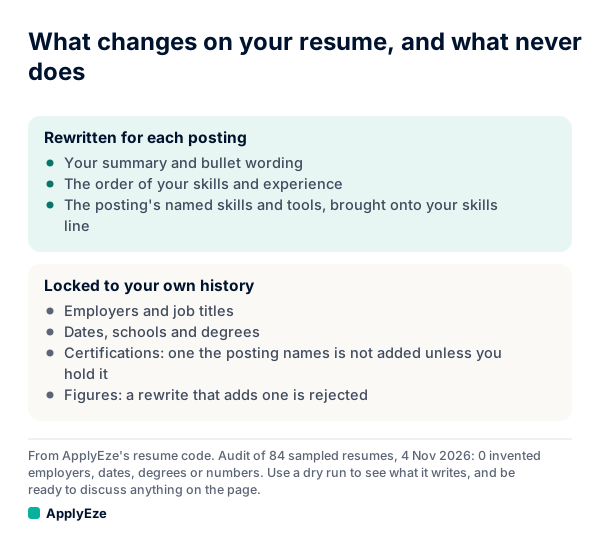
Two consequences follow. A rewrite cannot add your 112%, so it has to be in the resume you upload. And skills work differently from figures: ApplyEze brings the posting's named skills and tools onto your skills line, even when your own record does not list them. There is no step to remove one before a live run, so use a dry run to see what it writes, and be ready to discuss anything on the page. A certification the posting asks for is not added unless you hold it.
Hard facts come from your profile. When a required question is not covered by your saved answers, ApplyEze still fills it rather than stopping the run, so that answer may not come from you. Fill in your saved answers, use dry run first, and read your receipts. That matters for the pay and quota questions above, so save those answers before you queue anything.
ApplyEze polls more than 100,000 employer boards directly, and roughly 67% of sales roles sit on systems it applies to with an application inbox connected. Workday and Oracle jobs stay hidden until you connect one, because those sites email a code. You pick the matches and queue them in the desktop app, which runs while your computer stays on and awake, and a credit is used only when an application is confirmed as Submitted.
Your next step is the calculator. Run the six checks on your own lines, fix what fails, and put the result in the resume you upload. If you would rather spend your week on pipeline than on forms, your first 50 applications are free, with no card, and ApplyEze writes a resume for each posting with your figures locked.