

A cybersecurity resume has to settle three things quickly: what clearance status you hold, in exact words; which certifications are live, with dates; and what you have detected or contained, told without exposing anything you should not. Those three lines are where security resumes go wrong in ways other fields never face. "Active clearance" can be false the day you leave a job. "CISSP" can be false if you only passed the exam. A proud incident story can hand an attacker a map. Below you get the exact wording for each clearance status, a redaction test for incident lines, and samples for a SOC analyst, a GRC analyst and someone moving in from IT. Every sample is invented.
What a hiring manager checks first
In ISC2's December 2024 survey of 929 hiring managers, the attributes rated critical for entry and junior hires ran almost level: certifications 47%, IT experience 44%, relevant education 43%. The same survey found 84% of organizations use skills-based assessments or tests for those applicants. Read together, that means two things. Your credentials get you read, and everything on the page can come back as a test question. List a tool only if you could use it in front of someone.
For cleared roles there is an earlier check. Put the clearance line in the header, under your name and above your summary. If a recruiter filtering for it has to hunt, you lose them before anything else counts.
Sample header (invented)
[Name]  |  Arlington, VA  |  name@example.com
TS/SCI eligibility, investigation in scope, currently in access
CompTIA Security+ (SY0-701), earned Mar 2025, valid through Mar 2028
Stating a clearance correctly
The trouble is that the words people use loosely have narrower meanings. ClearedJobs.Net lays them out, and warns that employers screen on exact terms because the government's system of record stores exact states.
- Eligible: you have been adjudicated. It is "a status recorded in the system of record."
- Active: "the street term for access: being read into classified information right now."
- Current: your investigation is recent and in scope. "It is a property of the investigation, not of you."
- Inactive: access has been switched off and eligibility remains.
- Debriefed: "A debrief ends access. It does not, by itself, end eligibility."
An older ClearanceJobs FAQ, still online through George Washington University, uses "current" to mean "a terminated clearance that is still eligible for reinstatement", so ask which sense a recruiter means. This table is what to write. The wording follows ClearedJobs.Net and Best Military Resume, which disagree on one point: the second accepts "Active TS/SCI", the first prefers spelling out eligibility and access. If you are in access today, either is true, and "active" is the word postings search for.
| Your situation | Write | Do not write |
|---|---|---|
| In a cleared job, in access today | "TS/SCI eligibility, investigation in scope, currently in access" or "Active TS/SCI" | "TS clearance", with no status |
| In access, with a polygraph | "Active TS/SCI with CI polygraph" | "Poly", with no type |
| Left the job, eligibility remains | "Debriefed 2025, Secret eligibility retained, investigation current" | "Active Secret" |
| Working on temporary eligibility | "Interim Secret" (the current term is temporary eligibility) | "Secret" |
| Old clearance, investigation aged out | "Former Top Secret (investigation completed 2016)" | "Clearable" |
| Holding Secret and hoping for more | "Active Secret" | "Secret/TS/SCI" or "eligible for TS" |
| Never cleared | Nothing | "Clearable", "clearance eligible" |
On that last row: if a posting says "ability to obtain", the employer already knows what it will check. Best Military Resume notes that calling yourself eligible for a higher level is not a meaningful qualification, since U.S. citizens can generally be investigated for it. If citizenship is relevant and you want it visible, "U.S. citizen" is a plain fact you can state.
The 24-month number
Nearly every guide says a clearance stays "current" for 24 months after you leave. We looked for that figure in the rule itself. "24 months" does not appear in 32 CFR 117.10, the section on contractor eligibility, as of 9 November 2026. That older FAQ speaks of a two-year break in service, and ClearedJobs.Net traces the figure to DoD 5220.22-M, which stopped being the controlling authority on 24 February 2021. The same site cites DoD Manual 5200.02 for a 24-month reactivation window after separation, with conditions. We could not open that manual to confirm it.
The practical point is to leave the countdown off your resume. Ask your last security officer what your record shows. That office, and not a blog, can read it.
What stays off the page
Best Military Resume's list is a good default: no SCI compartments, program names or codewords, no classification markings, no Social Security or investigation case number. LaunchCode adds that classified systems and sensitive operations should stay high level.
If you worked in intelligence, there may be a further step. The U.S. Naval Cryptologic Veterans Association quotes NSA's rule that "All NSA/CSS affiliates (past or present)" must forward for review any material meant for public release that is or may be based on protected information. Treat a resume posted publicly as covered until your security office says otherwise.
Certifications and dates
Give every credential its issuer and date. A date tells a reader it is live, and expiry is a real event here: CompTIA says that once Security+ lapses, "the only way to get it back is to pass the certification exam again."
| Credential | Write it as | Why the date matters |
|---|---|---|
| Security+ | CompTIA Security+ (SY0-701), earned Mar 2025, valid through Mar 2028 | Good for three years from your pass date, 50 CEUs to renew |
| CISSP | CISSP, ISC2, certified Jun 2024 | 120 CPE credits over three years and a $135 annual fee keep it active |
| CISSP exam passed, years short | Associate of ISC2 (passed CISSP exam, 2026) | You have six years to earn the five years of experience |
| ISC2 CC | Certified in Cybersecurity, ISC2, earned 2026 | 45 CPE credits over three years |
| CISA exam passed, years short | Passed CISA exam, 2026; certification pending experience | ISACA asks for five years of experience within the prior ten, verified by a supervisor, and an application within five years of passing |
| Studying | CySA+ in progress, exam booked Jan 2027 | Says what is true, in the certifications section only |
Keep bare letters off your skills line. A reader seeing "CISSP" next to "Splunk" assumes you hold it. Our guide to the resume skills section has more on what belongs there, and hard skills for a resume covers how to judge a tool you have used only a little.
Incident and detection lines
A strong line has four parts: what happened, what you did, how fast or how much, and over what period. Numbers need a denominator. "Reduced response time 40%" tells a reader nothing. "Median time to contain fell from 6 hours to 2.5 hours across 38 incidents in 12 months" can be discussed for ten minutes.
Then run the redaction test on every line:
- Could an attacker use this? An open gap, an unpatched product or a network layout should not appear.
- Does it identify a client or a non-public incident?
- Does a contract or nondisclosure agreement cover it? If you are unsure, ask.
- Is the figure yours to share? Counts and durations usually are. Loss amounts usually are not.
- Could you defend it in an interview without breaking 1 through 4?
Here is that test applied to three invented lines.
| Exposes too much | Safer version |
|---|---|
| Contained ransomware at First Example Bank that came in through an unpatched VPN appliance | Led containment of a ransomware incident at a regional bank: isolated 140 endpoints within 3 hours, restored from clean backups in 2 days |
| Wrote a rule to cover the gap in our endpoint coverage on domain controllers | Closed a detection gap on identity infrastructure: new rule mapped to ATT&CK credential access techniques, 3 true positives in 6 months |
| Found SQL injection in a client's patient portal, still not fixed | Reported 23 web application findings across 4 engagements, 6 rated high, all retested before close |
For vocabulary, use terms a reader recognizes. MITRE ATT&CK is the common language for techniques, and NIST SP 800-61 Rev. 3, published April 2025, is NIST's current incident response guidance. If the work came from a lab, say "lab project". Passing a lab off as production work is the easiest lie to catch in an interview.
Sample: SOC analyst
Sample (invented). SOC Analyst, Tier 2, regional health system, Jun 2023 to present

- Triage about 60 alerts a shift across endpoint, identity and email telemetry in a
  round-the-clock security operations center.
- Median time to contain fell from 6 hours to 2.5 hours across 38 incidents in the
  last 12 months, after I wrote playbooks for the 5 most common alert types.
- Tuned 22 detection rules, cutting false positives on the top 5 from about 70% to 25%
  of alerts in those rules, measured over one quarter.
- Mentor 2 Tier 1 analysts; wrote the shift handoff template now used by the team.

CompTIA Security+ (SY0-701), earned Jan 2024, valid through Jan 2027
CompTIA CySA+, earned Sep 2025
Sample: GRC
Sample (invented). GRC Analyst, payments software company, Feb 2022 to present

- Ran the annual PCI DSS assessment for 3 cardholder environments: 9 findings, all closed
  before the assessor's final report.
- Mapped 180 controls to NIST SP 800-53 so one evidence request could serve 3 audits,
  cutting evidence tickets to engineering by about 40% year on year.
- Own a risk register of 62 risks with named owners; present the top 10 each quarter
  to the security steering committee.
- Reviewed 75 vendors against a tiered questionnaire; escalated 12 and ended 2 contracts.

Passed CISA exam, 2025; certification pending experience
ISC2 Certified in Cybersecurity, earned 2023
GRC readers look for audits, frameworks and owners rather than tools. Name the frameworks you actually worked in, and match them to the posting only where that is true.
Sample: moving in from IT
Sample (invented). Systems Administrator, mid-size manufacturer, Mar 2021 to present
Summary: Systems administrator moving into security operations. Security work below.

- Raised patch compliance on 420 Windows servers from 71% to 96% in 9 months, with a
  monthly report to the CIO.
- Removed local admin rights from 1,100 endpoints, with 6 documented exceptions.
- First responder on 14 phishing-led account compromises: reset access, checked mailbox
  rules, wrote the staff notice.
- Lab project, self-hosted: wrote and tuned a detection for one ATT&CK technique.
  Public write-up linked.

CompTIA Security+ (SY0-701), earned Aug 2026, valid through Aug 2029
The title stays what your employer would confirm. The summary carries the direction, and the bullets pull the security work out of a general IT job. For where that move leads, see how to get into cybersecurity.
Where these resumes go
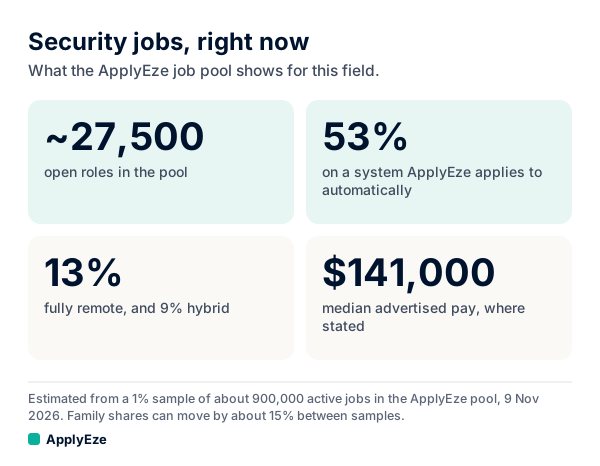
ApplyEze polls more than 100,000 employer boards directly, and the chart shows that pool in a 1% sample on 9 November 2026: roughly 27,500 open security roles, about 13% fully remote, a median advertised pay of about $141,000 among postings that state pay, and roughly 53% on a system ApplyEze applies to. These are rough, and the family may be wider than cybersecurity alone. With so few roles fully remote, your location line will often be read alongside the clearance line.
Why a clearance is never added for you
If you apply through ApplyEze, a clearance is never claimed for you. ApplyEze does not claim a security clearance you did not save, and a posting requiring one you lack is skipped, at no credit. The reason is the one running through this post. Status is a fact held in a government record, and the government determines it, so an added line cannot survive a check, and the wrong word can make you read as a different candidate.
The same logic covers the rest of the resume. Your employers, job titles, dates, schools, degrees and certifications come from your own record. Code rejects a rewrite that adds a figure, employer, school or credential your record does not hold, and an audit of 84 sampled resumes on 4 November 2026 found 0 invented employers, dates, degrees or numbers. A certification the posting asks for is not added unless you hold it. Each file is read back the way a parser reads it before the form is touched.
Skills work differently: ApplyEze brings the posting's named skills and tools onto your skills line, even when your own record does not list them. There is no step to remove one before a live run, so use a dry run to see what it writes, and be ready to discuss anything on the page. You choose what goes in the queue, and with 84% of organizations using skills tests, queue the postings whose tools you could use in front of someone.
On forms, hard facts come from your profile. When a required question is not covered by your saved answers, ApplyEze still fills it rather than stopping the run, so that answer may not come from you. Fill in your saved answers, use dry run first, and read your receipts.
You pick the matches and queue them in the desktop app, which fills and submits each form on your computer while it stays on and awake, and Workday and Oracle jobs need an application inbox connected. Get your clearance line right first. Then, if you would rather spend your evenings tuning detections than filling in forms, your first 50 applications are free, once per email address with no card, and a credit is used only when an application is confirmed as Submitted.