

A software engineer cover letter is worth writing only when it says something your resume cannot, because most software forms leave it optional. Of 155 software engineer application forms we read on 9 November 2026, 132 offered a letter field marked optional, 23 had no field, and none required one. Not one of those 155 postings mentioned a cover letter in its text. So the first question is when to write one. Two working papers on AI-written letters help answer that, and each is labelled below with its setting, because both studied freelance work rather than salaried engineering jobs. After them comes a way to build a letter around one project and one metric, with a sample.
Is a letter worth it here?
We read those forms through Greenhouse's public job board API, at most three postings per company, from 59 companies with US locations. It is one application system and it leans to technology firms. Our wider October sample across roles found the same pattern: 77 optional, 11 absent and 2 required out of 90.
| Situation | Write one? | Why |
|---|---|---|
| No letter field on the form | No | The employer removed it |
| The posting text asks for one | Yes | None of our 155 did, but read to the end anyway |
| A required "why us" box | Write the box, skip the letter | It can block submission, and it is the question they chose |
| You contributed to their open source code or built on their API | Yes | A resume cannot show that it was their code |
| An engineer there referred you | Yes, name them first | This is the one line a recruiter may act on |
| You are changing stack, or coming from another field | Yes | Explain what carries over |
| You are moving to the job's city | Yes, one sentence | See the chart below |
| Optional field, nothing specific to add | No | A generic letter gives the reader nothing |
The last row is the common one, and skipping is a fair call. Tech job seekers in a 2026 United Way NCA survey reported 69.9 hours over 103.7 applications, about 40 minutes each by our arithmetic, so a letter competes with your next application. Recruiters themselves disagree on the value. In a Wellfound article, one asks for "one or two short paragraphs", another says "I never require them because I know I'm not going to read them", and a third calls no letter and a generic letter "about the same".
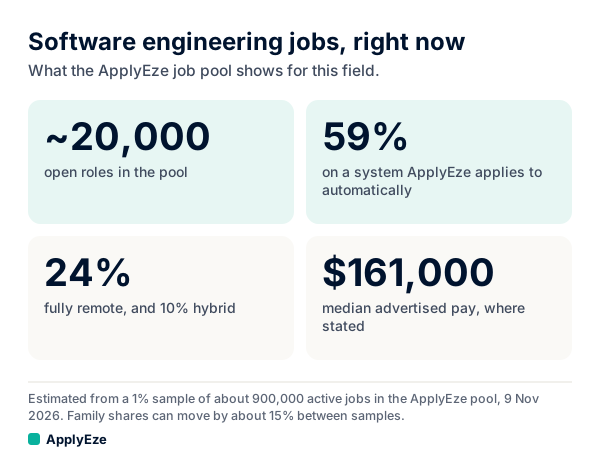
Location is the fact a letter most often settles. In the ApplyEze job pool, a 1% sample on 9 November 2026 puts software engineering at roughly 20,000 open roles, roughly 59% of them on a system ApplyEze applies to, with roughly 24% fully remote and a median advertised pay of $161,000 where stated. So about three quarters of postings tie you to a place or leave it unsaid, and a resume with a different city on it raises a question one sentence can answer. These figures are rough: a second sample moved field shares by up to about 15%.
What AI did to the letter's signal
Many guides quote hiring manager surveys here. The stronger evidence is two working papers using Freelancer.com's own data. Both are working papers, and both study freelance bids rather than a salaried job filled through a company's application form.
Galdin and Silbert, "Making Talk Cheap". Setting: the market for coding jobs on Freelancer.com. About 2.7 million applications from 212,000 workers, split at 30 November 2022, the paper's line for when large language models arrived. Workers bid on one-off tasks, with a short written proposal and a price between $30 and $250. Before large language models, a proposal one standard deviation more customized raised a worker's chance of being hired as much as a $26 lower bid. After them, that willingness to pay "falls sharply". The authors then simulate a market where writing signals nothing at all, and top-quintile workers are hired 19% less often and bottom-quintile workers 14% more. That last result comes from a model, not an observation.
Cui, Dias and Ye, "Signaling in the Age of AI". Setting: Freelancer.com's AI Bid Writer, launched 19 April 2023, in the PHP and Internet Marketing categories. Five million cover letters across more than 100,000 jobs over eight months, using a difference in differences design.
| Finding | Number | The catch |
|---|---|---|
| Tool access raised callbacks | 0.43 points | Significant at the 10% level, not 5%, as is the next row |
| Using the tool raised callbacks | 3.56 points, on a 7.02% base | The effect tapered off after two months |
| Link between tailoring and callbacks | Fell 51% | The link to job offers fell 79% |
| Link between platform review score and callbacks | Rose 5% | Employers moved to other evidence |
| More time editing a draft, per standard deviation | 0.31 points more job offers | A correlation, about 52% of the average offer rate on AI-assisted letters |
The authors also found that most AI letters went out with little or no editing.
Here is our reading, which goes further than either paper. Matching a posting's words used to be evidence of effort. It is now cheap, so it says less. The reader falls back on things that are harder to produce, and on that platform it was work history. On a software application, the equivalents are a link that opens, a named system, and a number that survives a follow-up question. So a letter now earns its place by pointing at something checkable.
One project, one metric
Pick the one project closest to the posting's main problem, and the one number that team would track. Leave the other four projects to your resume.
| The posting stresses | A metric that team would recognize |
|---|---|
| Reliability, backend scale | p99 latency, error rate, incidents a month |
| Infrastructure, developer tools | Deploy time, build time, cost per request |
| Frontend, product | Interaction latency, or a conversion change from a real experiment |
| Data pipelines | Freshness, failed runs a week |
| Mobile | Crash-free sessions, startup time |
| New grad, personal project | Real users, or a load test you ran and can describe |
Before you use a number, ask yourself three things an interviewer will: how did you measure it, what else changed at the same time, and which part was yours. If you cannot answer, state the scope instead ("replaced 40 cron jobs with one scheduler"). A true scope beats a shaky percentage. Never invent a figure.
A labelled sample
This is a sample. The person, employers, numbers and link are all invented. The posting it answers is an invented Senior Backend Engineer role on a payments ledger, which says the service must "stay correct while volume doubles".
Hello Tallyline engineering team,
Your posting says the ledger has to stay correct while volume doubles. I spent the last two years on that problem.
At Northway Freight I owned the service that posts carrier payments, about 40,000 a day on PostgreSQL. Retries were creating duplicate entries, around a dozen a month, each fixed by hand. I added idempotency keys and moved posting behind a queue with a nightly reconciliation job. In the six months after, there were no duplicates. The design note is public: example.com/ledger-note.
One thing my resume does not show: I am moving to Denver in March and would work from your office from then on.
Thanks for reading, Sam Rivera
What each part is doing:
- The first line uses their problem, not your enthusiasm. It quotes one requirement and stops.
- The middle has one system, one cause, one fix and one number. A dozen a month becomes zero over six months, and the reader can see how that was counted.
- The link is the point. It is the part a language model cannot supply for you, because it either opens or it does not.
- The last paragraph is the only thing the resume could not carry.
And a sample answer for the required box, also invented, for "Why do you want to work here?":
I built our team's review tool on your plugin API and hit its limit on large files, then read your engineering post on how you fixed it. I want to work on that rendering problem, and I have already spent evenings on it.
Startups against large employers
We have no study comparing the two, so most of this is judgment. The forms do show a difference worth using.
| Startup | Large employer | |
|---|---|---|
| Where the words go | Often a note. Wellfound says "notes are equivalent to asking for a cover letter" | A form field, shown beside your resume and form answers |
| If it is required | The employer chose it knowing, as Wellfound warns, that it "can limit the number of applicants". Treat it as read | Rare. None of 132 fields in our sample |
| What to lead with | Their product, and something you built with it | The posting's main requirement, and the referral if you have one |
| Length | Two or three sentences for a note | Up to the sample's length |
Written questions can also replace the letter outright. All three software postings we read at Figma had no letter field and required "Why do you want to join Figma?". Discord keeps an optional letter field and still requires "Why do you want to work at Discord?". If you only polish letters, you are preparing for a field nobody requires and skipping the box that can block you.
Greenhouse, which sells the system, says applications are "by and large" reviewed "by real people, one by one", and that reviewers see "your resume, cover letter, answers to questions on the application form" as you sent them. It adds that some applications go unseen because recruiters filter the queue. So an optional letter can reach a person, if the rest of the application gets that far.
Form fields: upload, text box or optional
- Greenhouse. All 132 letter fields in our sample accepted either an uploaded file or pasted text. If you paste, drop the address block and date, since the form already holds them.
- Lever. Its standard form has no letter upload. It ends with an optional box with the placeholder "Add a cover letter or anything else you want to share", so paste a short version there.
- Wellfound. A note, sometimes required. Write it for that startup.
- No field. Do not attach a letter to your resume file. Put the one fact that matters, such as a referral, in the form's other questions or in a message to the person who referred you.
We found no evidence that uploading beats pasting or the reverse. More on structure is in how to write a cover letter.
ApplyEze writes a cover letter when the form asks, for each posting you queue from your ranked board. Claims about you come from your record, and any name or figure about the company must appear in the posting. It has delivered 94,207 applications to 9,769 employers since August, counted on 9 November 2026. The desktop app fills and submits each form on your computer, which stays on and awake until your queue finishes, and Workday and Oracle jobs need an application inbox connected. Some employers ask applicants not to use AI or automation, and whether to apply there is your call.
So split your time by the table at the top of this post. Hand-write the few letters only you can write, with a referral, a contribution to their code or a move, and queue the rest. If you would rather save your writing for those, your first 50 applications are free, once per email address with no card, and a credit is used only when an application is confirmed as submitted.