
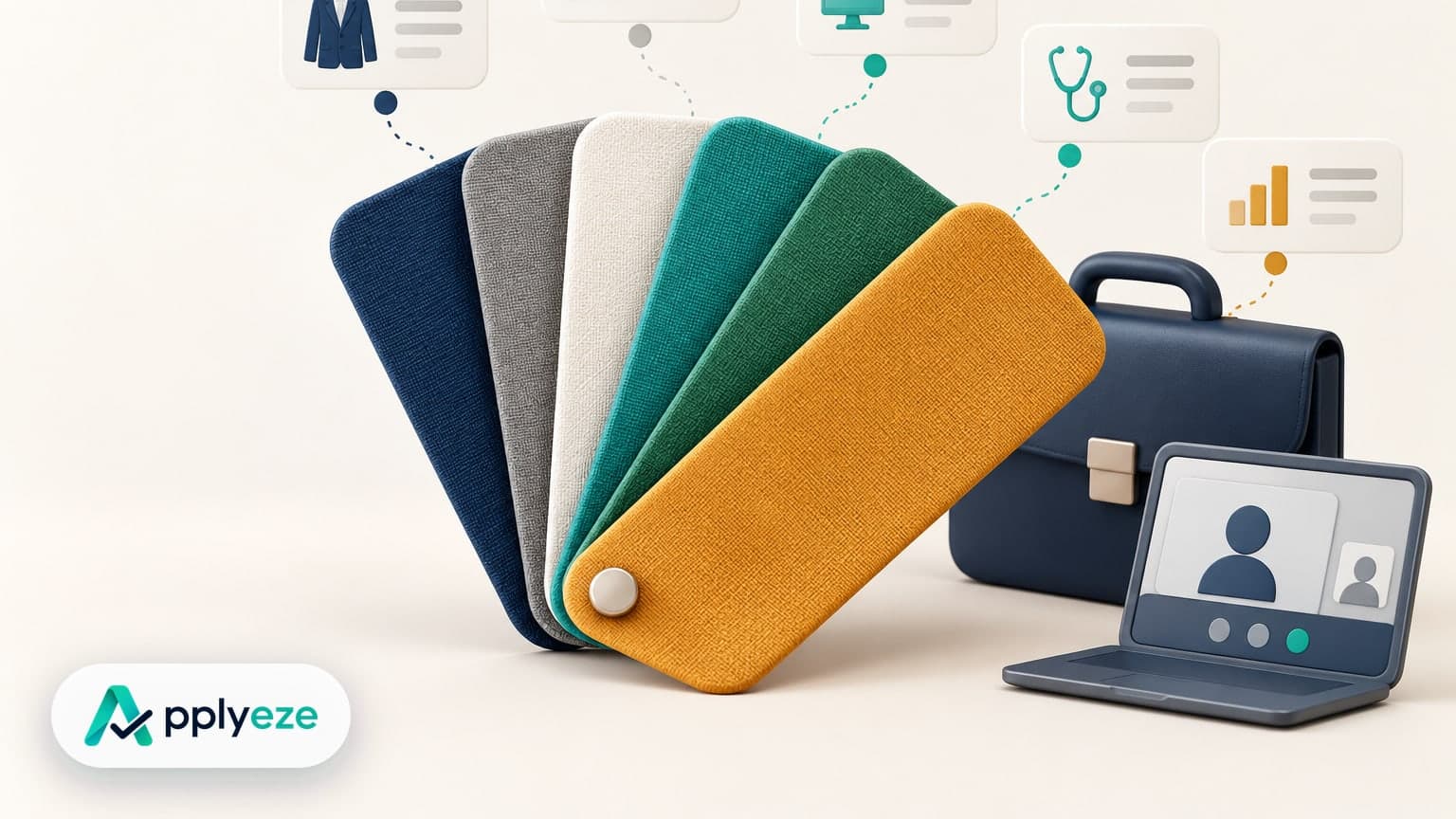
What to wear to an interview depends on two things: the kind of organization and the format of the interview. The rule that works almost everywhere is to dress one step above what the team wears on a normal day. That means business casual at most tech companies and startups, a suit at banks, consultancies and law firms, and business casual (not scrubs) for a hospital role. Video interviews follow the same rule from the waist up, with a few camera-specific adjustments, and long onsite loops add comfort as a requirement. The decision table below maps all of it on one screen, followed by a script for asking the recruiter and a checklist for the night before.
The rule: one step above what the team wears
Coursera's interview attire guide, updated in July 2026, puts the rule plainly: "Dress one step up from what those in the workplace environment wear." Its example: if leaders and staff wear jeans and T-shirts, one step up "might include a pair of non-denim pants and a tucked-in shirt."
That only works if you know what one step means. Here are the four levels used in the rest of this post, described by what you put on rather than by gender.
| Level | What it looks like | Typical shoes |
|---|---|---|
| 1. Casual | Clean jeans, T-shirt or hoodie | Sneakers |
| 2. Smart casual | Dark unripped jeans or chinos, a plain sweater, knit polo or simple blouse | Clean leather sneakers, loafers, flats |
| 3. Business casual | Chinos or dress trousers or a knee-length skirt, a collared shirt or blouse, optional blazer or cardigan | Loafers, flats, low heels, dress shoes |
| 4. Business professional | A matched suit (trousers or skirt) in navy, charcoal or black, a collared shirt or blouse, tie optional | Polished dress shoes, low heels |
Find the team's level, then go one up. If the team is at level 1, wear level 2. If the team is at level 3, wear level 4. If you cannot find out, see the next section.
Two cases sit outside the rule. Some employers tell you outright to dress down, and they mean it (more on Amazon below). And a few fields expect level 4 for every interview no matter what the office wears, which is why the table that follows matters more than the rule.
A decision table by industry
| Organization | What staff usually wear | Wear to the interview | Notes |
|---|---|---|---|
| Startup | Level 1 | Level 2, or 3 if client-facing | A suit can read as not knowing the culture |
| Tech company, engineering or product | Level 1 to 2 | Level 2 to 3 | Amazon says "smart casual" (source) |
| Tech company, sales, legal or executive | Level 2 to 3 | Level 3, or 4 for senior roles | Client-facing roles dress up |
| Bank or investment firm | Level 3 at many firms now | Level 4 | Office dress codes loosened; interview advice did not |
| Management consulting, Big Four, law | Level 3 | Level 4 | Clients see you, so interviewers picture that |
| Hospital or clinic, nursing and allied health | Scrubs | Level 3 | No scrubs at the interview |
| Government, city or state agency | Level 3 | Level 3, or 4 for managerial roles | Follow any instructions in the notice |
| School district or university | Level 2 to 3 | Level 3, or 4 for faculty and leadership | Teaching demos: dress to move |
The evidence behind the less obvious rows:
Tech. Amazon's careers blog published a list from Anna Duong, a talent acquisition manager at Amazon, of things she would do differently in her own Amazon interview. One was "dismissing the recruiter's advice and wearing a suit." Her recruiter had told her Amazon is "a casual and come-as-you-are company," and she says she would "wear anything but the pantsuit" if she did it again. The same page states: "We embrace a 'smart casual' look and encourage you to be comfortable," and "We're interested in what you have to say, not what you're wearing." Coursera's guide makes the same call for tech companies and startups in general: choose something "more on the business casual side rather than something very casual."
Finance. Daily dress codes at banks have relaxed, but interview advice has not followed. When Goldman Sachs moved to a more flexible dress code for employees in March 2019, a career coach at the University of Maryland's Robert H. Smith School of Business told the school's Smith Brain Trust that "We still strongly recommend dressing business professional for interviews, even an interview with Goldman Sachs," and "Better to be overdressed for an interview than underdressed" (UMD Smith). The article is dated, but nothing we found from a bank says the interview standard has changed since. Ask the recruiter if you are interviewing for a technology team, where the norms can be closer to tech.
Healthcare. The University of Rhode Island's interviewing guide for nursing majors says business casual is appropriate for a staff nurse position, and is blunt about scrubs: "You will not be providing patient care during a job interview." It also says shoes "should be comfortable for walking potentially long distances across the hospital campus," cover your toes and not be too high.
Government. Agency norms vary more than anywhere else. South Carolina's Operation Palmetto Employment, a state program for service members, veterans and their families, hands job seekers an attire sheet that recommends a suit for everyone (navy or dark grey, with black also listed for women), conservative shoes and little jewelry. That is the conservative end. For an analyst or clerical role at a city office, level 3 is usually right; for a managerial role or a panel interview with elected officials, go to level 4.
Video interviews
Plenty of interviewers now work from home themselves. In September 2026, 21.9% of employed people in the US teleworked at least some of the time, according to the Bureau of Labor Statistics. The interviewer may be at home in a T-shirt. Dress to the same level you would in person anyway.
What changes on camera is mostly color and setup. HireVue, which runs recorded and live video interviews for employers, gives these tips in its virtual interview guide (July 2025):
- "Solid colors look great on camera (skip the busy patterns)."
- "Avoid white (can wash you out) and neon (can glow weirdly)."
- Avoid shiny materials, which reflect light.
- Make sure your outfit contrasts with your background.
- "Frame yourself from about the chest up," with the camera "steady and at eye level."
- "Sit facing a window or a soft light source," not with a window behind you.
Three more:
- Dress fully. You may need to stand, fetch a charger or answer the door.
- Test the outfit on camera the day before. A shirt that looks navy in the mirror can look black on a webcam, and fine stripes can shimmer.
- Keep jewelry quiet. Bracelets click on a desk and a microphone picks it up.
Recorded one-way interviews (no live interviewer) follow the same rules. Our HireVue interview guide has a full setup checklist, and phone screens need no outfit at all, only preparation; see our list of phone interview questions.
In person and onsite loops
A single 45-minute meeting is easy to dress for. An onsite loop is different. At Amazon, for example, candidates meet individually with current employees in what the company calls the "interview loop," and many large employers run similar back-to-back sessions, sometimes with lunch, a tour or a walk between buildings. Plan for that day, not for the photo.
| Problem on a long onsite day | What to do |
|---|---|
| You walk between buildings or across a campus | Shoes you have already worn for a full day; no new shoes |
| Meeting rooms run hot or cold | A layer you can remove without looking undressed: a blazer, cardigan or light sweater |
| Lunch with the team | Avoid white tops or light ties; skip foods that splash |
| Whiteboard or coding round | Sleeves you can push up; nothing that restricts reaching up |
| Teaching demo or physical task | Ask in advance; Coursera notes a fitness interview might need athletic wear for the demonstration |
| Rain, transit, a long drive | A spare shirt in your bag, and arrive early enough to fix anything |
Comfort is not vanity here. In a five-hour day, the outfit you keep adjusting is the one interviewers remember.
How to ask the recruiter
Asking can feel awkward, but it is the one source that is specific to your interview. Coursera's guide recommends it directly, suggesting questions such as "How do people who work here usually dress?" Two sample scripts, written for this post:
By email, after the interview is scheduled:
Hi [Name],

Thanks for setting up Thursday's interview. One quick question:
what do people on the [team name] team usually wear to the office?
I want to dress appropriately for the day.

Best,
[Your name]
On a recruiter screen, at the end:
"Before we wrap up, is there anything I should know about the onsite day itself, such as how long it runs, whether there is a lunch, and what people usually wear?"
How to read the answer:
| The recruiter says | Wear |
|---|---|
| "We're very casual" | Level 2: smart casual. Take casual at face value, then step up one |
| "Business casual" | Level 3. A blazer is optional; bring it and decide on arrival |
| "Most candidates wear a suit" | Level 4 |
| "Wear whatever you're comfortable in" | Level 2 or 3, depending on the role's seniority and whether it faces clients |
If no one answers in time, look at the team's photos on the company's careers pages and LinkedIn, then apply the one-step rule.
A night-before checklist
Copy this list. Everything on it takes ten minutes the night before and none of it can be fixed on the morning of the interview.
- Try on the whole outfit, including shoes, and sit down in it.
- Check for stains, missing buttons, loose hems and pet hair. Iron or steam anything wrinkled.
- Lay out a backup top in case of a spill at breakfast.
- Polish or clean the shoes; check that they are comfortable after an hour of walking if it is an onsite.
- Pack the bag: printed resume copies, a pen, a notebook, a phone charger, a water bottle, any documents the invitation asked for.
- Skip strong perfume or aftershave. A light scent at most.
- For video: sit in your interview spot at the interview hour, open the video app, check light, framing and how the outfit's color looks on camera. Charge the laptop.
- Check the route and the arrival instructions (building, floor, who to ask for), and set two alarms.
For the rest of the prep, from the job posting to questions to ask, our guide on how to prepare for an interview has a full plan, and after the interview, a thank you email goes out the same day.
Where ApplyEze fits
ApplyEze works on the step before the interview. It watches the career boards of more than 100,000 employers directly (110,728 enabled boards on 17 October 2026) and applies with a resume and cover letter written for each one, on your own machine, in a browser you can watch. It does not prepare you for interviews or choose your outfit; that part is yours.