

An AI job finder reads your resume or preferences, pulls postings from one or more sources, and ranks them for you. That is useful, and it solves the easier half of the problem. On 5 November 2026 we were polling 109,237 employer boards holding 898,253 active jobs, so supply is rarely what stops a search. What stops it is choosing well among those jobs and then finishing the forms. This post shows how to compare finders on where their jobs come from, how fresh they are, and whether anything reaches a submitted application.
ApplyEze is in this category, with its own job board and a desktop app that fills and submits applications, so we know what each of these steps takes at scale. Rivals are named below with links to the pages we read.
What a job finder does
Three steps sit behind nearly every product with this label.
- Collect. It gets postings from employer boards, job boards or other aggregators. This is mostly crawling, with little AI in it.
- Rank. It orders them against you. This is where the AI label usually points. LinkedIn says its job search uses large language models. Indeed describes "our AI matching engine" and "more than 10,000 attributes". ApplyPass describes "vector based matching". ApplyEze's own board uses no AI here: hard filters first, then a rules-based fit score.
- Hand off. It shows you a list, and most products stop there.
Two limits follow. A ranking cannot show you a job the collection step missed. And a perfect ranking still leaves you holding a list. Our survey of what the AI does on each job board goes deeper on step two. This post is about the steps around it.
Where its jobs come from
Here is what each product says about its source, read on 9 November 2026 unless noted. These are the vendors' own claims, so test them with the audit further down.
| Finder | Where it says jobs come from | Stated freshness | Does a step reach a submitted application? |
|---|---|---|---|
| LoopCV | "LinkedIn, Indeed, Glassdoor, and 30+ job platforms" | Searches "every day" | Yes, if you switch it on |
| Indeed | Jobs posted on Indeed, plus jobs "aggregated or 'pulled'" from career sites | Not stated | Only where the employer enables it, and you press Submit |
| Jobright | Career sites of companies plus major job platforms (its FAQ, read 17 October) | "Frequent Updates" | Autofill stops at Submit. Its Agent claims more, and we could not confirm access |
| Simplify | "new postings scraped directly from company career pages" | "updated continuously" | Copilot stops at Submit. Autopilot submits jobs you choose |
| Tsenta | "50,000+ company career pages" | Watches them directly, no interval given | Yes. You approve each role below its top plan |
| ApplyPass | "Scraped hourly from Greenhouse, Glassdoor, AshbyHQ, Workable, Workday, etc." | Hourly | Yes |
| JobCopilot | Official company career pages, 500,000+ companies | Every 2 hours | Yes |
| ApplyEze | 109,237 employer boards polled directly, across 28 applicant tracking systems | Matched through the day | Yes, on 12 named systems, for roles you queue |
The real split is employer boards against aggregators. An employer's own board is the closest thing to the truth: if the role is gone there, it is gone. But polling boards misses any employer without a public board to poll. An aggregator reaches further and inherits copies that can outlive the original. Neither is simply better, and our best job boards ranking walks through what that means board by board.
No pool is the whole market. The Bureau of Labor Statistics counted 7.5 million US openings in September 2026, and openings and postings are different measures, so for a role you care about, check the employer's own careers page as well.
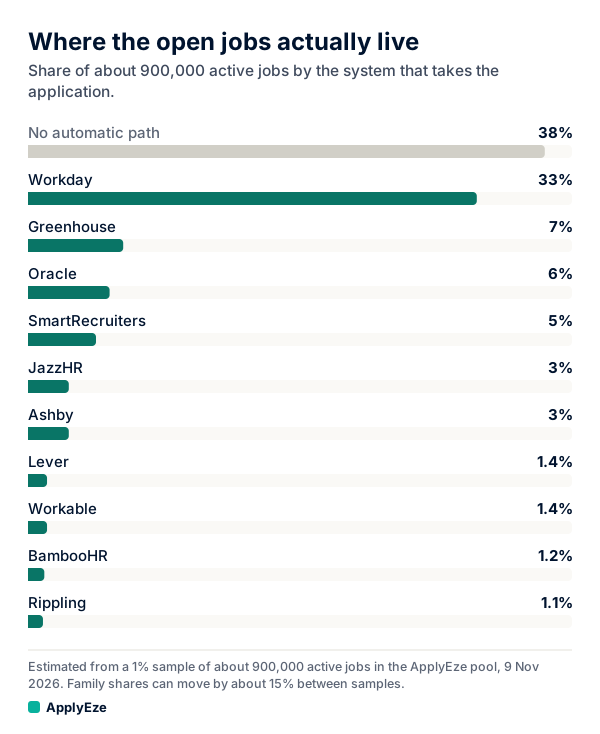
The chart shows where those jobs take applications, from a 1% sample, so read every share as rough. Workday holds roughly a third. Greenhouse has 7%, Oracle 6%, SmartRecruiters 5%, and JazzHR and Ashby about 3% each. The 38% bar is jobs on systems outside ApplyEze's automatic path. The other 62% or so sits on systems where ApplyEze can fill and submit the form, once an application inbox is connected.
This gives you a test no finder's homepage will run for you. A finder that reads only Greenhouse, Lever and Ashby sees roughly 7 + 1.4 + 3, or about 11% of this pool. Workday alone is roughly three times that. So when a product lists its sources, look for Workday first.
Your field changes the answer again.
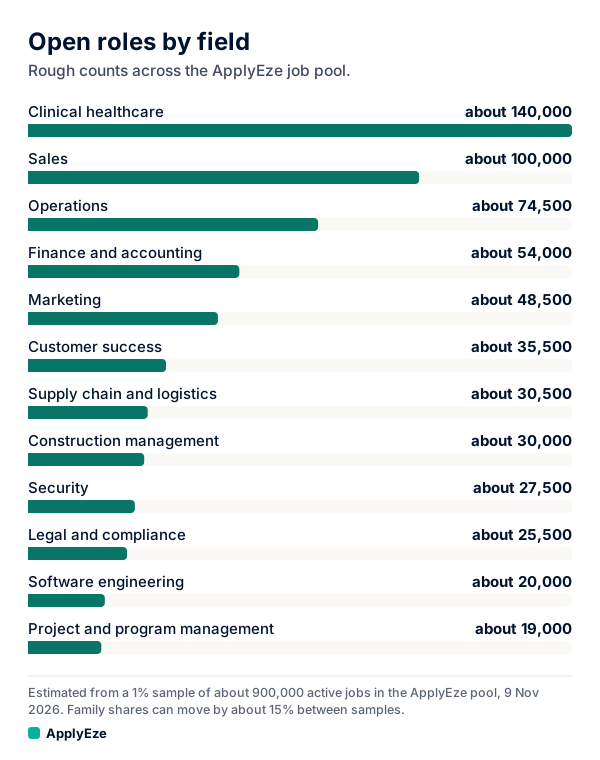
Clinical healthcare is the largest family we track, at roughly 140,000 open roles, then sales at roughly 100,000. Software engineering is roughly 20,000. Some finders were plainly built around tech: ApplyPass advertises "400+ software engineering jobs weekly". If you are a nurse or a sales rep, test with your real title before you believe a demo.
Freshness, and how to check it
Postings do not last long. In a study of 125 million applications on Dice.com from 2012 to 2017, 45% went to vacancies under 48 hours old and the median posting lived seven days. That data is old, tech-heavy and from one site, and whether being early raises your own odds has not been well measured. But a dead listing costs you the same time whatever the odds were.
Three things make a list look fresher than it is.
The label can mean when the finder saw it. Jobity, a competitor, spotted a Jobright listing marked "3 minutes ago" when the employer's own page showed it was more than an hour old. The author calls it one observation, and it is. The label may reflect when the listing was picked up, which is an easy thing for any aggregator to show.
An edit can look like a new post. We pulled one job from Greenhouse's own public board on 9 November 2026. Its first_published was 24 August and its updated_at was 27 October. A finder that sorts on the update would show an eleven-week-old role as under two weeks old.
Big counters measure something else. Jobright's homepage shows "total jobs 8,000,000+" and "Today's new jobs 400,000+", and its FAQ says it covers US opportunities. At 400,000 a day, 30 days is 12 million new jobs (our arithmetic). BLS counted 5.4 million hires in the whole US economy that September. Openings and postings are not the same unit, one opening can have many postings, and the page does not say what it counts. So this proves nothing about quality. It only shows that a big counter is not the number of openings you could win.
The ten-minute audit
Run this on any finder, including ours.
- Take ten roles it labels as posted today or yesterday.
- Open each on the employer's own careers page. Count how many still exist there.
- For those that do, view the page source and search for
datePosted, which Google defines as "the original date that employer posted the job". On Greenhouse boards, the public API showsfirst_publishedwith no login needed. - Write down the gap between the finder's label and the employer's date.
Our rule of thumb, and it is only that: if more than two of the ten are dead or over a week old, the finder's dates are not doing their job. Some systems stamp a posting at midnight, so ignore small differences in hours.
Dead roles are not the only waste. Some live postings are not being filled soon at all, and no finder can see that from outside. Our guide to ghost jobs covers the signals you can check.
Finding against deciding
A finder's list is a set of candidates, and the filters that built it hide more than they appear to.
- Pay. Roughly 15% of the active jobs we track state their pay. A finder with a salary floor has to do something with the other 85%. Ask whether it hides them or lets them through, because either answer changes your list.
- Work style. Roughly 8% of those jobs are remote, 8% hybrid and 81% onsite. A list that is mostly remote is showing you your filter, and the market looks very different.
- Titles. A ranking led by titles pushes down a role doing your work under a title you did not list. Title counts most on our own board too, so list several target titles on any finder you use.
Then comes the decision itself, which a finder leaves to you. ApplyEze Autopilot, our team product, shows how much that step matters, because an AI model reads each shortlisted role and its verdict decides whether an application goes out.
In the 14 days to 9 November 2026, the AI judge scored 259,378 roles, and 50,609, or 19.5%, reached the default pass mark of 6. So it turned down about 4 of every 5 roles that had already passed the rules and made a shortlist, at a median of 4.9 minutes from planning to verdict in the last 7 days. The list was never the decision.
We publish the checks on that decision too. On 20 October 2026, a separate, stronger model re-judged 601 decisions without seeing the verdict and agreed on 502, or 83.5%. On 26 October, a blind audit of 193 applications asked whether a recruiter would have sent each one, and it said yes to 84% of Autopilot's, against 69% of those hand-picked by recruiters. The sample is small, and it is a model's reading, not a recruiter's.
Autopilot is set up today for staffing and recruiting teams that work with ApplyEze. If you are job hunting on your own, you can start with 50 free applications on sign-up, no card needed. You pick the matches and queue them in the desktop app, and ApplyEze fills and submits each form. These are Autopilot's numbers, not a free user's result.
Finding against applying
Here is what a good list costs. Timed by researchers, a Fortune 500 application form took just under 5 minutes in a 2022 audit. Asked about the whole job, tailoring included, US job seekers in a 2026 survey said about 44 minutes. A finder that hands you 20 good matches a day has handed you about 97 minutes of forms at the low figure and about 14.7 hours of work at the high one (our arithmetic). More matches past that point only make a longer backlog.
Automating the form is how you close that gap. On team Autopilot in the 14 days to 9 November 2026, 35,874 runs ended in a submitted application and 9,502 did not, for any reason including a closed posting. That is 79.1% across 14 systems, from Rippling at 94.5% to iCIMS at 55.5%, at a median of 2.5 minutes an application in the last 7 days. Across ApplyEze as a whole, 94,207 applications have gone out since 14 August 2026, to 9,769 employers.
Volume does not have to wash out the result. At one staffing team, human callbacks (a screening call, an interview or an offer) per candidate per month rose from about 2 in spring to 7 for October applications, with volume more than tripled and the rate per 1,000 applications holding near 3. Part of that rise is better counting, it is one team, and results for any one person will differ.
People want this help and want to keep control of it. In Greenhouse's 2026 candidate report, 69% would feel comfortable using an AI agent but only 5% would let one apply on its own. That is how ApplyEze's self-serve path works: you choose each role you queue, and the app does the typing.
How to use AI to find a job
A general AI chat assistant does parts of this well if you give it narrow work. These prompts are samples to adapt. Take your address and phone number off the resume before you paste it.
Widen your titles first. This fixes the most common miss, on any board.
Here is my resume. List 10 job titles employers use for work I have actually done, closest first. For each, quote the resume line that supports it. Mark any title I could not defend in an interview.
Search employer boards directly. Ask for search strings per title, then run them yourself. A sample:
"revenue operations analyst" site:myworkdayjobs.com"revenue operations analyst" site:boards.greenhouse.io
Make it read, and do not ask for a score. A number invites you to trust it. Quoted evidence lets you check it.
Here is a job posting and my resume. List the hard requirements. For each, quote my evidence or write NONE. Then answer APPLY, MAYBE or SKIP, with one sentence of reasoning. Do not encourage me.
Cap the list at what you will finish. The strongest outside evidence on volume comes from Huntr, which compared the same 4,456 people across their own weeks. In weeks at three or more times their usual pace, their interview rate fell from 9.5% to 5.6%, and interviews per month rose from 0.7 to 2.9. So more volume brought more interviews and each application did less. That is observational, and their busiest weeks averaged only 17.5 applications. Our reading: add volume only for roles you would have sent by hand. If you finish 15 applications a week, a saved list of 200 is a to-do list you will never finish.
Check it is real. A chat assistant does not know a role is open unless it opens the page. Confirm on the employer's site before you spend time on it.
What to check before you trust one
| Check | How to test it | What a good answer looks like |
|---|---|---|
| Sources | Find the page that lists them | Named systems or sites, Workday among them |
| Your field | Search your real title and five employers you know are hiring | Those employers show up |
| Freshness | The ten-minute audit above | Labels close to the employers' dates |
| Missing pay | Set a salary floor and watch the count | It says what happens to postings with no pay |
| Why it ranked a job | Open one match | It shows factors you can check, not only a percentage |
| Zero results | Search something very narrow | It shows few or none, and does not pad with distant roles |
| What the score is for | Read its own wording | Jobright calls its score "a decision aid", and Dice says "Dice Match scores have no determining weight when you apply to a job" |
| After the list | Follow one job to the end | You know who submits, on which systems, and what you are charged for |
ApplyEze's self-serve path is built to pass that last row. You see a board ranked by rules on your target titles and the requirements in each posting, you pick the roles and queue them, and the desktop app fills and submits each form in Chrome on your computer while it stays on and awake. It covers Greenhouse, Lever, Ashby, Workday, Workable, SmartRecruiters, Oracle, JazzHR, BambooHR, Rippling, Pinpoint and Recruitee, and Workday and Oracle jobs stay hidden until you connect an application inbox, because those sites email a code. A credit is used only when an application is confirmed as Submitted. Run the ten-minute audit on our board next to any other, and if the forms are what stop you, your first 50 applications are free, once per email address, with no card.