

Job boards AI mostly means four things: ranking what you see first, putting a fit label on a job, explaining or summarizing, and drafting or filling text. On the boards whose own descriptions we read on 9 November 2026, none of it decides whether you apply. You still make that call, and a good part of using these tools well is knowing which of the four you are looking at.
If you typed this looking for a product, JobBoardAI is Wonsulting's, and JobBordai is a separate company. Both are in the table below. ApplyEze runs a job board of its own, described further down. If you want a ranking of where to look, our best job boards post does that. This one looks only at the AI.
What boards mean by AI
The word covers very different work, so here are the verbs we use below.
- Ranks: decides the order of jobs in your search or feed. Everything is still there if you scroll.
- Removes: takes jobs out of a feed or recommendation list.
- Labels: puts a score or a fit level on a job.
- Explains: tells you why, in words.
- Drafts: writes or fills something for you.
- Decides: an application goes out, or does not, because of the output.
Only the last one takes a choice away from you. "Removes" comes close, which is why it matters where it happens.
The table, by board
Each row is the company's own description, or press where marked. "Not stated" means the page we read did not say, and that tells you nothing about what runs behind it. Quotes were rechecked on 9 November 2026.
| Board | Ranks or removes | Labels | Explains | Drafts | Dated |
|---|---|---|---|---|---|
| Ranks. Embeddings retrieve jobs, and a small language model scores them | Fit level, such as Low, Medium or High (paper) | On request, by a separate model. Also Job Match summaries (press) | Premium Apply Assistant pre-fills and drafts letters (press) | Jan 2026, Oct 2025, Jan 2025, Jun 2026 | |
| Indeed | Removes "clear non-matches" from recommendations, then ranks on attributes and your signals | Not stated | GPT models explain fit in Invite to Apply | Career Scout has a resume builder and mock interviews | Undated, footer 2026. Aug 2024 |
| Dice | Not stated | Dice Match, from a skills taxonomy and models comparing your profile with the job | Not stated | Not stated | Updated Jan 2024 |
| Monster | Ranks. "a concept based semantic match" that weighs related skills | Not stated | Not stated | Not stated | Undated, footer 2026 |
| Handshake | Recommends from your profile, interests and engagement. The page does not mention AI | Not stated | Not stated | Not stated | Undated, footer 2026 |
| Jobright | Ranks from your target role, resume, skills and experience | Match Score | Not stated | Not stated on this page | Undated |
| JobBoardAI (Wonsulting) | "relevant roles based on your skills and preferences", method not stated | Not stated | Not stated | Tailors resumes and cover letters, and helps you submit | Undated, footer 2026 |
| JobBordai | Not stated | An ATS match score | Not stated | One-click autofill through an extension. It says "You review every field before you hit submit" | Footer 2026 |
We left out boards whose own description we could not open. ZipRecruiter's pages refused our fetcher, for example, so it is not here, and that says nothing about its product.
None of these rows describes a decision. That is the finding. These companies describe models that shape what you see, and on these pages they stop short of acting for you.
LinkedIn publishes the most, so there is the most to say. Three separate systems get called "AI".
Search. Its January 2026 engineering post says it is "using large language models (LLMs) to create a semantic search experience". An embedding model pulls a broad set of jobs, and a small language model then scores them using query, job and member features, producing both relevance and engagement scores. So your query matters, your profile matters, and predicted engagement is part of the ranking.
The fit label. The LANTERN paper, October 2025, says "given a candidate profile and a job description, the system produces a fit level", shown on the job page, with an explanation only on request. It reports what the label did in LinkedIn's online testing: "+0.24% increase in apply rate and a +0.28% increase in qualified applications". Those are small numbers. A label nudges behaviour, and it does not take it over.
Help with applying. Social Media Today reported in June 2026 a Premium Apply Assistant that pre-fills details and drafts letters, and that "LinkedIn users still have to approve all of these elements". The full dated record is in how LinkedIn job matching works.
Indeed
Indeed's page describes a two-step process. "First, we remove the clear non-matches based on a person's qualifications and preferences from their recommendations." Then it ranks using more than 10,000 attributes and "what they click on, save, or ignore". This is the row closest to a decision, and it applies to your recommendations. Indeed says people "can choose to browse all jobs manually", so a job missing from your feed may still be in search.
The same page holds two numbers worth reading closely. "Today, these AI-powered recommendations drive the majority of applications on our platform." And "70% of sponsored applications now come from AI-powered job recommendations we make to job seekers." Sponsored jobs are paid for by employers. So a recommendation is a matching system's output and also a channel employers pay to reach. That is a normal business, and it is worth remembering when you read your feed.
The explaining layer is separate. Indeed said in August 2024 that it uses GPT models to "better explain why a candidate's background or previous work experience makes them a good fit" in Invite to Apply. Career Scout, described as "Your personal career coach for every step", adds a quiz, a resume builder and mock interviews. See our post on the AI career coach for how far to take that.
Other boards, as sourced
Dice is the clearest about what its score is not: "Dice Match scores have no determining weight when you apply to a job." It says its models compare the skills on your profile and resume with the job description, using a skills taxonomy.
Monster's help article says its job-ad search "uses a concept based semantic match and weighs related skills in the body along with the job title". That article sits in Monster's help center for employers, so read it as a description of search and not of any recommendations.
Handshake names its inputs: "the student's profile data", "the student's career interests", and "the employers and jobs the student engages with". The page does not use the word AI for this. A rules system, a statistical model and a language model could all fit that description. Only Handshake knows.
Jobright says its "Match Score tells you how closely your background aligns with a role", and calls it "a decision aid". That row covers its matching page only. Jobright also markets application automation, which our post on job search agents looks at.
Ranking is not deciding
Three questions tell you which you are looking at.
- Can I still see and apply to a low-ranked job? If yes, it is ranking. The cost of a wrong rank is that you scroll further.
- Does the score reach the employer? Dice says its score carries no determining weight. For most others, the page does not say. Do not assume it either way.
- Does anything go out without me? On the boards above, as described, no.
Here is how that differs from a system that does decide:
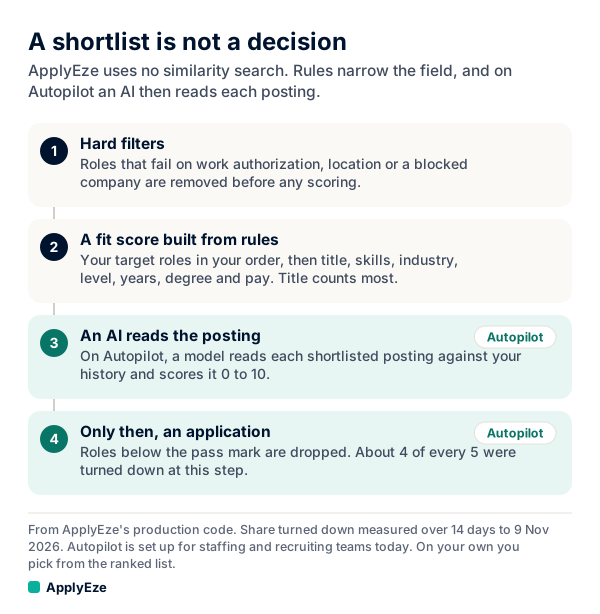
The chart shows ApplyEze's path in four steps: hard filters, a rules-based fit score, then on ApplyEze Autopilot an AI reading each posting and scoring it, and an application only for roles above the pass mark. A job board ranks jobs and leaves the decision to you. LinkedIn now uses large language models to do it, and has described showing a fit level on job pages. Autopilot's review differs in one way: its verdict decides whether an application goes out.
A verdict that decides has to be checked, so we check it. Across 259,378 roles judged in the two weeks to 9 November 2026, 50,609 scored 6 or higher, the default pass mark, or 19.5%. So about 4 of every 5 roles on the shortlist were turned down, in a median of 4.9 minutes from a role being planned to being judged. On 20 October 2026, a separate, stronger model re-judged 601 of the judge's decisions without seeing the verdict and agreed on 502, or 83.5%. A team can raise the bar per candidate.
Autopilot is set up today for staffing and recruiting teams that work with ApplyEze. If you are job hunting on your own, you can start with 50 free applications on sign-up, no card needed. You pick the matches and queue them in the desktop app, and ApplyEze fills and submits each form. On that path, you are the one deciding.
What ApplyEze's board is
Rules, with no AI in the ranking. Hard filters come first: work authorization, blocked companies, location. Then a score: matches are ranked by a fit score from your role, skills, industry, level, education, experience and pay, and title counts most. "Why this fits" shows the score's own factors, including skills matched and missing. If nothing fits, zero matches show as zero.
ApplyEze does not rank by text similarity. It ranks on your target titles and the requirements it reads out of each posting. Each posting is parsed by our own rules first, and when the rules cannot read a posting well enough, an AI model reads it on some application systems. So AI can help read a posting, and the score that orders your board is rules.
So your titles do the work. A role doing your work under a title you did not list ranks low, while semantic search is built to catch that kind of match. List several target titles, and the order counts, because the first one listed ranks first. Our post on semantic search vs keyword search runs the methods on the same four postings, so you can see where each misses.
Where the jobs come from matters as much as how they are ordered:
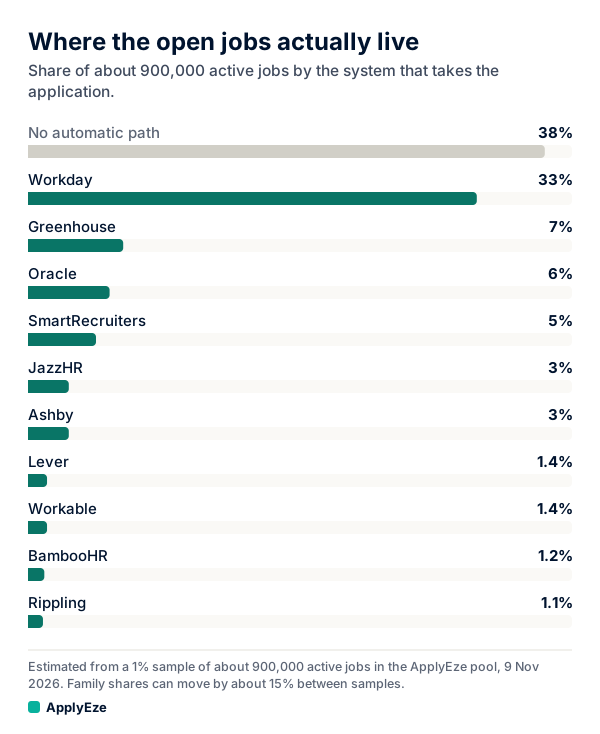
We poll more than 100,000 employer boards directly (109,237 on 5 November 2026), for about 900,000 active jobs. ApplyEze applies automatically on systems holding roughly 62% of them with an application inbox connected, and roughly 23% without one. The chart splits them by the system that takes the application, from a 1% sample, so these are rough shares: about 33% are on Workday, the next largest are Greenhouse, Oracle, SmartRecruiters, JazzHR and Ashby, and about 38% have no automatic path, so those you would apply to yourself.
How to use AI ranking well
- Treat clicks as votes. Indeed uses what you "click on, save, or ignore". Handshake counts views, favorites and applications. LinkedIn scores predicted engagement. Opening ten roles out of curiosity may teach the system the wrong lesson, so save and dismiss on purpose.
- Keep feed and search apart. The feed is what the system chose for you. Search is what you asked for. Run your main titles as plain searches each week, since recommendations can leave jobs out.
- Ask in a sentence, then in a title. LinkedIn's search takes natural language, such as the example Engadget reported, "business development roles in the video game industry". Run that, then run the bare title, and compare. The difference tells you what each is missing.
- Read a low fit label as a question about your profile. LANTERN works from your profile and the job description. If it says Low and you have the experience, the fix may be a missing line on your profile. If you do not have the experience, the label did you a favor.
- Refresh what it knows. Handshake prompts students to re-onboard each term, and the same logic applies elsewhere. Old preferences keep shaping what you see.
- Go to the source before you spend an hour. A ranked result can be stale, and the board may only pass you along. Open the employer's own posting first. Our best job boards post covers what the Apply button really does on each one.
- Track where your replies come from. Note the board on every application. After 30 or so, your own count will say more than any company's description of its model.
ApplyEze's free path covers 12 named application systems. You queue the roles you pick in the desktop app, which runs on your computer, so keep it on and awake until the queue finishes, and Workday and Oracle jobs stay hidden until you connect an application inbox, because those sites email a code. If you would like a board where you can see the factors behind each match, your first 50 applications are free, with no card, and a credit is used only when an application is confirmed as Submitted.