

A job search agent is software that decides which roles you apply to and then applies, without you approving each one. If you choose the roles and the software only fills or submits forms, it is doing something narrower, whatever the page calls it. That one test sorts this category better than a feature list does, and it sorts several products with "agent" or "autopilot" in the name into a different box.
A disclosure: ApplyEze makes a competing product, in both shapes. ApplyEze Autopilot passes this test and is set up for teams, and the free 50 leaves the choice with you. Where a rival is ahead below, we say so, and every rival quote is linked and was read in November 2026.
What makes something an agent and not a copilot
The definitions that rank for this term describe actions. LoopCV's blog calls an AI job agent "software that automates the mechanical parts of job searching". That covers a form filler and it covers a system sending applications to employers you have never heard of, and those two carry very different risks.
The step that matters is not mechanical. It is choosing. So ask one question of any product:
If you do nothing after setup, can an application go out to a role you never looked at?
| Who picks the role | Who presses Submit | Answer to the test | |
|---|---|---|---|
| Copilot | You | You | No |
| Submitter | You | The software | No |
| Agent | The software | The software | Yes |
None of these is the wrong thing to want. They are different amounts of trust, and a page that says "agent" tells you nothing about which one you are getting.
The three decisions an agent takes over
Passing the test means handing over the first decision below. Most agents hold the other two as well, and those are where the damage happens when they are done badly. The right column is a question you can put to any vendor.
| Decision | What goes wrong | Ask the vendor |
|---|---|---|
| Which roles go out | Applications in your name to roles you would never have chosen | What does it read to decide? What is the pass mark? How many does it turn down, and do you publish that? |
| What the form says | A required question with no saved answer gets stopped on, or gets answered with something you did not say | When a required question is not covered, does it stop or fill it? Can I see the answer afterwards? |
| When to stop | A second application after an unconfirmed submit, repeats at one employer, more applications to a company already interviewing you | What happens when it cannot confirm a submit? Is there a limit per employer, and what does it count? |
What rival pages say, as of November 2026
We applied the test to each product's own words. The verdicts are ours, and pages change, so follow the links.
| Product | What its page says | By this test |
|---|---|---|
| Simplify Copilot | "Choose Copilot if you want to inspect every field before the application is sent." You click the final Submit | Copilot |
| Simplify Autopilot | "You choose the jobs; Autopilot handles supported applications for those jobs." "There is no review step before submission" | Submitter, despite the name |
| Tsenta Starter and Pro | "you choose roles from your match feed, or reply yes over iMessage or WhatsApp, and Tsenta completes and submits each application." | Submitter |
| Tsenta Auto Apply, Power plan only | "Auto Apply can also pick and submit eligible roles within your filters and a daily cap you set, up to 150 a day." | Agent. The page does not say how "eligible" is decided beyond your filters |
| Jobright Agent | "proactively matching roles, customizing your resume, and applying for you" | Agent as described. Availability is unclear, see below |
| Mokaru Autopilot | "A job becomes a full match when both scores meet their thresholds." You get notified, or it prepares a tailored resume. The page does not describe submitting | A search agent in the literal sense. It decides what you see, and nothing goes out |
| ApplyEze free 50, Starter, Pro | You pick from a ranked board and queue. ApplyEze fills and submits each form | Submitter |
| ApplyEze Autopilot | Rules build a shortlist, an AI judge scores each role, and a role at the pass mark goes ahead | Agent, for teams |
On Jobright: its agent page has an FAQ entry titled "Are all the features available today?". When we read the answer on 9 November 2026, it said the rest of the features "will be launched in June". Jobity, a competitor whose founder says so in the review, created an account on 31 August 2026 and saw "You're on the Waitlist" above a button to pay and skip it. We have not tested it ourselves. Ask before you pay.
Where rivals are ahead
An individual can buy Tsenta's agent, at $99 a month for 4,500 applications as of November 2026, while ApplyEze Autopilot is set up for teams. At that same $99, ApplyEze Pro lists 3,000 applications, picked by you, and Tsenta lists 1,500 for $39, a price ApplyEze has no plan at. Only at $19 does the count go the other way, 700 against Tsenta's 600. Several rivals also run with your laptop closed, where the ApplyEze free path needs your computer on and awake, and Tsenta and Simplify surface employer replies for job seekers, which a self-serve ApplyEze account does not. Tsenta also hands more of the third decision to the person. Its help page says the daily cap starts at 10, you can add a per-company limit, and by default it pauses companies you are interviewing with. Its changelog, dated 1 July 2026, says "You can now see and edit an application before Tsenta sends it", on Greenhouse, Workday, Ashby, Lever, Oracle and SmartRecruiters. ApplyEze runs end rather than pause, and dry run is the preview.
Simplify's credit guide says its Autopilot "may stop rather than submit an answer it cannot determine from your information". ApplyEze makes the other choice on required questions and finishes the form, which we come back to below.
How ApplyEze Autopilot decides, in plain terms
ApplyEze Autopilot is set up today for staffing and recruiting teams that work with ApplyEze. If you are job hunting on your own, you can start with 50 free applications on sign-up, no card needed. You pick the matches and queue them in the desktop app, and ApplyEze fills and submits each form. Everything in this section is the team product.
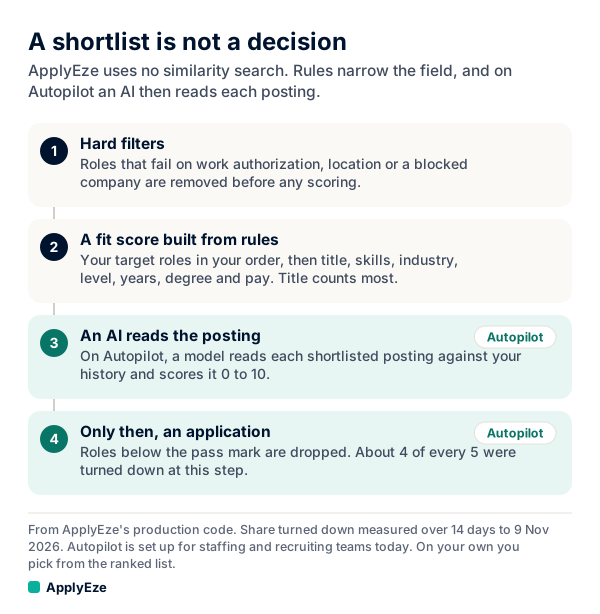
The chart has four steps: hard filters, a fit score built from rules, an AI reading each posting and scoring it, and an application only for roles at the pass mark. Rules build the shortlist. AI makes the call. A job board ranks jobs and leaves the decision to you. Autopilot's review differs in one way: its verdict decides whether an application goes out.
Here is what is published about that verdict, so you can hold us to the first row of the table above.
What it reads. For each role: the title, the company, the first 2,000 characters of the description, the parsed years and level, and up to three later sentences stating years of experience. About the person: target roles, role families, level, years, a new-grad flag, skills and past job titles. It does not get resume bullets, a name or contact details. It is not given the person's location or visa status, and it is told to ignore pay and company size. Citizenship, clearance and location rules run separately, in code.
How it scores. It is told to judge "as a careful recruiter who knows them would". A 10 is squarely a target role at their level. A 7 to 9 is a close neighbouring role they could do now. A 5 or 6 is plausible on paper, an adjacent field or a level gap. A 0 to 4 is a different field, or a level far above or below. Asking 3 or more years beyond theirs is a level gap. The full rubric is published.
The pass mark. It defaults to 6. A team can raise the bar per candidate.
What came out. In the 14 days to 9 November 2026 it scored 259,378 roles, and 50,609, or 19.5%, reached 6. So it turned down about 4 of every 5 roles the shortlist offered, in a median of 4.9 minutes from a role being planned.
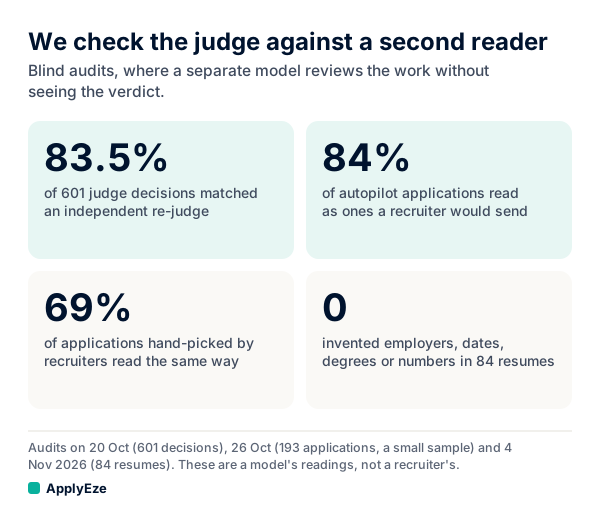
How it is checked. In a blind audit on 20 October 2026, a separate, stronger model re-judged 601 decisions without seeing the verdict and agreed on 502, or 83.5%. In a second blind audit on 26 October 2026, of 193 applications, 84% of Autopilot's read as ones a recruiter would send, against 69% hand-picked by recruiters. The sample is small, and both are a model's reading rather than a recruiter's. The third figure in the chart is a resume audit: 84 sampled resumes on 4 November 2026, with 0 invented employers, dates, degrees or numbers. ApplyEze brings the posting's named skills and tools onto your skills line, even when your own record does not list them. There is no step to remove one before a live run, so use a dry run to see what it writes, and be ready to discuss anything on the page.
What job seekers say they will hand over
Most of them will not hand it over, and this is worth taking at face value. Greenhouse's 2026 Future of Hiring Candidate Report, published 20 October 2026, found "69% would feel comfortable using an AI agent" but "only 5% would let one apply to jobs on its own". It adds: "Most also believe candidates should disclose when an agent applies on their behalf." That is 1,200 US respondents, and Greenhouse sells anti-spam products, so it has a position.
People who tried automation report mixed results. In Huntr's Q3 2026 survey, run 13 to 26 October 2026 with 329 self-selected respondents, 68 (21%) had used a tool that sends applications for them, and 40 of those (59%) had stopped. Of the 68, 6 (9%) got more interviews than when they applied themselves, 33 (49%) about the same, 17 (25%) fewer and 12 (18%) were not sure. It is small and self-reported, and Huntr sells resume tools.
Neither survey separates agents from submitters as we have here. But both fit the same picture: people want help with the work, they want to keep the choice, and they want evidence before they trust a tool with their name. If that is where you stand, you want a copilot or a submitter, and you can skip the agent question altogether. Our guide to job bots sorts those by kind.
What no agent should do for you
Some things should stay with you whatever the software can do.
- Take an assessment. It is meant to measure you. ApplyEze does not take assessments for you.
- Claim what you do not hold. A clearance is never claimed by ApplyEze, and a certification the posting asks for is not added unless you hold it. Ask any vendor the same question.
- Hand over a national ID. A form that requires your full Social Security or national ID number stops that application on ApplyEze. You should be the one who types that, if anyone does.
- Overrule an employer's request on your behalf. Some employers ask applicants not to use AI or automation. Whether to apply there is your call.
- Interview, negotiate or accept. These are yours.
- Have the last word on what you said. Read what went out. On ApplyEze, hard facts come from your profile. When a required question is not covered by your saved answers, ApplyEze still fills it rather than stopping the run, so that answer may not come from you. Fill in your saved answers, use dry run first, and read your receipts.
Who can use which today
| Product | Picks roles itself | Who can get it | Listed price, as of November 2026 |
|---|---|---|---|
| Simplify Copilot | No | Anyone | Basic autofill free |
| Simplify Autopilot | No | Simplify+ subscribers | $39.99 a month, 20 credits a week |
| Tsenta Starter, Pro | No | Anyone | $19 for 600, $39 for 1,500, per month |
| Tsenta Auto Apply | Yes | Power subscribers | $99 for 4,500, per month |
| Jobright Agent | Claimed | Unclear | No public job-seeker price page found |
| ApplyEze free 50, Starter, Pro | No | Anyone who signs up | $0 for 50. Starter listed at $19 for 700 and Pro at $99 for 3,000, per month |
| ApplyEze Autopilot | Yes | Staffing and recruiting teams set up with ApplyEze | Team plans are custom |
What we can show
Nobody can show which tool gets the most interviews, because nobody publishes the data to compare. So judge a vendor on what it is willing to put a denominator on. Here is ours.
ApplyEze publishes completion by system, how many roles it turns down, a blind check on that decision, callback counts with denominators, and a resume audit. On the pages we read on 9 November 2026, we found no rival that does. That is ahead in what is shown, not a claim about results.
- Volume. 94,207 applications delivered through ApplyEze since 14 August 2026, to 9,769 employers, from more than 100,000 employer boards polled directly.
- Selectivity. About 4 of every 5 shortlisted roles turned down by the judge, in the 14 days to 9 November 2026.
- Completion. 79.1% of Autopilot runs settled in those 14 days ended in a submission, with a median of 2.5 minutes an application in the last 7 of them.
- Replies. At one staffing team, human callbacks per candidate per month rose from about 2 in spring to 7 for October applications, with volume more than tripled and the rate per 1,000 holding near 3. A human callback is a screening call, an interview or an offer. Part of the rise is better counting, and results for any one person will differ.
Those Autopilot numbers are team numbers. For how the team version runs from start to finish, see how Autopilot works end to end, and for what it does when something goes wrong with nobody there, see what runs with nobody watching.
If you are one person who wants to keep the choice and hand over the typing, the first step costs nothing. Your 50 free applications are twice Tsenta's 25, both once and both with no card, and at the listed $19 ApplyEze shows 700 applications with a resume for each posting, against Tsenta Starter's 600. You queue the roles you picked, keep your computer on and awake while they run, and connect an inbox for Workday and Oracle. Start with your first 50 here.