

An autopilot job search is one where software decides which roles to apply to and submits the forms, with nobody queueing anything. The word gets used for less than that. Simplify's Autopilot says "You choose the jobs", and Mokaru's Autopilot runs a saved search each day and, on the page we read on 9 November 2026, does not describe submitting anything. This post follows one sample role through ApplyEze Autopilot, which does pick, with the count at each step in the 14 days to 9 November 2026: 259,514 roles planned, 50,609 scoring 6 or higher, and 34,541 applied.
What ApplyEze Autopilot is, and who it is set up for
ApplyEze Autopilot applies on a candidate's behalf from ApplyEze's own servers. Once a team turns it on, it plans, judges and applies without anyone queueing roles.
It is set up today for staffing and recruiting teams that work with ApplyEze. If you are job hunting on your own, you can start with 50 free applications on sign-up, no card needed: you pick the matches and queue them in the desktop app, and ApplyEze fills and submits each form. The figures below are measured on the team product, and they are not a free user's result. Our side by side separates the two line by line.
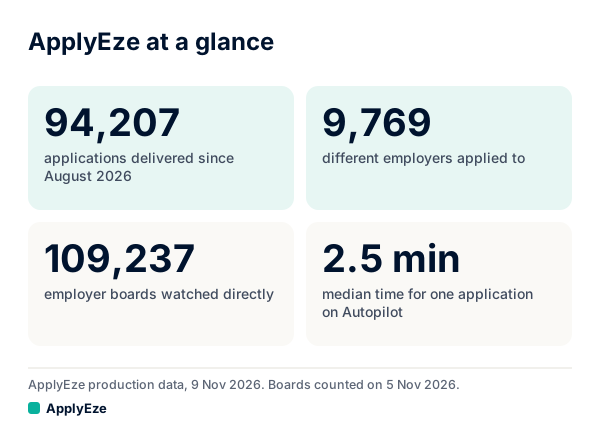
That is the scale of the system this role moves through. Since 14 August 2026, ApplyEze has delivered 94,207 applications to 9,769 employers, counting every channel and not Autopilot alone, and it polls more than 100,000 employer boards directly.
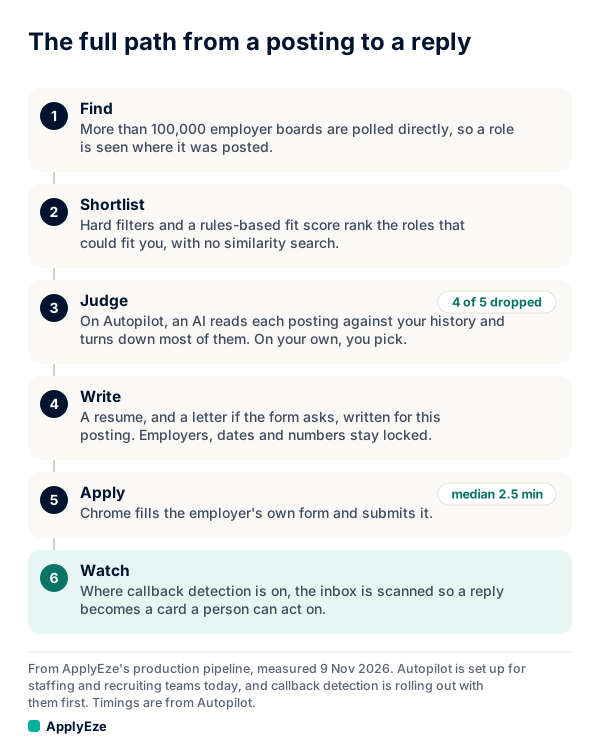
The second chart shows six stages: find the posting on an employer board, shortlist it, judge it, write a resume, apply in a real browser, then watch the inbox. This post covers the middle four. The last box, callback detection, is rolling out with staffing teams first and is not part of self-serve accounts yet.
Here is the role we will follow. All of it is invented for this post.
Sample candidate: a staff accountant with five years of experience. Target roles, in order: Senior Accountant, then Accounting Analyst.
Sample posting: Financial Reporting Analyst at Northgate Foods, posted this morning on Greenhouse, asking for three to five years of experience.
Step 1: a match list built by rules
A team sets the candidate up first: 1 to 10 target roles, a level, a work style, places, how recent a posting must be, employers to skip, and applications per day.
ApplyEze then scores each new job for that candidate on title, skills, industry, seniority, years, education and salary, and ranks it by which target role it matches. No AI is involved, and there is no similarity search. The sample posting lands on the list because it sits close to Accounting Analyst, the candidate's second target role.
That match score is a different number from the judge's score later, so keep them apart as you read.
Step 2: the planner builds a shortlist every 10 minutes
Every 10 minutes the planner tops the queue up to what is left of today's target, plus a small buffer. A candidate with no target roles or role families is skipped.
To build the shortlist it removes closed postings, roles already applied to, skipped companies, citizenship and clearance requirements the candidate cannot meet, non-local jobs if a strict location choice is set, and employers at the cap. All of that is code. Then one fixed rule runs: a posting that says it is not real, such as "DO NOT APPLY" or "test posting", is dropped. Everything else goes to the judge.
Order is same-day roles first, then which target role it matches, then match score. So our sample is read ahead of older roles for the candidate's first choice, even though it sits under the second. How Autopilot picks jobs walks through every filter with its own samples.
Measured: 259,514 roles planned in 14 days.
Step 3: the AI judge scores each role from 0 to 10
The judge runs every 2 minutes and takes roles in batches of 20, same-day roles first. The median time from a role being planned to being judged was 4.9 minutes (7 days to 9 November 2026).
It reads a short brief. For the role: the title, the company, the first 2,000 characters of the description, the parsed years and level, and up to three later sentences stating years of experience. For the person: target roles, role families, level, years, a new-grad flag, skills and past job titles. It does not get resume bullets, a name or contact details. It is not given the person's location or visa status, and it is told to ignore pay and company size. It is told to judge "as a careful recruiter who knows them would", and it records a score and a one-line reason.
The rubric, beside what it produced across 259,378 judged roles:
| Score | What the rubric says | Roles | Share |
|---|---|---|---|
| 10 | Squarely a target role at their level | 729 | 0.3% |
| 7 to 9 | A close neighbouring role they could do now | 30,978 | 11.9% |
| 5 or 6 | Plausible on paper: an adjacent field, or a level gap | 43,500 | 16.8% |
| 0 to 4 | A different field, or a level far above or below | 184,171 | 71.0% |
The default pass mark is 6, and a team can raise the bar per candidate. In this window 50,609 roles, or 19.5%, scored 6 or higher, so the judge turned down about 4 of every 5 roles the shortlist offered. The full rubric is published in its own words.
A sample verdict for our role, also invented: score 8, "a close neighbouring role at their level; asks for three to five years and they have five." It passes and becomes ready.
Step 4: a browser on ApplyEze servers fills and submits the form
A free slot asks for the next role. The portal calls one slot an "AI recruiter", and it works on one application at a time. Before anything starts, ApplyEze checks that Autopilot is on for the company and the candidate, that it is inside the company's working hours, that nobody has paused it, that the candidate has room left today, and that the profile is complete.
Which ready role goes next blends fit and freshness: a role's rank is its score, plus 2 if it was posted today. Our same-day 8 ties an older 10. An older 10 beats a same-day 7. Fresh roles get a head start, not a free pass.
A resume is then built for the posting and read back the way a parser reads it. A failed read stops the run before the form. Employers, job titles, dates, schools, degrees and certifications come from the candidate's own record, and code rejects a rewrite that adds a figure, employer, school or credential the record does not hold. An audit of 84 sampled resumes on 4 November 2026 found 0 invented employers, dates, degrees or numbers.
ApplyEze brings the posting's named skills and tools onto the skills line, even when the candidate's own record does not list them. There is no step to remove one before a live run, so be ready to discuss anything on the page. On the desktop app, a dry run shows what it writes. A certification the posting asks for is not added unless the person holds it.
Then real Chrome opens the employer's form, using the same form filling as the desktop app. Nobody has to be signed in. The answers work like this:
Hard facts come from the candidate's profile. When a required question is not covered by the saved answers, ApplyEze still fills it rather than stopping the run, so that answer may not come from the candidate. Fill in the saved answers. On the desktop app, use dry run first and read your receipts.
Measured: median 2.5 minutes from a lane picking up the role to the application going in, 4.9 minutes at the 90th percentile (17,994 applications, 7 days). By system, the 14-day median ran from 1.2 minutes on Pinpoint to 4.5 on Workday.
Step 5: every run ends as applied or released
Runs do not wait for a person. There is no approval step and no pile of half-finished forms for someone to look at. A run ends as applied, as a duplicate or a closed posting, back in the queue if it is known not to have submitted, or released. Our sample role goes in, and it is recorded as applied.
Across the 14 systems Autopilot applies on, 79.1% of runs settled in the 14 days to 9 November 2026 ended in a submission. The outcome rules, including why a run with an unknown submit is never replayed, have their own post: what runs with nobody watching.
The numbers at each step, two weeks to 9 November 2026
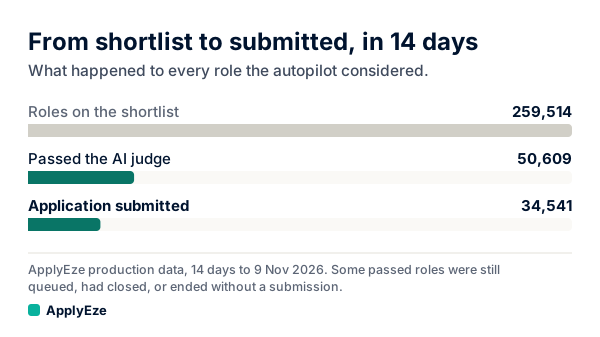
The chart narrows from 259,514 roles on the shortlist to 50,609 that scored 6 or higher to 34,541 submitted. Here is where all of them ended up:
| Where the role ended | Roles | Share of 259,514 |
|---|---|---|
| Rejected, below the candidate's bar | 209,893 | 80.9% |
| Applied | 34,541 | 13.3% |
| Released | 9,162 | 3.5% |
| Posting closed | 2,402 | 0.9% |
| Ready, still in the queue | 1,444 | 0.6% |
| Withdrawn | 1,375 | 0.5% |
| Duplicate | 624 | 0.2% |
| Still being judged | 63 | under 0.1% |
| Dry runs | 10 | under 0.1% |
Those rows add up to 259,514. The rejected count runs slightly above the 208,769 roles that scored under 6 (259,378 less 50,609), which fits teams raising the bar for some candidates.
The clock tells a second story:
| Stage | Time | Window |
|---|---|---|
| Planner runs | Every 10 minutes | Schedule |
| Judge runs | Every 2 minutes, batches of 20 | Schedule |
| Planned to judged | Median 4.9 minutes | 7 days |
| Lane pickup to application | Median 2.5 minutes, 90th percentile 4.9 | 7 days, 17,994 applications |
| Posting date to application | Median 32.9 hours, 25th percentile 16.9 hours | 7 days, 17,994 applications |
The two machine steps take minutes. The rest of the 32.9 hours sits outside them: reaching the shortlist, waiting in the queue, working hours and daily targets, and older roles chosen on purpose. Within 24 hours of posting, 37.9% had gone in, 63.1% within 72 hours and 68.4% within 7 days. The rest are roles up to 30 days old, picked because they fit. Some systems stamp a posting at midnight, so the short times are approximate.
How we check it
A system that sends applications with nobody watching has to be checked, and these are the checks we publish.
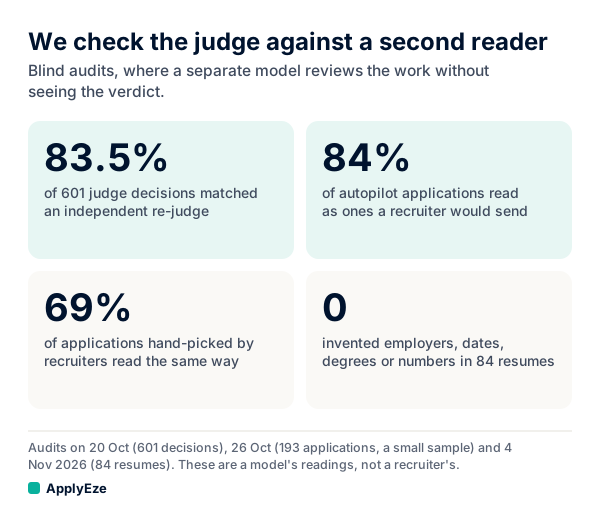
- The decision. On 20 October 2026, a separate, stronger model re-judged 601 of the judge's decisions without seeing the verdict and agreed on 502, or 83.5%. That is one model checking another, not a panel of recruiters. How that audit works has the method, and a version you can run on any tool.
- The application. On 26 October 2026, a blind audit of 193 applications asked whether a recruiter would have sent each one. 84% of Autopilot's read that way, against 69% of those hand-picked by recruiters. The sample is small, and it is a model's reading, not a recruiter's.
- The resume. The third figure is the audit from step 4.
The outcome that matters most is a reply from a person. At one staffing team using ApplyEze, human callbacks per candidate per month rose from about 2 in spring to 7 for October applications, while volume more than tripled and the rate held near 3 per 1,000 applications. A human callback means a screening call, an interview or an offer. Part of the rise is better counting, and results for any one person will differ.
If you are job hunting on your own
On your own, you are the judge. The free path has no AI review: you pick from a board ranked by rules, you queue what you want in the desktop app, and ApplyEze fills and submits each form. For how this compares with other tools people call agents, see what a job search agent should decide.
The judge's questions work just as well with no software at all. Before you send a role, ask them in this order:
- Is this squarely what I am targeting, at my level?
- If not, is it a close neighbouring role I could do now?
- If it is only plausible on paper, do I have a specific reason to send it anyway?
- Is it a different field, or does it ask for 3 or more years beyond what I have? The rubric treats 3 as a level gap and 5 or more as far above you.
And its one instruction to itself: "Read the description, not just the title."
Once you have a list you trust, the typing is the part to hand over. Applications run on your computer while the app is open, so keep it on and awake until your queue finishes, and connect an application inbox if you want Workday and Oracle roles, since those sites email a code. A credit is used only when an application is confirmed as submitted, and your first 50 applications are free, no card needed.