

How AI reads a job posting depends on the system, and most public explanations stop at the concept. So here is one literal case. The AI judge in ApplyEze Autopilot gets a short brief: the title, the company, the first 2,000 characters of the description, the parsed years and level, and up to three later sentences that state years of experience. Beside that sits a second brief on the person: target roles, role families, level, years, a new-grad flag, skills and past job titles. It sends back a score from 0 to 10 and one line of reason. This post shows each line, a labelled sample verdict, what to watch for in any short read, and how to run the same read on any posting yourself.
Who this applies to, before anything else. Autopilot is set up today for staffing and recruiting teams that work with ApplyEze. If you are job hunting on your own, you can start with 50 free applications on sign-up, no card needed. You pick the matches and queue them in the desktop app, ApplyEze fills and submits each form, and no judge sits in that path.
We show the input because the usual description tells you very little you can test. One guide says "Modern matching reads for meaning, not keyword overlap". Another describes a model that "reads text and turns it into a numerical representation of its meaning" and produces a similarity score. Those may be fair summaries of those products. Neither page, as we read them on 9 November 2026, shows what the model literally receives, and that is the question that tells you when to trust the answer.
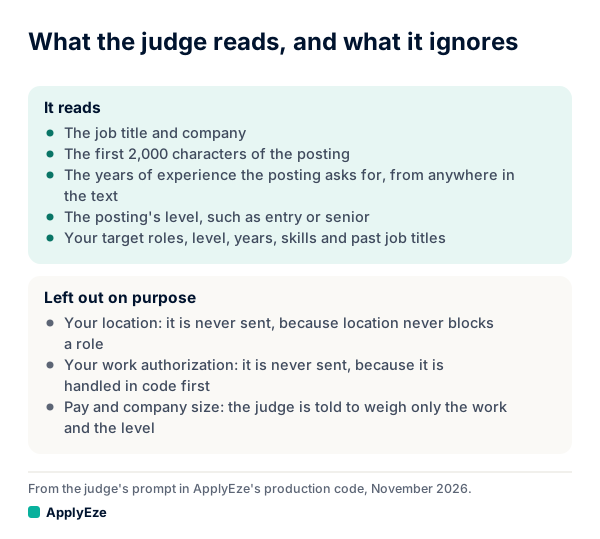
The chart is the summary: on one side what the judge reads, on the other what it does not get. The rest of this post goes through it line by line.
The brief on the role
This is the shape of one role as the judge receives it. This sample is invented for this post. The company, the role and the wording are not real and this is not production output. Only the layout is real.
[id: 2]
Title: Senior Data Analyst
Company: Sample Health Group
Experience asked: 6+ years
Posting level: senior
Posting says: Minimum of 6 years of experience in healthcare analytics
Description: Lead analytics for our claims team and mentor junior analysts...
| Line | Where it comes from | Limit |
|---|---|---|
| Title | The posting | |
| Company | The posting | |
| Experience asked | Parsed from the posting | Only when parsed |
| Posting level | Parsed from the posting, such as entry, senior or staff | Only when parsed |
| Posting says | The posting's own sentences about years of experience | Up to 3, from further down |
| Description | The posting | First 2,000 characters |
Roles arrive in batches of up to 20, numbered 1, 2, 3, and one call is always about one person. The posting date and the application system are not in the brief. Freshness is handled by a different part of the system.
Two thousand characters is roughly 330 words, on our rough count of six characters a word with spaces. That is the number to remember, because the model has no way to know what comes after it unless something carries it across.
Why years of experience are pulled out of the rest of the posting
Job descriptions usually run longer than the 2,000 characters the judge reads, and many state their years of experience further down. So the years, and the posting's own sentences about them, are pulled out and shown separately. A stated requirement of years can reach the model even when the posting puts it far below the cut.
The lines matter because the rubric does arithmetic with them. It says that asking 3 or more years beyond the person's "is a level gap that would usually get them screened out, and 5 or more years beyond theirs is far above them". For an invented analyst with 3 years:
| Posting asks | Years beyond theirs | How the rubric treats it |
|---|---|---|
| 2 to 4 years | None | Within reach |
| 5+ years | 2 | Under the level-gap line, so the work decides |
| 6+ years | 3 | A level gap, usually screened out |
| 8+ years | 5 | Far above them |
When a posting states no years, no experience lines are sent, and the model works from the title and the description.
The brief on the person
Same warning: this person is invented.
Job seeker
Target roles: Data Analyst, BI Analyst
Role families: analytics
Level: seniority mid; years of experience 3; new grad no
Skills: SQL, Python, Tableau
Past roles: Reporting Analyst (2023 to now); Junior Analyst (2021 to 2023)
All target roles and role families go in. Skills stop at the first 30. Past roles stop at 6, newest first, with their years, taken from the profile's work history or from the parsed resume if that is empty.
What is left out is deliberate. There are no resume bullets, no resume file and no education. There is no name or contact detail. Location and visa status are never sent, and the model is told to ignore pay and company size. What the judge is never shown goes through why each of those is left out and where those facts are handled instead.
So the brief describes the shape of a career, and everything is measured against the target roles, since the instruction is to judge how well each job fits those roles and that level "as a careful recruiter who knows them would".
What a verdict contains
Three things: a whole number from 0 to 10, one short sentence of reason, and a short role family.
If the model gives no usable answer for a role, the role goes back and is tried again. After 3 failed tries it is rejected and marked "judge: no verdict", so it is not applied to. A role the model failed to read costs a possible application, rather than sending one nobody judged. The bands behind the number are in the 0 to 10 rubric.
A labelled sample verdict
Here is the kind of verdict the judge writes. All three are invented for illustration, against the invented analyst above. None is production output. The first answers a role called Reporting and Insights Analyst asking 2 to 4 years. The second answers the Senior Data Analyst brief shown earlier. The third answers an Account Executive role with no years stated.
{"id": 1, "score": 8, "reason": "A close neighbour of their analyst targets at their level, and the 2 to 4 years asked fits their 3.", "family": "data analytics"}
{"id": 2, "score": 6, "reason": "Right field, but 6+ years asked is a level gap for someone with 3.", "family": "data analytics"}
{"id": 3, "score": 1, "reason": "A sales quota role, a different field from their data analyst targets.", "family": "sales"}
Look at the second one. The reason names the exact gap, in a sentence a recruiter on the team can check. At the default bar of 6 the role goes ahead. A team can raise the bar per candidate, and at 7 this role is turned down.
Across 259,378 real roles in the 14 days to 9 November 2026, 50,609 scored 6 or higher, or 19.5%, so the judge turned down about 4 of every 5 roles the shortlist offered. The median role went from planned to judged in 4.9 minutes (7 days).
What to watch for in any short read
Any model reading a short brief trades depth for speed. Knowing where the trade falls is how you read its verdicts well, on this system or on any other.
- The company introduction takes up the budget. If a posting opens with 1,500 characters about the company's history and values, the model gets 500 characters about the job.
- The deciding requirement can sit below the cut. Sentences stating years are carried across. A required licence, a night shift or a named tool on line 40 is not, unless the same sentence states years.
- A number is not a requirement. A parsed "6+ years" looks the same whether the posting says required, preferred or "or equivalent". Carrying the posting's own sentence across is what lets the model weigh the wording.
- Titles carry the history. A Project Coordinator who spent two years writing SQL reports arrives as a Project Coordinator. The skills line is where that work shows.
- The target list frames the answer. A good role in a field nobody listed reads as a neighbour. If target roles change, new postings are judged against the new list as they arrive, but existing matches are not re-scored.
- An AI model makes mistakes. So it gets checked. On 20 October 2026 a separate, stronger model re-judged 601 decisions without seeing the verdict and agreed on 502, or 83.5%. That is one model checking another, not a panel of recruiters, and how that audit works covers what it proves and how to run the same test on any tool.
The title question runs both ways, and job title versus job description works through it with examples.
Run the same read on any posting
You do not need any software for this, and it is a good way to learn how much of a posting survives a short read.
- Paste a posting into a character counter and cut it at 2,000 characters.
- Read only that part. Write down the work and the level you think it describes.
- Search the rest for the word "years" and copy those sentences. Add them to your note.
- Write your own brief in the format above: target roles, level, years, skills and past titles. Leave out your bullets.
- Place the role in one band. Is it squarely your target, a close neighbour you could do now, plausible on paper with a gap, or a different field or a level far off?
- Now read the whole posting. Whatever changes your answer is what a short read would have missed.
Try it on five postings. You will see how often the first 2,000 characters are about the employer, and how often the real filter is near the bottom. It is also the fairest test of any AI job tool you use: ask what it literally receives, where its cut falls, and what happens to the rest. A vendor who can show you the brief has given you a way to know when to doubt its answer.
Who sees the reason, and what you do with it
Company admins, and recruiters for their assigned candidates, see an AI review section: the role, the fit label, passed or turned down, and the one-sentence reason, up to 240 characters, for the latest decisions. A record is kept per role, with the score, the reason and the times it was planned, judged, claimed and settled. The job seeker sees neither the score nor the reason.
On the self-serve path there is no judge and so no judge's reason. What you get on each match is "Why this fits", which shows the factors of the rules-based score, including skills matched and missing. It explains a ranking, and you make the decision.
So the exercise above is yours to use on your own board. Do it on your top matches, queue the ones that hold up, and keep your computer on and awake while they run. Workday and Oracle jobs stay hidden until you connect an application inbox. Your first 50 applications are free, no card needed, and ApplyEze builds a resume for each posting you queue.