

Job title vs job description comes down to this: the title tells you the market and roughly the level, and the description tells you the work, the real level and whether you qualify. When they disagree, believe the description. Titles still deserve their weight, because they carry more information than most people assume. They fail in three specific ways, and each one is easy to check once you know what to look for. This post shows all three with labelled samples, explains how a ranking and an AI review each use a title, and ends with a five-point read you can run on any posting.
Why titles carry so much weight in ranking
Titles are not noise. Economists Ioana Marinescu and Ronald Wolthoff studied CareerBuilder postings and found that, among vacancies that post a wage, "job titles explain more than 90% of the wage variance". Titles also explained more than 80% of the variance across vacancies in the education and experience of the people who applied. Few short strings of text say that much.
They are also practical. Every posting has a title, it is short, and it can be compared across systems. A description is long, free-form and written differently by every employer. So anyone ranking hundreds of thousands of jobs starts with the title.
We do too. The ApplyEze board uses rules, with no AI in the ranking. Hard filters run first, then a score: "Matches are ranked by a fit score from your role, skills, industry, level, education, experience and pay." Title counts most, because it carries the most information.
The trouble is that the same work goes by many names. The US government's O*NET database files Financial and Investment Analysts as one occupation, and its sample of reported titles includes Equity Research Analyst, Planning Analyst, Portfolio Manager, Credit Products Officer, Trust Officer and plain Analyst. Some of those do not contain the word analyst. One of them is nothing but that word.
What happens when something reads past the title
Our team product, ApplyEze Autopilot, has a step the board does not: an AI judge reads each shortlisted role and scores it from 0 to 10. It is told to judge "as a careful recruiter who knows them would", and one line of its instructions is the subject of this post: "Read the description, not just the title." By default a role needs a 6 to go ahead, and a team can raise the bar per candidate.
Autopilot is set up today for staffing and recruiting teams that work with ApplyEze. If you are looking for a job on your own, you can start with 50 free applications on sign-up, no card needed. You pick the matches and queue them in the desktop app, and ApplyEze fills and submits each form. The app runs on your computer, so keep it on and awake until your queue finishes, and Workday and Oracle roles need a connected inbox. There is no judge on that path. You are the judge, which is why the five-point read below is written for you.
The samples below show what reading the description changes. All three are invented for this post, and the person, roles and companies are fictional. They show the kind of verdict the judge writes, following its rubric.
The sample job seeker:
| Field | Sample value |
|---|---|
| Target roles | Financial Analyst, FP&A Analyst |
| Level | Mid, 4 years of experience, not a new grad |
| Skills | Excel, budgeting, forecasting, variance analysis, SQL |
| Past roles | Financial Analyst (2023 to now), Junior Accountant (2021 to 2023) |
Sample 1: a different title, the same work
- Title: Business Operations Associate, at Sample Freight Inc.
- Experience asked: 3 to 5 years
- Description: "Own the monthly budget-to-actuals pack, build the rolling forecast with the CFO's team, and explain variances to department heads."
- Sample verdict: 8. "Titled as operations, but the work is budgeting and forecasting at their level, a close neighbour of their targets."
Nothing in that title says finance. This person would scroll past it, and a ranking led by titles would place it low. The duties are close to what they do today. In the rubric, 7 to 9 means a close neighbouring role they could do now.
Sample 2: the right title, the wrong level
- Title: Senior Financial Analyst, at Placeholder Health Group
- Experience asked: 9+ years
- Posting says: "Minimum of 9 years of progressive FP&A experience, including 3 managing analysts."
- Sample verdict: 4. "The title is close to a target, but 9+ years is 5 beyond their 4, far above them."
"Senior" did not tell you anything here. The number did. With the same title at 5+ years, the gap is 1 and the role is within reach. So two postings with identical titles can sit in different bands of the rubric, which treats 3 or more years beyond a person's own as a level gap and 5 or more as far above them. Our post on required years of experience works through that arithmetic.
Sample 3: a shared word, a different field
- Title: Security Analyst, at Fictional Bank
- Experience asked: 3 to 5 years
- Description: "Triage alerts from the SIEM, investigate phishing incidents and tune detection rules for the security operations center."
- Sample verdict: 1. "Shares the word analyst, but this is security operations, a different field from their finance targets."
A word search for "analyst" at a bank returns this. O*NET's list includes Securities Analyst, which sits one suffix away from a job in a different profession. Years and level both fit, and neither one helps.
| Sample | The title suggests | The description shows | Sample score | At the default mark of 6 |
|---|---|---|---|---|
| 1 | Not your field | Your work at your level | 8 | Goes ahead |
| 2 | Your target, one level up | 5 years beyond you | 4 | Turned down |
| 3 | Your job family | A different profession | 1 | Turned down |
In production, the judge scored 259,378 roles in the 14 days to 9 November 2026, and 50,609 of them, or 19.5%, reached 6 or higher. So it turned down about 4 of every 5 roles the shortlist offered, after a median of 4.9 minutes from a role being planned to being judged (7 days to the same date). Those are numbers from a team product, and they show how selective a read of the posting can be.
What title-led ranking misses, and how to list titles
A board led by titles has one predictable gap, and ours is no exception: a role doing your work under a title you did not list ranks low. Sample 1 is exactly that case. On Autopilot such a role can still reach the judge once better-ranked roles run out. On the self-serve board, it sits lower in your list, and you may never scroll that far.
The diagram shows the order. Hard filters come first, then a rules-based fit score. On Autopilot alone, an AI then reads each posting and scores it, and an application follows only for roles above the pass mark. A title you never listed loses ground at the second step, before anything reads the description.
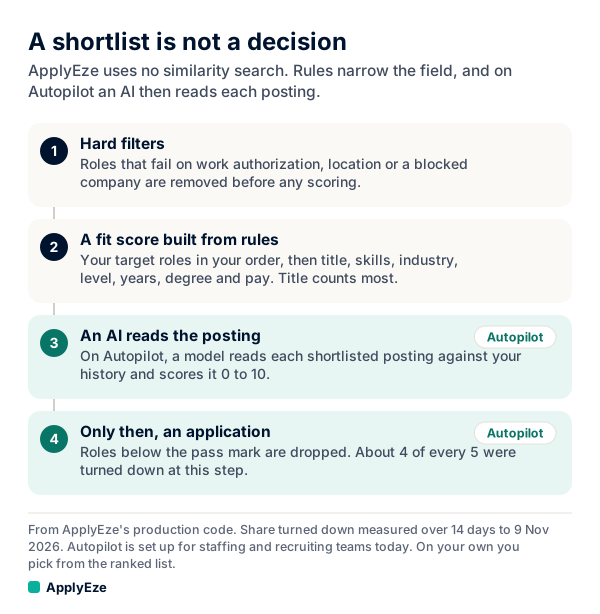
"ApplyEze does not rank by text similarity. It ranks on your target titles and the requirements it reads out of each posting." So the titles you list do real work. The method below works on any job site with a title search:
- Start from the government's list. Look up your occupation on O*NET and read the sample of reported titles.
- Mine real postings. Open ten postings you would want, ignoring their titles. Write down the titles of those whose duties match yours.
- List neighbours as well as your current title. A financial analyst might add FP&A Analyst, Business Analyst (Finance), Planning Analyst and Finance Manager if the level fits.
- Put the closest first. On ApplyEze the order is real: first listed ranks first. More on that in target job titles.
- Do it early. A change to target roles applies to new postings as they arrive, and existing matches are not re-scored.
A five-point read of any posting
This takes a couple of minutes per posting and needs no software. Cover the title with your thumb if you have to.
- The work. Read the first three duties. Could you say "I do that now" about at least two? If not, the title does not matter.
- The years. Search the page for the word "year". It often sits far below the opening. Subtract your years from the lowest number asked. At 3 or more you have a level gap. At 5 or more the role is far above you.
- The level in the verbs. Titles inflate and verbs mostly do not. "Owns", "sets strategy" and "manages a team of six" describe a different job from "supports", "prepares" and "assists", whatever the title claims.
- The hard gates. Look for anything you cannot argue around: a license, a clearance, a required certification, a language. These tend to sit near the bottom.
- The one-sentence test. Finish this sentence: "This is the same as my current work, except ___." If the blank is small, you have a neighbour. If you cannot fill it, you have a different field that happens to share a word.
| Your read | What to do |
|---|---|
| All five clear | Send it today |
| Only the years short, by 3 or 4 | A reach. Your call, and worth it if the work is an exact match |
| The work is off, whatever the title says | Skip it |
| A hard gate you do not meet | Skip it, or check that it is truly required |
| The work is right, the title is odd | Send it, and add that title to your list |
The last row is where the time pays back. Each odd title that turns out to be your work is a new search term for next week.
What 2,000 characters teach you about reading
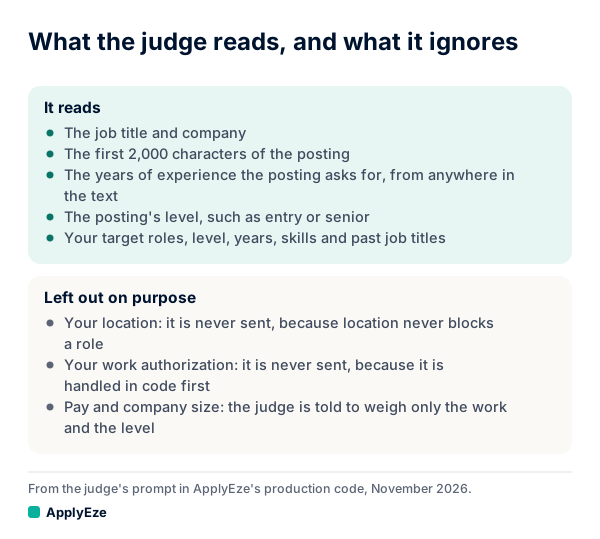
The judge reads a focused brief. For each role it reads the title, the company, the first 2,000 characters of the description, the parsed years and level, and up to three later sentences stating years of experience. At ordinary English word length, 2,000 characters is roughly 300 words (our arithmetic).
The chart lists the inputs. On one side are the title, the company, those 2,000 characters, the experience asked and the person's history. On the other, location and work authorization are never sent, and it is told to ignore pay and company size.
That design carries three lessons for your own read:
- Skip the company introduction. Descriptions usually run longer than 2,000 characters, and a posting that opens with several paragraphs about the company leaves fewer of them for duties. Go straight to the work.
- Go looking for the years. Many postings state them late, which is why those sentences are pulled up and shown to the judge separately. Do the same by hand, and look for a required license on the way down.
- Make your own titles carry the work. About the person, the judge reads target roles, role families, level, years, a new-grad flag, skills and past job titles, and not resume bullets. If your job title undersells your work, make sure your target roles and skills say what you actually do.
Titles are short, so they travel well, and every system that has to read quickly leans on them. The check is whether something reads past them. On 20 October 2026, a separate, stronger model re-judged 601 of the judge's decisions without seeing the verdict and agreed on 502, or 83.5%. We go further into what it sees in how AI reads a job posting, and into what a score can say in job match scores explained.
Your next ten postings
Run the five-point read on the next ten postings you save, before you send anything. Add each odd title that turned out to be your work to your target list, closest first.
Once you trust your read, the forms are the part left to hand off. Your first 50 applications are free, with no card, and ApplyEze writes a resume for each posting you pick and fills and submits the form.