

Required years of experience are less a wall than a number you can subtract. Take the lowest figure a posting asks for and take away your own. A gap of 1 or 2 is within normal reach. A gap of 3 or 4 is a level gap that would usually get you screened out. A gap of 5 or more is far above you. Those two thresholds, 3 and 5, come from the rule we wrote into the AI judge in ApplyEze Autopilot, and you can run the same arithmetic on any posting in ten seconds.
Autopilot is set up today for staffing and recruiting teams that work with ApplyEze. If you are job hunting on your own, you can start with 50 free applications on sign-up, no card needed. You pick the matches and queue them in the desktop app, and ApplyEze fills and submits each form. The app runs on your computer, so keep it on and awake until your queue finishes, and Workday and Oracle roles need a connected inbox. No judge reads those roles for you, so this arithmetic is yours to run.
The 3 and 5 rule, in the rubric's words
The judge scores each role from 0 to 10, reading it "as a careful recruiter who knows them would". On years, its instruction is that "asking 3 or more years beyond theirs is a level gap that would usually get them screened out, and 5 or more years beyond theirs is far above them."
That sentence maps onto the rubric's bands:
| Asked, minus yours | What the rubric calls it | Band it points to |
|---|---|---|
| 0 or less, within range | At their level | Up to 10, if the work is squarely a target |
| 1 or 2 | Not called a gap. "One step up or down is fine" | 7 to 9, if the work is a close neighbour |
| 3 or 4 | "A level gap that would usually get them screened out" | 5 or 6, "plausible on paper" |
| 5 or more | "Far above them" | 0 to 4 |
A model applies this, not a formula, and it weighs the work as well as the number. On 20 October 2026, a separate, stronger model re-judged 601 of its decisions without seeing the verdict and agreed on 502, or 83.5%. The table is a fair way to think, because it turns a vague worry ("am I qualified?") into a number you can compare from posting to posting.
Treat 3 and 5 as a recruiter's rule of thumb written down, not a measured law. We know of no public dataset that gives interview rates by years of gap, so if you have seen a precise figure for how much each missing year costs, ask where it came from.
How a posting states years, and where it hides them
Postings write this number in several ways, and they do not mean the same thing. The wording below is written fresh as samples, not taken from real postings.
| Sample wording | What it means | The number to subtract |
|---|---|---|
| "5+ years of experience" | A floor | 5 |
| "3 to 5 years" | A floor and a soft ceiling | 3. Well above 5, you may read as too senior |
| "Minimum of 6 years" | A floor with teeth | 6, and take it literally |
| "Up to 2 years" | Early career only | Compare the other way: the role may sit far below you |
| "5 years with a bachelor's, or 3 with a master's" | Two floors | The one for your degree |
| "5 years preferred" | A wish | 5, and treat a gap of 3 as less serious |
| "8 years, including 3 managing analysts" | Two conditions | Check both. The harder one is your real gap |
| "Senior" in the title, no years stated | No number at all | Read the duties instead |
The number is often far from the top. Job descriptions usually run longer than the 2,000 characters the judge reads from the start, and many state their years of experience further down. So the years, and up to three of the posting's own sentences about them, are pulled out and shown to it separately. When a posting states no years, none of those lines are sent.
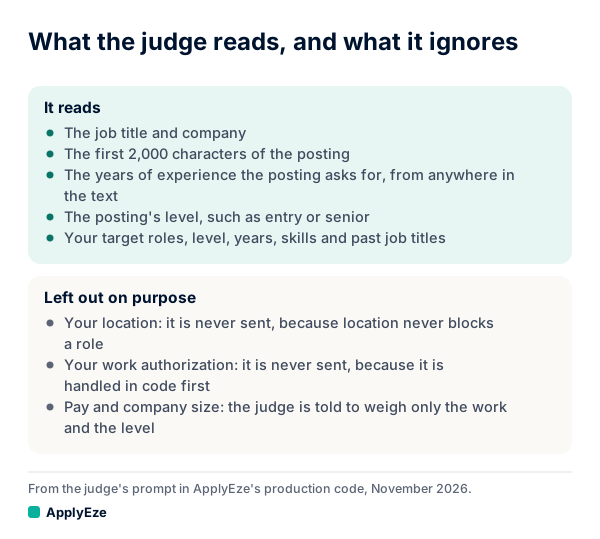
Do the same by hand. Search the page for "year" before you decide anything. A posting that reads like a fit for four paragraphs can state its floor in the last one.
One more trap: a number attached to a tool is not a number attached to the career. "3+ years of SQL" and "3+ years of experience" ask different things. Someone with six years in the field and one year of the tool has a gap on the tool and none on level.
How the new-grad flag changes the reading
About the person, the judge reads one level line: seniority, years of experience, and new grad yes, no or unknown. The rubric has no separate rule for new graduates. Nothing in its instructions softens the 3 and 5 rule for them. The flag tells the reader who the number belongs to: a 0 next to "new grad yes" reads as someone just out of school.
The practical effect is that the arithmetic starts from zero or close to it. "2+ years" is a gap of 2. "3+ years" is a level gap, even on a role titled entry level. "5+ years" is far above. That is why a junior title is no protection. A title says what a job is called, and the sentence with the number says who they want.
On ApplyEze, a person picks an experience level before uploading anything, and that choice sets a default years value and the new-grad flag. A resume parse does not overwrite it. So if your default years value is wrong for you, change it. Every later reading starts from it.
Years of experience is one number, so read it with care if you changed fields. A career changer with ten years in another field and one in this one reads as ten, with the past job titles as the other signal. If that is you, count the years that match the work when you run this arithmetic on a posting.
A labelled sample at each gap
These samples are invented for this post, and the people, roles and companies are fictional. They show the kind of score the rubric points to, assuming the work is a good match, so that only the years move.
The first sample person is a growth marketer with 5 years of experience, targeting Marketing Manager and Growth Marketing Manager.
| Sample role | Asked | Gap | Sample score | Sample reason |
|---|---|---|---|---|
| Growth Marketing Manager, Sample Software | 4 to 6 years | 0 | 9 | "A target role at their level, and the range includes their 5." |
| Senior Growth Marketer, Example Retail | 7+ years | 2 | 7 | "One step up, and the work matches what they do now." |
| Head of Demand Generation, Placeholder Inc. | 8+ years | 3 | 6 | "Right field, but 8+ years is a level gap for someone with 5." |
| Director of Marketing, Fictional Health | 10+ years | 5 | 3 | "10+ years and a large team is far above someone with 5." |
| Marketing Coordinator, Sample Foods | Up to 2 years | Below | 3 | "Far below their level and their target roles." |
The second sample person is a new graduate in marketing, with 0 years and the flag set to yes.
| Sample role | Asked | Gap | Sample score | Sample reason |
|---|---|---|---|---|
| Marketing Associate, Sample Foods | 0 to 2 years | 0 | 9 | "Early career role in their target field." |
| Junior Marketing Specialist, Example Media | 2+ years | 2 | 7 | "Within reach for a recent graduate, one step up." |
| Entry Level Marketing Analyst, Placeholder Inc. | 3+ years | 3 | 5 | "Titled entry level, but 3+ years is a level gap for a new graduate." |
The third row of that second table is the one to study. The default pass mark is 6, so a role that scores a 5 stops there, whatever its title promised.
What the outside data says about entry-level titles
Huntr, a job search tracker, compares the two ends in its Q3 2026 report. In 2026, applications to entry-level titles got interviews at 3.9%, against 6.4% for senior titles. In 2025, the rates were 2.8% and 4.0%. It sorts by keywords in the title, and a title with words from both lists counts as entry-level.
The more interesting split is by who applied:
| Applicants | Entry-level titles | Senior titles |
|---|---|---|
| 3 to 9 years of experience | 5.4% | 5.8% |
| 10 or more years | 3.9% | 6.6% |
| The same 109 people with 10 or more years, who applied to both | 3.0% | 5.5% |
Stepping down does not look like a safe bet. People with long experience logged a little over half the interview rate on junior titles that they logged on senior ones. The rubric treats it the same way, as a level "far above or below". None of this proves cause. These are self-tracked users, Huntr sells job search software, and it says its findings are most reliable for tech and professional roles in the United States.
From the other direction, iCIMS reported in May 2026 that 54% of 1,000 US job seekers "believe employers now expect entry-level candidates to already have mid-level experience." That is a belief, and iCIMS sells hiring software. Its platform numbers complicate the mood: in April 2026, entry-level openings were up 18%, applications down 9% and hires up just 3%.
When to apply anyway, by your own reading
The strongest argument for ignoring a floor has nothing to do with confidence. It is that the floor moves with the labor market.
Alicia Modestino, Daniel Shoag and Joshua Ballance studied online postings and found that requirements rise when more workers are available. They estimate the increase in unemployed workers accounts for "18% to 25% of the increase in skill requirements between 2007 and 2010". An earlier version of that paper estimated that rising unemployment increased the fraction of postings requiring two or more years of experience by 3.5 percentage points. Their follow-up on 82.5 million postings found it reverses: a 1 percentage point drop in local unemployment went with a roughly 0.23 point drop in the share requiring five or more years.
So part of that number describes how many applicants the employer expects, and not how hard the work is. It is older US data and an average across many postings, so it cannot tell you which floor in front of you is soft. It does tell you that some are.
Then decide with this table:
| Gap | The work | Your read |
|---|---|---|
| 0 to 2 | Close to what you do | Send it |
| 0 to 2 | Adjacent field | Worth sending if you can explain the move in a sentence |
| 3 or 4 | Exact match to what you do | Your call. A fair reach, and tailor it |
| 3 or 4 | Adjacent field | Two reaches at once. Usually skip |
| 3 or 4 | Exact match, and "preferred" not "required" | Send it |
| 5 or more | Any | Skip, unless someone inside will vouch for you |
| Any | A license or certification required by law | Skip until you hold it |
Three more checks before you send across a gap:
- Read the form, not only the posting. Employers can reject on a form answer automatically. Ashby's documentation describes rules that reject applications based on answers to application questions, running at submission. It does not mention years, but a years question would work the same way. An application that is fine with a person may never reach one.
- Answer years questions truthfully. A number you cannot defend in an interview only moves the problem one step later.
- Say the gap out loud. A line in your summary, such as "4 years running the same budget process at a smaller company", gives a reader something other than subtraction to go on. It is a sample, so write your own from what you did.
What the pass mark does with a gap
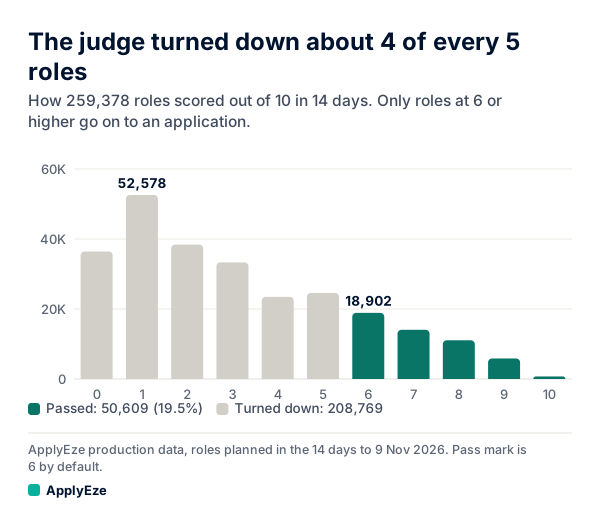
By default, a role needs a 6 to go ahead on Autopilot, and a team can raise the bar for any candidate, to Strong fit (7 and up) or Top fit (8 and up). That sends fewer applications, each a closer match. It is the same choice you make by hand each time you read a gap of 3 and decide whether to send.
The judge is selective. The chart shows how scores fell across 259,378 roles judged in the 14 days to 9 November 2026. Most score 3 or lower. In all, 50,609 roles, or 19.5%, reached 6 or higher, so about 4 of every 5 roles the shortlist offered were turned down. The median role was judged 4.9 minutes after it was planned, in the 7 days to the same date. These are measurements of a product run for staffing teams, and results for any one person will differ.
For the full scale, see the 0 to 10 rubric. The trade-off at the mark itself is in why the default is 6, and the other half of a posting's first impression is in job title vs job description.
Run the number on your next posting
Open the next posting you are unsure about and search it for "year". Subtract your number from the lowest one it asks for, read the sentence around it, and use the table above to decide. It takes ten seconds.
Your reading time is better spent on that decision than on retyping your history into forms. Your first 50 applications are free, with no card, and ApplyEze writes a resume for each posting you pick and fills and submits the form.