

An AI job fit score is a model's rating of how well one role suits one person, and it has no shared scale. Equip's runs from 0 to 100 and ranks a candidate within that job's applicant pool. Jobylon's is a similarity score from 0 to 100. PastaHR's sorts candidates into bands, with Great Fit at 90% or more. So a number alone tells you little until you know what the scale means and how often each value occurs. Here is both for one system: the rubric the AI judge in ApplyEze Autopilot uses, in its own words, with its measured share of 259,378 roles in the 14 days to 9 November 2026.
| Score | The rubric's own words | Roles | Share |
|---|---|---|---|
| 10 | "squarely one of their target roles at their level" | 729 | 0.3% |
| 7 to 9 | "a close neighbouring role they would reasonably apply to and could do now, at a level within reach (one step up or down is fine)" | 30,978 | 11.9% |
| 5 or 6 | "plausible on paper but a stretch: an adjacent field, or a level gap that would usually get them screened out" | 43,500 | 16.8% |
| 0 to 4 | "a different field, or a level far above or below theirs" | 184,171 | 71.0% |
Each is a judgement against one person's target roles and level, and those roles had already come through a rules-based shortlist. These are numbers from staffing teams' candidates, and they are not a free user's result, because a free user has no judge. Autopilot is set up today for staffing and recruiting teams that work with ApplyEze. If you are job hunting on your own, you can start with 50 free applications on sign-up, no card needed: you pick the matches and queue them in the desktop app, and ApplyEze fills and submits each form. The rubric is still worth reading, because you can use it on your own list, and the last sections show how.
Two different scores, and which this is
ApplyEze has two scores with similar names, so here they are side by side.
| The board's match score | The judge's 0 to 10 score | |
|---|---|---|
| Built by | Rules, no AI | An AI model reading a short brief |
| Reads | Your role, skills, industry, level, education, experience and pay | The title, company, 2,000 characters, parsed years and level, and your target roles, level, skills and past titles |
| Who gets it | Every account | Autopilot only, where switched on |
| Who sees it | You, with "Why this fits" showing its factors, including skills matched and missing | The team, not the candidate |
| What it does | Ranks a board. You decide | Decides whether an application goes out |
Reaching the shortlist does not mean a high judge score, and the table at the top is the evidence: every role in it had come through the rules, and 71.0% still landed in the bottom band. That is the judge doing its job. How AI reads a job posting shows its brief line by line.
10: squarely a target role
The rubric asks for the right role and the right level at once. It also warns against reading only the title: "Read the description, not just the title: a generic title such as Accountant or Software Engineer is often squarely a target."
The samples in this post are written for this post and are not production output. The person and every role are invented: a staff accountant with 4 years, targeting Staff Accountant and Senior Accountant.
Sample, score 10. Accountant, asks 3 to 5 years, mid level. "Squarely a Staff Accountant role at their level, and the 3 to 5 years asked fits their 4."
A 10 is rare: 729 of 259,378, about 1 in 356 (our arithmetic). So a list with no 10s on it is normal, and tells you nothing bad about a search.
7 to 9: a close neighbour they could do now
Two parts must both hold. The work is near enough to apply for without a change of direction, and the level is within one step. A 7 was 14,057 roles (5.4%), an 8 was 11,063 (4.3%) and a 9 was 5,858 (2.3%).
Sample, score 8. Revenue Accounting Analyst, asks 3+ years. "A close neighbour of staff accounting at their level, and the 3+ years asked fits their 4."
"Could do now" is the phrase to hold on to. A job you could grow into in two years does not belong in this band, however appealing it is.
5 or 6: plausible on paper but a stretch
This band has two routes into it: an adjacent field, or a level gap. The years rule makes the second one concrete: "asking 3 or more years beyond theirs is a level gap that would usually get them screened out".
Sample, score 6. Accounting Manager, asks 7+ years. "Right field, but 7+ years asked is a level gap for someone with 4."
Sample, score 5. Payroll Specialist, asks 2+ years. "Adjacent finance work, but not a target, and payroll is a separate skill set."
A 6 was 18,902 roles (7.3%) and a 5 was 24,598 (9.5%). The rubric defines them with one sentence, and the default pass mark runs straight through the middle: a 6 goes ahead and a 5 does not, and a team can raise the bar per candidate. That one point decides more than any other point on the scale, so we gave it its own post on the pass mark.
0 to 4: a different field, or a level gap
Most roles land here. Scores of 0 to 4 cover 184,171 of the 259,378, or 71.0%. A 1 alone was 52,578 roles (20.3%), the most common single score, and 0 or 1 together made 88,998, or 34.3% (our arithmetic).
The band covers three different things, and a sample of each makes the point:
Sample, score 1. Account Executive, sales quota. "A sales role that shares a word with their target, in a different field."
Sample, score 3. Controller, asks 12+ years. "12+ years asked is far above their 4."
Sample, score 4. Accounts Payable Clerk, no experience needed. "Right field, but a level far below a staff accountant."
The second follows the rule that 5 or more years beyond theirs "is far above them". The third is worth noticing: a low score can mean over-qualified. And none of these says anything about the person. A 1 means this role is not what they asked for. Change the target list and the same role could score differently.
How often each score happens
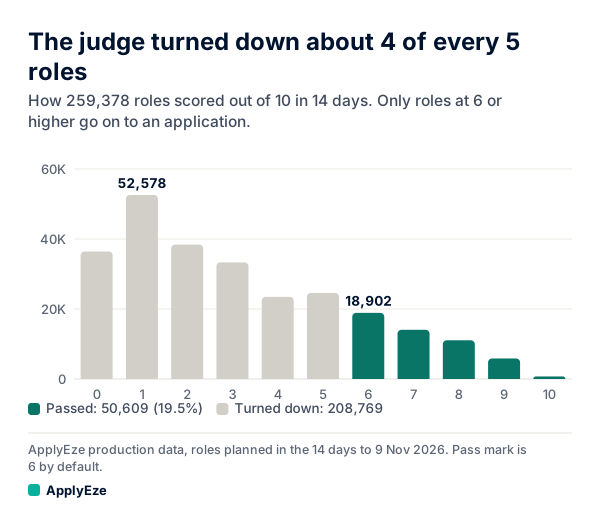
The chart shows the full spread. Most roles score 3 or lower, the peak is at 1, and it thins out to almost nothing at 10. In numbers, 50,609 of 259,378 scored 6 or higher, or 19.5%, so the judge turned down about 4 of every 5 roles the shortlist offered, in a median of 4.9 minutes from a role being planned (7 days).
That is the shape for the candidates of staffing teams, and another group would show another one. What the 259,378 show goes through the distribution in more depth, including why a rules-based shortlist still holds so many misses.
What a score does and does not tell you
It is a band of words, not a probability. A 6 is not a 60% chance of anything. It is a label on a band of words, and the gap between 6 and 7 is not the same size as the gap between 1 and 2.
It reads fit, not the future. The score says how well the work and the level suit one person's targets. It is not a forecast of what an employer will do, and the pass mark post sets out what we have measured on that question.
It leaves eligibility to the rules. The judge is not given location or visa status, and it is told to ignore pay and company size. Those are handled by rules elsewhere, so a 9 says nothing about whether the employer will sponsor.
It is checked. On 20 October 2026 a separate, stronger model re-judged 601 decisions without seeing the verdict and agreed on 502, or 83.5%. That is one model checking another, not a panel of recruiters. In a blind audit on 26 October 2026 of 193 applications, 84% of Autopilot's read as ones a recruiter would send, against 69% hand-picked by recruiters. The sample is small, and it is a model's reading, not a recruiter's.
It does not travel. A 75 on Equip is relative to the other applicants for one job. A 7 here is relative to one person's target list. They answer different questions, so converting one to the other means nothing.
Use the rubric on your own list
If you pick your own roles, you can score them by hand. Ask these in order, and stop at the first one that settles it.
1. Field. Is this work I listed as a target, or next door to it?
   No: 0 to 4. Next door, but a change of direction: 5 or 6.
2. Years. How many more years does it ask than I have?
   5 or more beyond mine: 0 to 4. 3 or 4 beyond mine: 5 or 6.
3. Level. Is it more than one step above or below mine?
   Far off in either direction: 0 to 4.
4. Now. Could I do this job next month, with normal onboarding?
   Yes, and it is on my target list: 10.
   Yes, and it is a close neighbour: 7 to 9.
This is our plain-words version for you to use, not the model's instructions. It stops a long list from feeling all the same, and it shows you how many of your applications are really stretches.
Four questions for any fit score
Use these on any tool that gives you a number.
- Against what? The same 75 means something else against an applicant pool, a job ad's text or your stated goals.
- Are the bands defined in words? A band definition is something you can disagree with. A bare number is not.
- How often does each value occur? Without a distribution, you cannot tell whether a score is rare or routine.
- What does it control? Some scores only inform. Jobylon calls its score "a support signal, not a decision", and PastaHR generally marks a candidate No Fit if a must-have is unmet. On Autopilot, the verdict decides whether an application goes out.
The people using these tools have reason to ask. In Greenhouse's 2025 survey, which covered 665 US recruiters and hiring managers, 8% of recruiters said they "have no idea what their algorithms prioritize", and "Only 21% are very confident that their systems aren't rejecting qualified candidates". Greenhouse sells hiring software, so read that as one vendor's survey. A published rubric gives you something those recruiters did not have: a scale you can read and argue with.
So score your own list. Once you know which roles are your 7s and up, the rest is typing. Queue those in the desktop app, keep your computer on and awake while they run, and connect an application inbox if you want Workday and Oracle roles. Your first 50 applications are free, no card needed, and ApplyEze fills and submits each form you queued.