

A job fit pass mark is the score a role must reach before an application goes out. On ApplyEze Autopilot the default is 6 out of 10, and the AI judge's own rubric describes a 5 or 6 as "plausible on paper but a stretch". So a default run includes some stretch roles, and a team can raise the bar for any candidate. This post shows how many roles clear a bar of 6, 7 and 8, what raising it costs, how large a rise in callbacks a higher bar would have to earn to break even, and what the data says so far.
Whether any of this touches you depends on how you search. Autopilot is set up today for staffing and recruiting teams that work with ApplyEze, and the bar is theirs to set. If you are job hunting on your own, you can start with 50 free applications on sign-up, no card needed. You pick the matches and queue them in the desktop app, and ApplyEze fills and submits each form. There is no judge on that path, which makes you the pass mark. The last section is for you.
The default is 6, and the rubric calls that a stretch
The rubric defines the band that holds 6 this way: "plausible on paper but a stretch: an adjacent field, or a level gap that would usually get them screened out". A 7 is the first score it calls a role someone "could do now".
So the bar sits one point below the rubric's own line for work a person could do today, and that is a deliberate choice. Even at 6, the judge turned down about 4 of every 5 roles the shortlist offered in the 14 days to 9 November 2026.
Here is a sample, invented for this post and not production output, of what a 6 looks like. A person with 3 years of experience sees a Senior Data Analyst role asking 6+ years, and the verdict reads: "Right field, but 6+ years asked is a level gap for someone with 3." That role goes ahead at the default bar.
Why a default would include stretch roles at all
Three arguments support a default at 6.
The callback data does not separate a 6 from a 7. Across 20,234 applications, a 6 gave 2.25 human callbacks per 1,000 and a 7 gave 2.22. Dropping the 6s would cost real volume, and nothing we have measured says the remaining applications would pay for it. The limits of that data are spelled out below.
Postings overstate what they require. In a Harvard Business School and Accenture study published in 2021, 88% of employers believed qualified high-skills candidates "were vetted out of the process because they did not match the exact criteria established by the job description". That is what employers believed, not a measured rate, and it predates language models. It still suggests a stated requirement is not always a real one, and the rubric itself says a gap would "usually" get someone screened out, not always.
Some fields run thin. A niche candidate at a bar of 8 can run out of roles. One of the system's alerts is for a candidate short of roles, and a lower default gives such a candidate something to apply to.
The case for a higher bar is also sound. A stretch application goes out under a person's name, to a recruiter who has to read it. A team could look at that and choose 7 for a candidate, and the control is there for exactly that reason. So 6 is where a candidate starts, and the bar per candidate is the team's to raise.
The bar is also not the only thing deciding the order. Roles posted today get a boost when the next application is picked, so a strong older role can still beat a weak new one.
How many roles survive at 6, 7 and 8, with the math
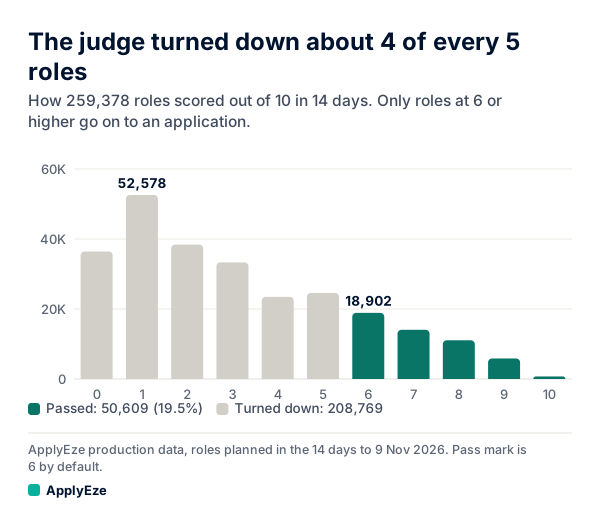
The chart shows all 259,378 roles judged in the 14 days to 9 November 2026, peaking at a score of 1 and thinning out to the right. Everything right of 5 is the part this post is about. Added up from the counts for each score:
| Bar | Sum of counts | Clear the bar | Share of 259,378 | Per 1,000 on the shortlist |
|---|---|---|---|---|
| 6 | 18,902 + 14,057 + 11,063 + 5,858 + 729 | 50,609 | 19.5% | 195 |
| 7 | 14,057 + 11,063 + 5,858 + 729 | 31,707 | 12.2% | 122 |
| 8 | 11,063 + 5,858 + 729 | 17,650 | 6.8% | 68 |
These count scores, not applications. A role can clear the bar and still not produce one: the posting closes, the run ends without a submission, or a team has set a higher bar. Of the roles planned in the same 14 days, 34,541 ended in an application. These are also staffing teams' candidates on Autopilot, so none of this describes what a free user would see, and the mix changes from one person to the next.
How a team raises the bar for one candidate
The bar is set per candidate, in the team's portal, under fit level. A team can move a candidate up to Strong fit (7 and up) or Top fit (8 and up). A company can raise the bar but cannot lower it below ApplyEze's minimum.
The change takes effect on work already queued. If the bar goes up later, ready roles under the new bar leave the queue at the next sweep, so a team does not have to wait for the old ones to run out.
Raising the bar sends fewer applications, each a closer match by the judge's reading. What the judge reads shows exactly what that reading rests on.
What a higher bar costs in volume
The cost in roles is simple subtraction (our arithmetic throughout):
- From 6 to 7: 18,902 fewer, which is 37.3% of the 50,609.
- From 7 to 8: 14,057 fewer, which is 44.3% of the 31,707.
- From 6 to 8: 32,959 fewer, which is 65.1% of the 50,609.
The more useful number is the break-even. Callbacks in total are applications times the rate per application. So if a bar cuts applications, the rate has to rise by enough to make up for it:
- A bar of 7 leaves 31,707 of 50,609. To match the total, each remaining application must earn 50,609 / 31,707 = 1.6 times what the average application at a bar of 6 earns.
- A bar of 8 leaves 17,650. The same sum gives 50,609 / 17,650 = 2.9 times.
That framing is useful because it turns a feeling into a test. "A closer match should do better" is plausible. "A closer match should do 2.9 times better, or the team loses callbacks overall" is something you can hold up against evidence. The highest band measured, 9 and 10 together, gave 2.71 per 1,000 against 2.25 at a 6, a ratio of 1.2, on very few callbacks.
Break-even on callbacks is not the only test, though. A team may accept fewer callbacks in exchange for closer matches, less load on employers' recruiters and a better conversation with a candidate about where their name went. Those are fair reasons, and they do not show up in this math.
What the data says about score and callbacks
A higher score has not been shown to bring more callbacks. Here is the entire measurement, on applications from 20 October to 2 November 2026:
| Score | Human callbacks per 1,000 applications |
|---|---|
| 6 | 2.25 |
| 7 | 2.22 |
| 8 | 1.68 |
| 9 and 10 | 2.71 |
Human callbacks mean a screening call, an interview or an offer. Those rates rest on 20,234 applications and only 44 callbacks, which shows no trend. It does not show the absence of one either, for three reasons.
The counts are small. Spread evenly, 44 callbacks is about 11 per group. Chance alone can move a count of 11 by 6 or 7 in either direction, about 60%, at the usual 95% level (our arithmetic: 1.96 times the square root of 11, treating callbacks as rare independent events). The real groups are not equal in size, so this is only a rough guide. The dip at 8 could easily be noise.
A real difference would take far more data to see. To detect a 1.5-times gap at these rates, with the usual standards (80% power, 5% significance), you would need about 35,000 applications in each band (our arithmetic: 2.25 against 3.375 per 1,000). This measurement has 20,234 across all of them.
The judge has changed, and the applications are recent. On 4 November 2026 the judge began receiving a posting's stated years separately, so every application in that table was judged by the earlier version. And recent applications have had less time to get a reply.
It is one measurement of staffing teams' candidates. Results for any one person will differ.
How to think about your own bar when you pick roles yourself
The same sum applies to you with one change: what is scarce. On Autopilot it is the supply of good roles. For a person applying by hand, it is hours. In a 2026 United Way NCA survey, 1,000 US job seekers reported about 44 minutes per application for the whole job, tailoring included. That is self-reported, but at that pace ten stretch applications come to more than seven hours.
You also cannot settle this with your own data. Suppose your interview rate were 4% on stretch roles and 6% on close ones. Telling those apart with the same standards takes about 1,860 applications in each group (our arithmetic). Nobody runs that test on their own search, so choose your bar from what an application costs you, and from how many close roles exist. Score your list by hand first using the four bands, then pick a row.
| Your situation | A bar that fits | Why |
|---|---|---|
| Writing each application by hand | 7 and up, and a 6 only with a referral or a specific reason | Hours are the limit, and a stretch spends the same hours as a close match |
| A small budget of applications, such as 50 credits | 7 and up first, 6 once those run out | Close roles first tell you whether your materials work before you spend the rest on long shots |
| Plenty of close roles in your field | 7 and up | A stretch has to beat something good that you could have sent |
| A thin field, or few roles in your area | 6, and read each one | A high bar may leave you nothing to send |
| Changing fields | Rescore against your new target list | If the new field is your real target, its roles stop being adjacent, though the level gap may remain |
Three more points hold at any bar. A hard requirement you do not meet, such as a licence, is not a stretch, and it should come off the list whatever it scores. If a role would not survive you talking about it in an interview, sending it does you no favours. And the free credits are worth planning, since a credit is used only when an application is confirmed as submitted: how to use your 50 free applications gives an order to spend them in, and what volume looks like shows the other end of the scale.
So pick your bar, then let the typing go. On the free path you queue the roles that clear it, keep your computer on and awake while they run, and connect an application inbox if you want Workday and Oracle roles. Your first 50 applications are free, no card needed, which is enough to send your 7s and up first and then decide whether to go lower.