

Applications at volume, measured: in the 30 days to 9 November 2026, 75,963 applications went out through ApplyEze, to 9,278 distinct employer names, for 46 candidates. That is about 1,651 per candidate, or 55 a day each. By hand, at the timed length of a form, the same count is 6,161 hours of work. At the length people report for the whole job, it is 55,706. A count is an input, not a result, so this post also shows what came back and what keeps that volume targeted.
Much of this runs on ApplyEze Autopilot, which is set up today for staffing and recruiting teams that work with ApplyEze. If you are job hunting on your own, you can start with 50 free applications on sign-up, no card needed. You pick the matches and queue them in the desktop app, and ApplyEze fills and submits each form. The volume in this post is team volume, not a target for one person.
The record: 30 days in numbers
| Measure | Value |
|---|---|
| Applied, last 30 days | 75,963 |
| Distinct employer names, last 30 days | 9,278 |
| Candidates with an applied run, last 30 days | 46 |
| Applied per candidate (75,963 / 46) | 1,651 |
| Applied per day (75,963 / 30, our arithmetic) | About 2,532 |
| Applied, all time, since 14 August 2026 | 94,207 |
| Distinct employer names, all time | 9,769 |
"Applied" means the form was submitted. The counts are slightly low, because an outage on 7 and 8 November left 676 applied runs unrecorded, and a few test candidates are included.
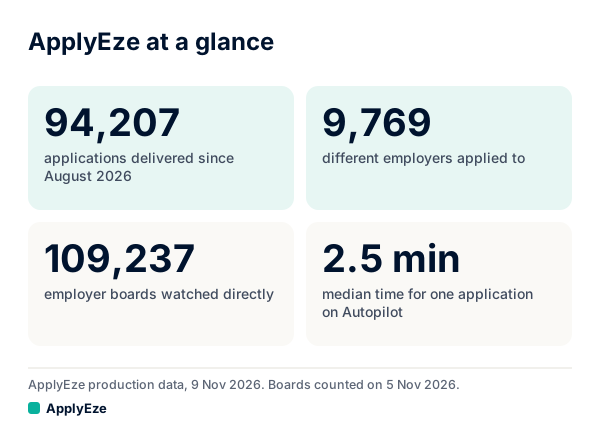
The card adds two figures. The 109,237 employer boards were counted on 5 November, and the 2.5 minute median covers Autopilot runs in the 7 days to 9 November.
How wide 9,278 employers is
Across all candidates, 75,963 applications to 9,278 employer names is about 8.2 per name. Employers with many openings will take more than eight, and many others far fewer.
For scale, our job pool held 64,616 distinct active companies on 5 November 2026. So the last 30 days touched roughly 1 in 7 of them (9,278 divided by 64,616, on slightly different dates). The count is of names, not legal entities, so a parent and a subsidiary that post under different names count twice.
The width matters for one reason. Volume sent narrowly is the behaviour employers build limits against. ApplyEze limits how often it applies to the same employer, so that one candidate does not look like spam to one employer.
The weekly climb since August
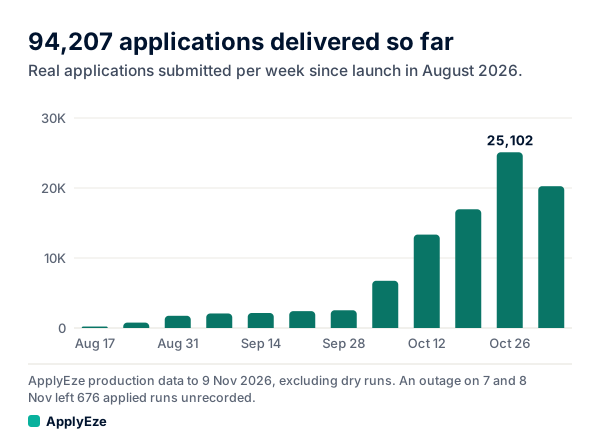
The chart shows two phases: a slow rise to about 2,500 a week through September, then a steep one in October. The table adds a column the chart does not have (our arithmetic).
| Week starting | Applied | Candidates | Per candidate |
|---|---|---|---|
| 17 Aug | 90 | 3 | 30 |
| 24 Aug | 767 | 5 | 153 |
| 31 Aug | 1,746 | 10 | 175 |
| 7 Sep | 2,072 | 15 | 138 |
| 14 Sep | 2,143 | 15 | 143 |
| 21 Sep | 2,408 | 16 | 151 |
| 28 Sep | 2,538 | 24 | 106 |
| 5 Oct | 6,746 | 25 | 270 |
| 12 Oct | 13,346 | 31 | 431 |
| 19 Oct | 16,958 | 30 | 565 |
| 26 Oct | 25,102 | 34 | 738 |
| 2 Nov | 20,261 | 38 | 533 |
Between the weeks of 28 September and 26 October, volume rose about tenfold while candidates rose by less than half. So the climb did not come mainly from adding people. It came from each candidate's applications going from about 106 a week to about 738. The week of 2 November came in below that peak, and the outage accounts for 676 of the difference.
What that volume would take by hand
Two measured answers exist for how long one application takes, and they measure different work. Neither is a 2026 stopwatch study. Hours below are our arithmetic.
| Source | What it measures | Per application | 1,651 applications | 75,963 applications |
|---|---|---|---|---|
| InFlight audit, reported by SHRM, 2022 | Researchers timing Fortune 500 forms, first click to confirmation. No tailoring | 4 min 52 s | 134 hours | 6,161 hours |
| United Way NCA survey, 2026 | 1,000 US job seekers reporting the whole job: forms, uploads, tailoring | About 44 min | 1,211 hours | 55,706 hours |
Read the 1,651 column first. At the timed length, one candidate's month is about 134 hours, or 4.5 hours every day for 30 days, with no tailoring and no looking for the jobs. At the reported length it is 1,211 hours, and a 30-day month only has 720. The fleet column at the timed length is about 35 people working full time on nothing else, if you count a full-time month as 176 hours.
For comparison, the median time from a lane picking up a role to the application going in was 2.5 minutes, and 4.9 minutes at the 90th percentile (7 days to 9 November 2026, 17,994 applied runs). Those clocks measure different work, so this is no claim of 41 minutes saved. The 44 minutes includes thinking and tailoring by a person. The 2.5 minutes is a machine's run, after other steps have done the deciding.
One staffing team's tracker shows what the machinery changed.
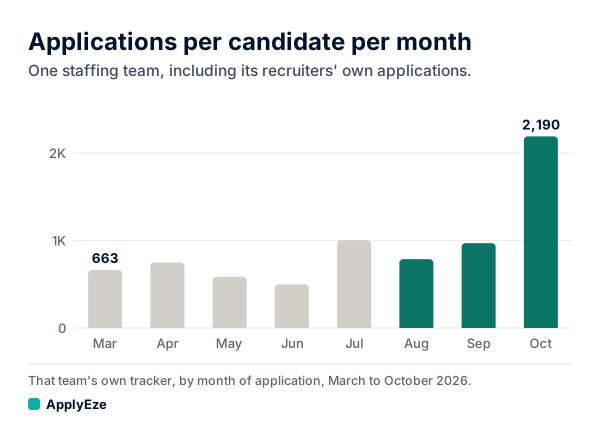
The chart runs from 663 per candidate in March to 2,190 in October, including recruiters' own applications. From March to July, before ApplyEze's first application on 14 August, that tracker showed between 500 and 1,003 per candidate per month. Staffing recruiters reached hundreds a month by working at it as a job. What the machinery changed was the cost of the next application.
Sustaining about 2,500 a day takes several unglamorous parts working together. A planner tops up each candidate's queue every 10 minutes, and an AI judge reads roles in batches every 2 minutes. A resume is built per posting and read back the way a parser reads it. Careful retries run only where a run is known not to have submitted. The queue lives in the database, so a restart does not lose queued roles. Servers report health every 15 seconds, and one silent for 5 minutes stops counting toward capacity by itself.
Volume is the input. Here is what came back.
A count of applications is an input. The output that matters is a human callback: a screening call, an interview or an offer.
At one staffing team, callbacks went from about 2 per candidate per month in spring to 7 for October applications, while the rate per 1,000 applications held at about 3. Volume rose more than threefold and the rate did not fall. October's 63,508 applications at that team brought 204 human callbacks. Automatic inbox detection started in mid-September, and before that recruiters logged callbacks by hand, so part of the rise is better counting. That detection is rolling out with staffing teams first and is not part of self-serve accounts yet. It is one team, and results for any one person will differ.
Within that, the callback rate on applications through ApplyEze rose from 1.5 per 1,000 for those sent 14 to 30 September to 3.2 for those sent 16 to 31 October.
The other side of the count is the person reading. Ashby reports recruiters processing 291 applications per hire. Greenhouse reports 244 applications per job in 2025, up from 116 in 2022. In a Robert Half survey, 67% of US HR leaders said reviewing AI-generated applications has slowed hiring. Ashby and Greenhouse measure their own customers, and all three sell into this problem. Their numbers are why targeting matters more than count.
What keeps volume from becoming spam
Spam is the recipient's judgement, so the work is in deciding what not to send. These are the controls in place.
| Control | What it does |
|---|---|
| AI judge, on Autopilot | Turned down about 4 of every 5 shortlisted roles in the 14 days to 9 November. A team can raise the bar per candidate |
| Blind checks | A separate, stronger model re-judged 601 decisions on 20 October and agreed on 83.5%. In a blind audit of 193 applications on 26 October, 84% of Autopilot's read as ones a recruiter would send, against 69% hand-picked. The sample is small, and it is a model's reading, not a recruiter's |
| Limit per employer | Limits how often it applies to the same employer |
| Duplicate checks | Built to stop double applications: history is checked, and a lock stops two lanes applying to one posting at once |
| Live check | Checks that the posting is still live before a run |
| A resume per posting | Each application carries its own resume, read back before the form |
| Careful retries | A run with an unknown submit is never replayed, because a replay could apply twice |
The reasoning behind the first row is in the AI job fit score rubric and the job fit pass mark. The per-employer limit exists because employers now push back in the product itself: Ashby's Application Limits "automatically block excessive applications", and Greenhouse offers similar rules. Volume aimed at a limit just gets blocked. Some employers ask applicants not to use AI or automation. Whether to apply there is your call.
What this means for one person
1,651 a month is an average across a fleet of machines, and copying it is not the lesson. The lesson is in how more applications behave.
The strongest outside evidence for one person is Huntr. It compared the same 4,456 job seekers across their own weeks. In weeks at 3 or more times their usual pace, their interview rate fell from 9.5% to 5.6%, and their interviews per month rose from 0.7 to 2.9. Usual weeks averaged 2.5 applications and the busiest 17.5, so this is far below anything in the tables above, and those are Huntr's users and its definition of an interview. Do not read those rates against the callback figures earlier in this post. They count different people and different events. The direction is what carries over: more applications brought more interviews in total, at a lower rate per application.
So treat volume as something to test on yourself:
- Note your interview rate over your last 30 to 50 applications.
- Raise your pace for two weeks and keep every application one you would stand behind.
- Recount. If total interviews rose, the extra volume was worth it even with a lower rate. If the total stayed flat, it was not.
Huntr's own advice is to send more only when each one can still be matched to the job. For a daily number, see how many jobs to apply to a day.
You can run that test with your first 50 applications free, no card needed. The free credits mean up to 50 submitted applications, not 50 attempts. You pick each role from a ranked board, explained in job match scores, and queue it in the desktop app. Applications run on your computer while the app is open, so keep it on and awake until your queue finishes, and connect an inbox for Workday and Oracle roles.