

A job match score is a number a tool computes by comparing your profile with what a posting states. It is a reading of two documents, and that is all it is. It is not your odds of an interview, and it cannot see the other applicants, the hiring manager or whether the role is about to go to an internal candidate. On ApplyEze's board the score is built by rules: hard filters run first, then a fit score from role, skills, industry, level, education, experience and pay, with title counting most. This post explains how to read that number, what to do with a zero, and what to ask of any tool that hands you a percentage.
What a match score is
Tools use the phrase for different things, and they mostly say so in small print.
- Jobright calls its score "a decision aid" and says it does not promise that an employer or tracking system will select your resume.
- Dice says "Dice Match scores have no determining weight when you apply to a job."
- LinkedIn's LANTERN paper describes a fit label of High, Medium or Low shown beside a job, and says the system "has been deployed in production at LinkedIn."
- Greenhouse, on the employer side, says "AI compares your application to the job's requirements and assigns a match score", and that "It does not automatically advance or reject candidates."
So a score of 80 on one product and 80 on another are different measurements with the same label. Treat any of them as a reason to read a posting, or to skip it faster.
Hard filters come first
A filter and a score do different jobs. A filter removes a posting, so you never see it. A score orders what is left. On ApplyEze, a posting is filtered out before scoring if it has closed, if you have already applied, if it is at a company you blocked, if it conflicts with your work authorization answers, or if it fails on location.
Location is the filter people underestimate. Remote roles are location-independent. A hybrid or on-site role needs an overlap with your city or preferred locations, or your willingness to relocate. If you set remote only, you get only remote roles, and roughly 8% of the about 900,000 active jobs we track are remote (from a 1% sample on 9 November 2026). So that one answer removes most of the market before any score runs.
The practical point: a low score means a posting got through and fits poorly. A posting you never see may have been filtered out, and no score will tell you that.
What goes into the score
The score runs from 0 to 100 and is plain code. We do not publish the exact weights or cut-offs, because they change. Here is what each input compares.
| Input | What is compared | When the information is missing |
|---|---|---|
| Role title | The posting's title against your target titles, as phrases. Counts most | No title match keeps the score low |
| Skills | The posting's required skills, from a fixed list, against the skills on your profile | If the posting names none, skills leave the calculation |
| Industry | Overlap between your target industries and the posting's | Treated as no signal |
| Level | Your level against the posting's. Same band counts fully, nearby bands partly | Counts as no credit |
| Education | Whether you meet the required degree | No requirement counts as met |
| Experience | Your years against the posting's stated range | Leaves the calculation if the posting states none |
| Pay | Whether your minimum sits at or below the posting's stated top | Leaves the calculation if pay is not stated. About 15% of postings state it |
Two consequences matter more than the table.
Without a title match the score stays low, however well the rest lines up. Skills are the one input that still counts on its own, and they cannot lift a posting into your main list. So the same job under a different title is a Long shot, the real limit explained in target job titles.
Your title order decides position before the score does. The board sorts by which of your titles a posting matched, and uses the score inside each group. A 70 under your first title sits above a 90 under your second. The desktop app also has tabs for Sweet spot, Competitive and Long shots. Those are score bands, so a row can carry one of your titles and still sit in the Long shots tab.
Some things can add points, and the panel below names them when they apply: a preferred company, a posting that says it sponsors H-1B or has sponsored before when you need sponsorship, and a new-grad friendly posting if you are a new graduate.
Reading Why this fits
The factor breakdown is on the web, in the Matches list on your home page, under Why this fits. It shows the score's own factors. It is not an AI explanation. The footer says so plainly: "The score weighs these, from your profile and this posting." You queue from the desktop app, whose match page shows the score and the job description but not this breakdown, so keep both open when you are deciding.
Each card also has a short line, such as "Matches SQL, dbt and Python, missing Airflow". Here is a sample panel, written for this post from a sample profile and posting.
Analytics Engineer at a sample company
| Row | Word | Detail |
|---|---|---|
| Role title | Strong | |
| Skills | Good | Matched: SQL, dbt, Python. Missing: Airflow |
| Seniority | Strong | |
| Education | Strong | |
| Years of experience | Strong | |
| Salary | Strong |
Rows carry one of four words: Strong, Good, Some or Weak. Here is how to act on what you see.
| What you see | What it means | What to do |
|---|---|---|
| A skill under Missing that you have | Skills compare by name against a fixed list. A profile with "postgres" read as missing "postgresql" when we ran it | Add it to your profile, using the posting's wording |
| A skill under Missing that you lack | A real gap, or a nice-to-have the parser read as required | Read the posting. If you could not discuss it in an interview, weigh that |
| No Years of experience row | The posting states no years, or the gap is so wide it scored nothing. The panel cannot tell these apart | Read the posting. Do not read absence as a pass |
| No Salary row | No stated pay, or pay under your minimum. Same problem | Check the pay line yourself |
| Strong title, Weak seniority | The right kind of job at the wrong level | Usually skip. Compare the stated years with yours |
| Long shot, with most skills matched | Possibly your work under a title you did not list | Read it. If it is your work, queue it and add the title |
One note on the Missing list. ApplyEze brings the posting's named skills and tools onto your skills line, even when your own record does not list them. There is no step to remove one before a live run, so use a dry run to see what it writes, and be ready to discuss anything on the page. That makes a skill on this list a question to answer before you queue.
When you see zero matches
Zero matches show as zero. The setup screen says "No strong matches yet" when it has nothing to show, and that count covers only the stronger rows, so a zero there does not mean your board has no rows at all.
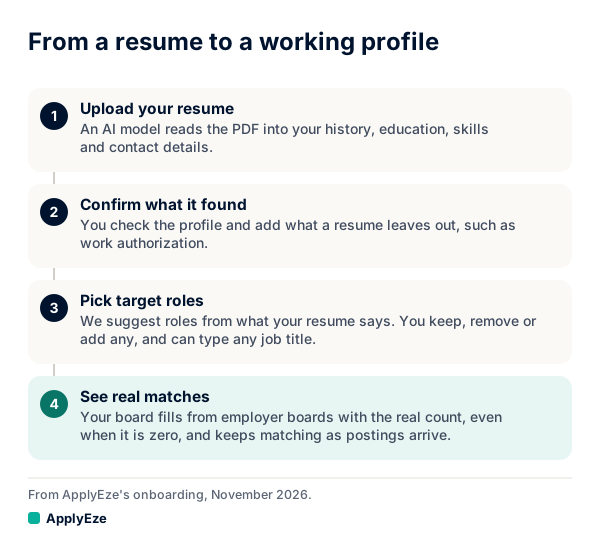
The last step in that chart is the one to hold us to: the board shows the real count, even when that count is zero, and it keeps matching as postings arrive. If yours is empty, work down this list, ordered by what is quickest to check.
| Check | Why it matters | What to do |
|---|---|---|
| Did you just finish setup? | The screen says matching a new profile can take several minutes | Wait, then look again |
| Is your application inbox connected? | "Workday and Oracle jobs stay hidden until you connect an application inbox, because those sites email a code." Roughly 4 in 10 of the open jobs we track are on those two | Connect one. The product advises a new Gmail kept only for applications |
| Are your titles too narrow? | With no title match, a posting stays out of your main list | Add the other names your work goes by |
| Is your location answer strict? | Remote only leaves roughly 8% of active jobs. Hybrid and on-site need a city overlap or willingness to relocate | Add locations, or relocation if it is true |
| Is it mostly on systems outside our list? | ApplyEze applies automatically on systems holding roughly 62% of active jobs with an inbox, and roughly 23% without | Some fields have less coverage. Apply elsewhere for those |
| Could your work authorization answers be filtering? | They are a hard filter | Check that they are correct, and leave them alone if so. Do not change a true answer to see more jobs |
New postings keep arriving
Your board is not a one-time result. New postings are scored against your profile as they come in, from more than 100,000 employer boards polled directly (109,237 on 5 November 2026). A row can also be refreshed after a posting is read more fully, so a score can shift. If you change your target titles, that affects new postings as they arrive, and existing matches are not re-scored.
So check on a rhythm that suits you, and make small edits. If you edit everything at once, you will not know which edit helped.
Questions to ask of any match percentage
These work on any tool. We answered them for our own board, so you can hold us to the same standard.
| Question | Why ask | For ApplyEze's board |
|---|---|---|
| A percentage of what? | A percentage needs a denominator. Fit to a job description is different from odds of a hire | A 0 to 100 fit score from rules. It is not a probability |
| Which inputs go in? | A score from title and skills alone reads very differently from one that includes level and pay | Role, skills, industry, level, education, experience and pay |
| What is filtered out before scoring? | Filtered jobs never appear, so you cannot tell what you are missing | Closed, already applied, blocked company, work authorization, location |
| What happens when a posting omits something? | Some tools punish silence, and that drags good roles down | Skills, years and pay leave the calculation when not stated |
| Can I see the factors on one job? | If you cannot, you cannot act on the number | Yes, under Why this fits on the web |
| Does the score decide anything? | Some scores are advice, and others send applications | No. You pick what to queue |
| Has it been tested against results? | A score that does not track replies is only a description, so ask for the denominator | It describes fit, and it makes no promise about replies |
If a tool quotes a success rate for its match score, ask how many applications it covers and over what dates. Our job shortlist post covers what to do once the number has narrowed things down, and semantic search vs keyword search explains why we rank with rules at all.
Your next step is to read one board closely. You can build yours here, and your first 50 applications are free, with no card. You pick the matches and queue them in the desktop app on your computer, and ApplyEze fills and submits each form.