

A job shortlist is the small set of postings left after you cut the whole market down to the ones worth a closer look. It is not a decision. Rules can build one quickly, because they read titles, named skills and stated years, and they still cannot tell you which of those roles you should spend an application on. Something has to make that call. On ApplyEze's free path that something is you, picking from a ranked board. On ApplyEze Autopilot it is an AI review whose verdict decides. Below is a ten-minute routine for the first path, and our measured numbers from the second: that review turned down about 4 of every 5 roles the rules offered it, which gives a sense of how much a shortlist still contains.
Search this term and nearly every page you get is written for recruiters shortlisting applicants. They are facing the same problem from the other side: Greenhouse counts 244 applications per job in 2025, up from 116 in 2022. Their method transfers well, so we borrow it below.
What rules can and cannot know
| Rules can read | Rules cannot know |
|---|---|
| The posting's title against your target titles | Whether two different titles mean the same work |
| Skills the posting names, against skills you list | Whether you could really do the skill, or how deep it needs to be |
| Stated years, level, degree and pay | Whether "5 years" is firm or a wish list |
| Stated location and remote policy | Whether the team actually works that way |
| Whether a posting is still listed | Whether it is really being filled (ghost jobs are their own problem) |
| Whether you would want the job |
The right-hand column is why a ranked list still needs someone to read it. To see the left-hand column at work, job match scores explained walks through the score.
On the free path, you decide
A self-serve account gets a board ranked by rules: your target titles in your order, then fit. The board does not read a posting against you and decide. You press Queue on a card, Pass to hide one, or Queue all, which takes rows matching your listed titles and leaves Long shots for you to queue by hand. Nothing goes out until you press start in the desktop app, which runs on your computer, so keep it on and awake until your queue finishes.
Then it goes out. There is no approval step before Submit, and dry run is the preview: it fills the form and stops before Submit, and uses no credit as long as you have one left. So your queue is where the decision sits. Use dry run on your first few, and spend the attention here.
A ten-minute triage for your board
Recruiters sort criteria into tiers. Recruitee's guide uses three: mandatory, preferred and desirable. Applicants who do not fit are disqualified, and the rest get ranked. Turn that around and you have a routine for a batch of postings. Set a timer, because this works by being quick.
| Minutes | Do this | You are looking for |
|---|---|---|
| 0 to 1 | Write your three dealbreakers, such as level, pay and type of work, and how many you will queue today | Your mandatory tier, written down before you start reading |
| 1 to 3 | Scan the top of the board by title and employer alone. Press Pass on anything you would not accept | Fast cuts, with no reading yet |
| 3 to 6 | Check matched and missing skills on what is left, in Why this fits on the web | A missing skill you could not discuss in an interview |
| 6 to 9 | Open the survivors and read the requirements only: years, must-have tools, licenses | The rules' blind spots from the table above |
| 9 to 10 | Check you are not sending too many to one employer, then queue. Note any title worth adding | A short queue you can defend |
Here is a sample batch, invented for this post, for a person with four years of analyst experience.
| Sample posting | What the panel or posting shows | Call | Why |
|---|---|---|---|
| Analytics Engineer | Missing only Airflow | Queue | Has done the work with similar tools and can discuss it |
| Senior Analytics Engineer | Posting asks for 8 years | Pass | Four years beyond theirs is a level gap |
| Business Analyst | Top of the board, all listed skills matched | Pass | Requirements gathering, not analysis. A shared word raised it |
| Data Analyst | Requires an active clearance | Pass | They do not hold one, so it fails a hard requirement |
| Insights Analyst | Long shot, all listed skills matched | Queue | Their exact work under an unlisted title. Add the title |
| Data Scientist | Missing machine learning and statistics | Pass | Could not discuss them in an interview |
Note what that batch did to the rank order. It passed on a top-of-board row and pulled one up from the bottom. That is the job of the step.
Which roles to skip first
If you are short on time, cut in this order.
- Level gaps, in both directions. ApplyEze's AI review works from a rule you can use by hand: asking 3 or more years beyond yours is a level gap, and 5 or more is far above you. Going down does not obviously help either. In Huntr's Q3 2026 data, 109 job seekers with 10 or more years of experience who applied at both levels got interviews on 3.0% of entry-level applications and 5.5% of senior ones. That is self-tracked data from one tool, and it is still a useful caution.
- Different work under a similar title. Rules give credit for shared words. When we ran the title rule, Customer Support Manager earned partial credit against Customer Success Manager. Read one paragraph of the description before you trust a title.
- Hard requirements you do not hold. A license, a clearance or a certification is rarely negotiable. ApplyEze never claims a clearance and skips a posting requiring one you lack, and a certification the posting asks for is not added unless you hold it. So these are easy cuts to make yourself.
- Employers you have already hit hard. Choose your own limit per employer and keep to it. ApplyEze checks your employer limit before a run, where one applies.
- Employers who ask you not to automate. Some employers ask applicants not to use AI or automation. Whether to apply there is your call.
On Autopilot, a verdict decides
ApplyEze Autopilot is the other path, and the difference is who decides. Every 10 minutes a planner builds a shortlist from a candidate's rule-scored matches, same-day postings first, with fences for already applied, skipped companies, citizenship, clearance and a strict location choice, plus an employer cap. Every 2 minutes an AI judge takes roles in batches of 20.
For each role it reads the title, the company, the first 2,000 characters of the description, the parsed years and level, and up to three later sentences stating years of experience. About the person it reads target roles, role families, level, years, a new-grad flag, skills and past job titles. It does not read resume bullets, name or contact details. Location and visa status are never sent, and it is told to ignore pay and company size. It is told to judge "as a careful recruiter who knows them would", and it records a score from 0 to 10 and a one-line reason.
The short version: rules build the shortlist, and AI makes the call. A job board ranks jobs and leaves the decision to you. LinkedIn now uses large language models to do it, and has described showing a fit level on job pages. Autopilot's review differs in one way: its verdict decides whether an application goes out.
Autopilot is set up today for staffing and recruiting teams that work with ApplyEze. If you are job hunting on your own, you can start with 50 free applications on sign-up, no card needed. You pick the matches and queue them in the desktop app, and ApplyEze fills and submits each form. The details of the review are in how Autopilot picks jobs.
How much a shortlist still contains
Here is what that review did. In the 14 days to 9 November 2026, the judge scored 259,378 roles, and 50,609 of them, or 19.5%, reached the default pass mark of 6. So it turned down about 4 of every 5 roles the shortlist offered, and the median role was judged 4.9 minutes after it was planned (measured over 7 days).
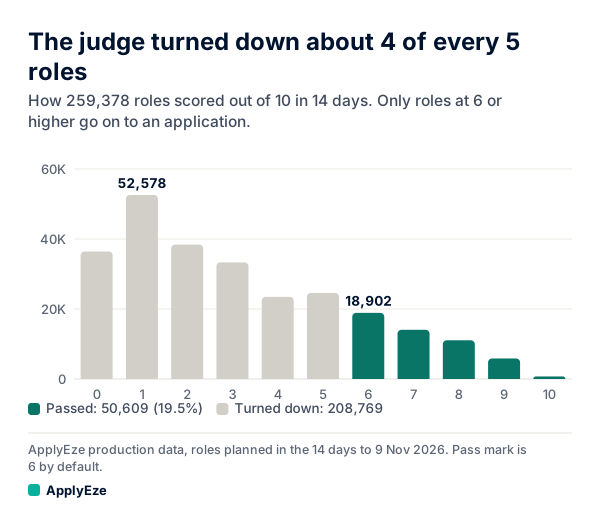
The chart shows the shape. Scores pile up at the low end, and 127,398 roles, or 49.1%, scored 2 or lower (36,420 + 52,578 + 38,400, our arithmetic). Only 729 scored a 10.
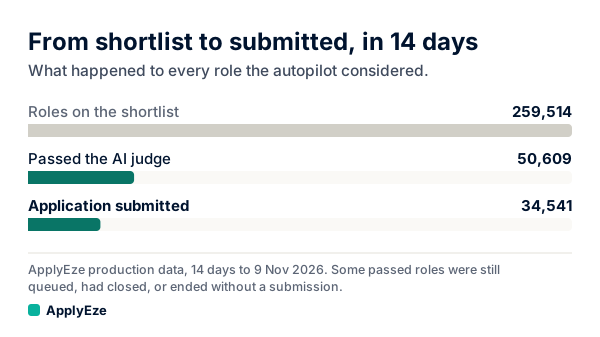
The second chart follows the roles through. Of 259,514 planned in that window, 209,893 were rejected and 34,541 ended in a submitted application. A further 9,162 were released, meaning the run ended without an application for any reason, and the rest had closed, were still waiting, or were withdrawn, duplicates or dry runs.
Two independent checks sit behind those verdicts:
- Blind re-judging. On 20 October 2026, a separate, stronger model re-judged 601 decisions without seeing the verdict and agreed on 502, or 83.5%.
- Would a recruiter send it? On 26 October 2026, a blind audit of 193 applications found that 84% of Autopilot's read as ones a recruiter would have sent, against 69% of those hand-picked by recruiters. The sample is small, and it is a model's reading, not a recruiter's.
The pass mark of 6 is a default, and a team can raise the bar per candidate.
Read 4 of 5 as a sense of scale. These are team Autopilot numbers, not a free user's result, and that shortlist runs deep, because a role with no title match can reach the judge once better roles run out. So it is not the share of your own matches that are wrong. It shows how much a rules shortlist still holds for someone to sort, which is what your ten minutes are for.
Why a shortlist still earns its place
We poll more than 100,000 employer boards, with about 900,000 active jobs on 5 November 2026. Nobody reads that. Rules make the problem small enough for a person, or a model, to work on, and neither could do this step well without them. The judge above could only read what the rules passed along, and your ten minutes only works because the board puts likely rows near the top.
The price is what the rules hide. A role doing your work under a title you did not list ranks low, so it may never reach your triage at all. Spend a minute of each session on Long shots. If you keep finding roles you want down there, your list needs a new title, as target job titles explains.
So use the shortlist for what it is good at, and keep the decision for whoever can read the posting. On the free path that is you. Your next step is one timed batch. Your first 50 applications are free, with no card, and a credit is used only when an application is confirmed as Submitted, so a tight queue is the way to spend them. You can try this routine on your own board.