

These are AI job screening results from production. In the 14 days to 9 November 2026, the AI judge inside ApplyEze Autopilot scored 259,378 shortlisted roles from 0 to 10. Only 50,609 of them, or 19.5%, reached the default pass mark of 6, so the judge turned down about 4 of every 5 roles it was offered. And 34.3% scored 0 or 1, even though every one had already come through a rules-based shortlist. A role got its verdict a median of 4.9 minutes after it was planned (7 days to 9 November). On the rival pages we read on 9 November 2026 we did not find a figure like this.
Autopilot is set up today for staffing and recruiting teams that work with ApplyEze, so this is team data. If you are job hunting on your own, you can start with 50 free applications on sign-up, no card needed. You pick the matches and queue them in the desktop app, and ApplyEze fills and submits each form. There is no AI judge on that path.
Note the direction, too. Most pages on this search report AI screening people for employers, such as the 70,000-applicant experiment on AI-led interviews covered by Chicago Booth Review. This post reports the reverse: AI screening jobs on a candidate's behalf, before any application exists.
The full distribution
Each row below is one role judged for one candidate, so a posting shortlisted for two candidates counts twice. The window is roles planned in the 14 days to 9 November 2026.
| Score | Roles | Share | The rubric's words |
|---|---|---|---|
| 0 | 36,420 | 14.0% | A different field, or a level far above or below |
| 1 | 52,578 | 20.3% | Same band |
| 2 | 38,400 | 14.8% | Same band |
| 3 | 33,306 | 12.8% | Same band |
| 4 | 23,467 | 9.0% | Same band |
| 5 | 24,598 | 9.5% | "Plausible on paper" |
| 6 | 18,902 | 7.3% | Same band, and the default pass mark |
| 7 | 14,057 | 5.4% | A close neighbouring role they could do now |
| 8 | 11,063 | 4.3% | Same band |
| 9 | 5,858 | 2.3% | Same band |
| 10 | 729 | 0.3% | Squarely a target role at their level |
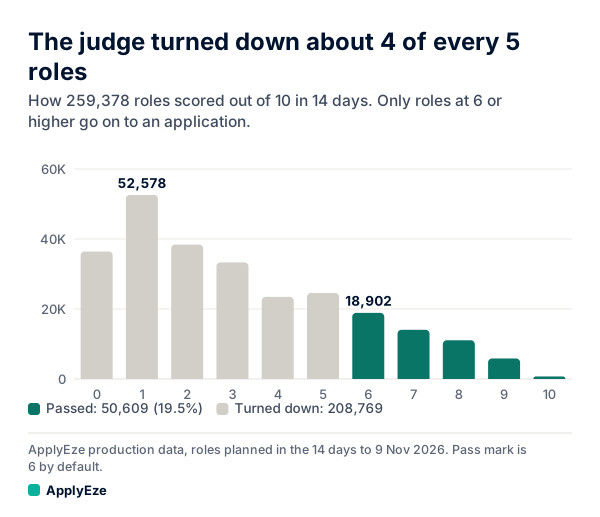
The chart shows the same thing as a shape: a hump at 1, then a long thin tail to the right. Grouped by the rubric's own bands (our arithmetic):
- 0 to 4: 184,171 roles, 71.0%.
- 5 or 6, plausible on paper: 43,500 roles, 16.8%.
- 7 to 9: 30,978 roles, 11.9%.
- 10: 729 roles, 0.3%.
The default pass mark sits inside the 5 or 6 band. A 5 is turned down and a 6 goes ahead. Any line has to fall somewhere, and a team can raise it per candidate.
A third of the shortlist scored 0 or 1
That is 88,998 roles, or 34.3%. These were not random postings. Each had a rule score for that candidate and had cleared the fences described below. So a third of the list sitting at the floor measures how far a rules-based shortlist and a reading of the posting can drift apart.
Here is how a role like this gets onto a list. These three are invented samples, written for this post. They are not real verdicts.
| Profile says | Posting title | What the body says | Why rules could pass it |
|---|---|---|---|
| Project manager, software delivery | Project Manager | Runs commercial building sites, site safety card required | Exact title match |
| Data analyst, 2 years | Data Analyst | Abstracts patient charts, active nursing license required | Exact title, SQL named once |
| Account manager, business software, 3 years | Account Manager | Surgical implant territory, 8 years of device sales stated near the end | Title, and CRM in the skills |
A careful recruiter reads any of those and stops. A scoring rule sees a title match.
Why rules leave so many misses
Rules build the shortlist. AI makes the call. Four things explain why the first step leaves so much for the second.
Titles carry the score, and titles are ambiguous. The board ranks matches by a fit score from role, skills, industry, level, education, experience and pay, and title counts most. That is why "Project Manager" can cross fields. The same design can miss in the other direction, since a role doing your work under a title you did not list ranks low. List several target titles.
Rules read fields. Postings are prose. Each posting is parsed by rules first, and when the rules cannot read it well enough, an AI model reads it on some application systems. Either way, a rule only sees what was extracted. The judge reads the title, the company, the first 2,000 characters of the description, the parsed years and level, and up to three later sentences stating years of experience. So a demand for eight years in the ninth paragraph has a route to the judge even when a field missed it.
The list is ordered for freshness. The planner builds the shortlist from a candidate's rule-scored matches, same-day postings first, and tops the queue up to what is left of today's target. A turned-down role does not fill that target, so the next round reaches further into the list. Part of the share at the bottom therefore reflects how deep the queue has to go, so 34.3% is not an error rate for rule matching in general.
The rules are not asked to decide fit. One fixed rule drops a role before the judge: a posting that says it is not real, such as "DO NOT APPLY" or "test posting". Everything else goes through. The rules' other job is the fences: already applied, skipped companies, citizenship, clearance, a strict location choice and an employer cap. Location and visa status are never sent to the judge, and it is told to ignore pay and company size. So a low score is not about any of those. It is told to judge "as a careful recruiter who knows them would", from target roles, role families, level, years, a new-grad flag, skills and past job titles.
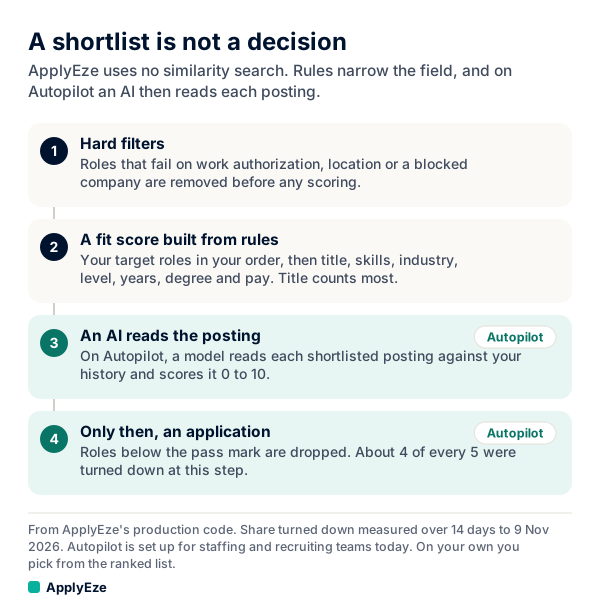
The chart lays out those four steps in order: hard filters, a rules-based fit score, the AI reading on Autopilot, then an application only above the pass mark.
A job board ranks jobs and leaves the decision to you. LinkedIn now uses large language models to do it, and has described showing a fit level on job pages. Autopilot's review differs in one way: its verdict decides whether an application goes out.
What 6 or higher includes
Of the 50,609 roles at 6 or higher (our arithmetic):
- 18,902, or 37.3%, scored exactly 6, the lowest score that clears the default bar.
- 30,978, or 61.2%, scored 7 to 9.
- 729, or 1.4%, scored 10.
So a default run reaches into the plausible-on-paper band. A team that wants a tighter run can raise the bar per candidate, to Strong fit (7 and up) or Top fit (8 and up). On this spread that would be 31,707 roles (12.2%) or 17,650 roles (6.8%), which sends fewer applications, each a closer match. The trade is worked through in job fit pass mark.
Nor is 50,609 a count of applications. Some candidates have a higher bar than 6, and not every role that passes ends in a submitted form. The job application funnel accounts for each one.
How rare a 9 or 10 is
Scores of 9 or 10 came to 6,587 roles, or 2.5%, about 1 in 39 (our arithmetic). A 10 alone came to 729 roles, or 0.3%, about 1 in 356. The rubric defines 10 as squarely a target role at the person's level, and even after a rule had already matched these roles to a profile, that description rarely held.
The judge does not read resume bullets, so a 10 says the posting lines up with a profile's target roles, level, years, skills and past titles. What you can take from this: on this population, anyone holding out for a posting that is exactly their job would see very few of them.
How the judge was checked
A turned-down role sends no application, so no employer ever answers for it. That is why the judge gets a second reader.
A blind re-read. On 20 October 2026, a separate, stronger AI model re-judged 601 of the judge's decisions without seeing the verdict and agreed on 502, or 83.5%. That is one model checking another, not a panel of recruiters. The method is in our AI hiring audit.
A blind read of the applications. On 26 October 2026, a separate model read 193 applications and asked whether a recruiter would have sent each one. 84% of Autopilot's read that way, against 69% hand-picked. The sample is small, and it is a model's reading, not a recruiter's. The detail is in the blind audit.
Why checking matters. Privacy International tested two employer-side recruitment tools in January and February 2026 with ten identical candidates per role. On Talenteria, identical Technologist candidates ranged from 1.9 to 3.3. On Manatal, eight of ten received the same 28% and two differed. Talenteria replied that some results "may not reflect the current product", and Manatal did not respond. Those are other products screening in the other direction, and they show why any AI score deserves a test like this.
These are 14 days of candidates set up by staffing teams, so wider targets would move the whole curve, and results for any one person will differ.
Run the rubric on your own saved jobs
This costs nothing and needs no software, on any job board.
- Take the last 20 jobs you saved, in the order you saved them.
- For each, read the title, the company and the top of the description, then search the page for "years".
- Score it in the rubric's words. 10 is squarely your target role at your level. 7 to 9 is a close neighbouring role you could do now. 5 or 6 is plausible on paper, though you would be reaching. 0 to 4 is a different field, or a level far above or below you.
- Apply its two level rules. Asking 3 or more years beyond yours is a level gap, and 5 or more is far above you.
- Ignore pay and company size in this pass, and check those on their own.
Then read your own spread:
| Most of your 20 scored | What it suggests | What to change |
|---|---|---|
| 0 to 4 | Your search terms pull in another field | Find the title word doing it, and narrow or exclude it |
| 5 or 6 | You are mostly reaching | Keep some, knowingly, and add closer titles to the search |
| 7 or higher | Your filter is fine | Your limit is probably time, not targeting |
Score the same 20 again a week later without looking at your first answers. If you disagree with yourself on several, tighten your own rule before you trust it. The spread measures targeting, not callback odds.
If your spread says targeting is fine and time is the limit, your first 50 applications are free, no card needed. You pick the matches and queue them in the desktop app, ApplyEze fills and submits each form while your computer stays on and awake, and Workday and Oracle roles need a connected inbox.