

A job application funnel usually means the employer's view: many applicants at the top, one hire at the bottom. This one runs earlier, from a role being considered to an application going out, with every role accounted for. In the 14 days to 9 November 2026, ApplyEze Autopilot planned 259,514 roles for its candidates. It rejected 209,893 and submitted 34,541 applications, or 13.3%. The remaining 15,080 split into buckets that mean very different things, and treating them as one number is the mistake this post is here to prevent.
Autopilot is set up today for staffing and recruiting teams that work with ApplyEze, so these are team numbers. If you are job hunting on your own, you can start with 50 free applications on sign-up, no card needed. You pick the matches and queue them in the desktop app, and ApplyEze fills and submits each form. The last section shows how to keep the same ledger by hand.
The pages we read on this phrase are mostly written for recruiters, and they run from awareness to hire. The job seeker versions are advice: Career.com's five-stage funnel carries no measured counts. A ledger where each role lands in a named bucket is what this post adds.
Every bucket, with counts
Roles planned in the 14 days to 9 November 2026. Shares are our arithmetic.
| Bucket | Roles | Share of 259,514 | What it means | Was an application lost? |
|---|---|---|---|---|
| Rejected | 209,893 | 80.9% | Turned down before any form opened | No, a decision |
| Applied | 34,541 | 13.3% | Submitted | Delivered |
| Released | 9,162 | 3.5% | A run ended with no application | Some of them |
| Closed | 2,402 | 0.9% | The posting had closed | No |
| Ready | 1,444 | 0.6% | Passed, waiting for a slot when counted | Not yet known |
| Withdrawn | 1,375 | 0.5% | Taken out of the queue before a run | No, a decision |
| Duplicate | 624 | 0.2% | Already applied to | No |
| Listed total | 259,441 | |||
| Still being judged | 63 | Waiting for a verdict when counted | Not yet known | |
| Dry runs | 10 | Filled, stopped before Submit | No | |
| All planned | 259,514 |
The seven main buckets sum to 259,441, which is 73 short of 259,514. Those 73 are the last two rows, so nothing is missing. Each row is one role for one candidate, and a posting planned for two candidates appears twice.
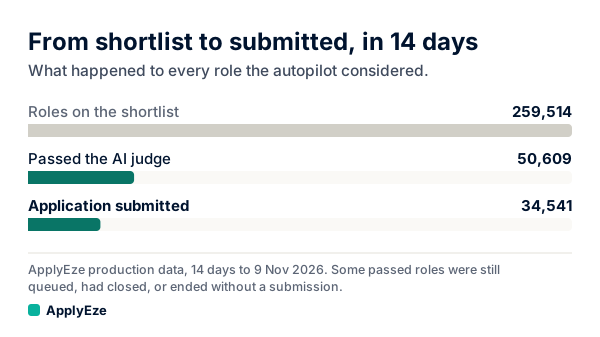
The chart reduces this to three bars: 259,514 on the shortlist, 50,609 at 6 or higher on the judge's scale, and 34,541 submitted. That is about 7.5 roles considered for each application sent (259,514 divided by 34,541). The middle bar gets a footnote two sections down.
Rejected: mostly the judge
The AI judge scored 259,378 of these roles from 0 to 10, and 50,609 reached the default pass mark of 6. That leaves 208,769 below 6 (259,378 minus 50,609). Set against 209,893 rejected, scores below 6 account for more than 99% of the bucket. The spread itself is in AI job screening results.
Rejection costs less than anything else in this table. The median time from a role being planned to being judged was 4.9 minutes (7 days to 9 November 2026). No browser opened, no resume was built for that role, and nothing reached an employer. In a funnel, you want the largest cut to happen where it costs least, and here it does.
A rejected role sends no application, so no employer can grade the call. So the call is checked another way. On 20 October 2026, a separate, stronger AI model re-judged 601 of the judge's decisions without seeing the verdict and agreed on 502, or 83.5%. That is one model checking another, not a panel of recruiters.
Why rejected exceeds the count below 6
Rejected is 209,893 and the count below 6 is 208,769, a gap of 1,124. If 6 were the only line, those would match. Two things explain the gap.
Some candidates have a higher bar. A team can raise the bar per candidate to Strong fit (7 and up) or Top fit (8 and up). A role scoring 6 for that candidate is rejected even though it clears the default.
A few roles get no usable score. If the model gives no usable answer for a role, it is tried again, and after 3 failed tries the role is rejected and not applied to.
You can size these with the same totals. Planned minus scored is 136 roles (259,514 minus 259,378). Take away the 63 still being judged and at most 73 roles have no score. So at least about 1,050 of the 1,124 must be roles that scored 6 or more and fell under a higher bar (1,124 minus 73). Both totals were read from the same table on the same morning, so treat that as close rather than exact.
That is the footnote on the chart: its middle bar counts roles at 6 or higher, and a small share of those fell under a higher bar. Roles not rejected come to 49,621 (259,514 minus 209,893), including the 63 still being judged and the 10 dry runs.
Released: what it covers
Released is the bucket to read carefully. It means the run ended without an application, for any reason. In practice that covers:
- A real form failure. The run could not complete the form, and it is released with its reason.
- A submit whose outcome is unknown. The form may have gone in, and the site never confirmed it. These are never replayed, because a replay could apply twice. So some of these may be real applications that this table does not count.
- A posting that closed. The definition is broad enough to include one found closed along the way, so not every closure sits in the Closed row.
A run known not to have submitted because of an infrastructure problem does not go straight here. It goes back in the queue, waiting 15 minutes, then 1 hour, then 4 hours, at most 3 tries.
The table does not split released by reason, so 9,162 is an upper limit on lost applications, not a count of them. Against applied, it gives 34,541 of 43,703, or 79.0%, as the share of settled runs that ended in an application. The breakdown by application system is in job application completion rate.
Closed and duplicate are not lost applications
Closed is 2,402 roles, about 1 in 21 of the 49,621 not rejected. A posting that has closed cannot take an application. A sweep every 10 minutes moves waiting roles out when their posting closes, and a run can also discover it. Either way the candidate lost nothing but the look.
Duplicate is 624 roles. Here the application already exists, sent earlier or through another channel. That is a safeguard working, not a shortfall: ApplyEze is built to stop double applications, and a second submission to the same posting only lands the same person on the same recruiter's screen. Duplicate job applications covers what those safeguards catch and what they miss.
Withdrawn, at 1,375, belongs with these. The same sweep takes a waiting role out when it passes the age limit, when the employer is skipped, or when it falls under a bar that was raised later. Those are decisions, made before any form opened.
This distinction changes what you would fix. Add closed, duplicate and withdrawn into the failures and you get 13,563 roles (9,162 plus 2,402, 1,375 and 624) that look like problems. Only the 9,162 can contain a lost application.
Why this table does not add to the completion table
We publish a second table, of forms completed by application system. It shows 35,874 applied and 9,502 released, against 34,541 and 9,162 here. Neither is wrong. They count by different dates.
- This funnel counts by the date a role was planned. It follows one group of roles forward.
- The completion table counts by the date a run settled. It looks at what finished in the window.
A role planned the day before the window opened and applied to the day after appears in the completion table and not here. A role planned on the last day and still in the queue appears here as ready and not there. So do not add the two tables, subtract one from the other, or divide this table's planned count into that table's applied count. Each is sound on its own terms.
What a funnel like this tells a job seeker
These ratios are not targets. They come from candidates run by staffing teams with a model doing the reading, and they say nothing about replies. The structure is what travels.
Most of the cut belongs before the form. You already reject most of what you see by scrolling past it. Writing the reason down turns that into data.
Separate could not from chose not. A form you abandoned, a posting that closed and a job you decided against are three different events. Lumped together they tell you to try harder, when the fix may be applying sooner or narrowing a search.
Unknown is its own outcome. If a site gives you no confirmation screen and no email, record it as unknown, and look before you apply again. That is how one person ends up in a recruiter's system twice.
Here is the ledger for your own search. Keep it for two weeks, one line per role you seriously looked at, in a sheet or a job application tracker.
| Bucket | Count it when | Sample count (invented) |
|---|---|---|
| Turned down | You read it and decided no. Add a one-word reason | 52 |
| Applied | You saw a confirmation | 18 |
| Could not finish | The form or account step beat you | 3 |
| Unknown | You submitted and saw no confirmation | 0 |
| Closed | It was gone by the time you got there | 4 |
| Already applied | You had applied before | 1 |
| Waiting | Still on your list | 2 |
| Considered | The sum of the above | 80 |
Then three small sums, using the sample:
- Completion: applied divided by (applied plus could not finish plus unknown). 18 of 21 is 86%. If this is low, the forms are the problem, so look for which application system keeps beating you.
- Closed rate: closed divided by everything you did not turn down. 4 of 28 is 14%. If this is high, you are reaching postings late, so start from newer ones and check a posting is still live before you tailor anything.
- Turn-down reasons: count the one-word reasons. If "senior" is 30 of the 52, your search terms are the fix, not your stamina.
This ledger stops at the moment an application goes out. For what happens after that, from application to interview to offer, use the funnel in how many applications to get a job.
If your completion sum says the forms are what beat you, your first 50 applications are free, no card needed. You pick the matches and queue them in the desktop app, ApplyEze fills and submits each form while your computer stays on and awake, and Workday and Oracle roles need a connected inbox.