

A blind audit of job applications asks a second reader to grade the work without seeing the verdict. On 26 October 2026, a separate AI model read 193 applications and answered one question: would a recruiter have sent this? 84% of applications from ApplyEze Autopilot read that way, against 69% of those hand-picked by recruiters. The sample is small, and it is a model's reading, not a recruiter's. This post sets that result beside real callbacks at one staffing team, shows how the two fit together, and gives you a version to run on your own applications.
Autopilot is set up today for staffing and recruiting teams that work with ApplyEze, so these are team results. If you are job hunting on your own, you can start with 50 free applications on sign-up, no card needed. You pick the matches and queue them in the desktop app, and ApplyEze fills and submits each form.
The question the model was asked
The question was "would a recruiter have sent this?" It asks whether a decision to apply looks sensible. It does not ask whether the employer would reply, and the model had no way to know.
"Blind" here means the reviewing model did not see the verdict on the work it was reading. In hiring research, "audit" usually means a field experiment. Kline, Rose and Walters, for example, sent more than 83,000 fictitious applications with randomized characteristics to jobs posted by 108 of the largest US employers, then measured who got contacted. That design measures what employers do. This one asks a narrower question, quickly and repeatably: did the decision to apply look sensible to a careful second reader?
The result
| Group | "Would a recruiter have sent this?" |
|---|---|
| Hand-picked by recruiters | 69% |
| ApplyEze Autopilot | 84% |
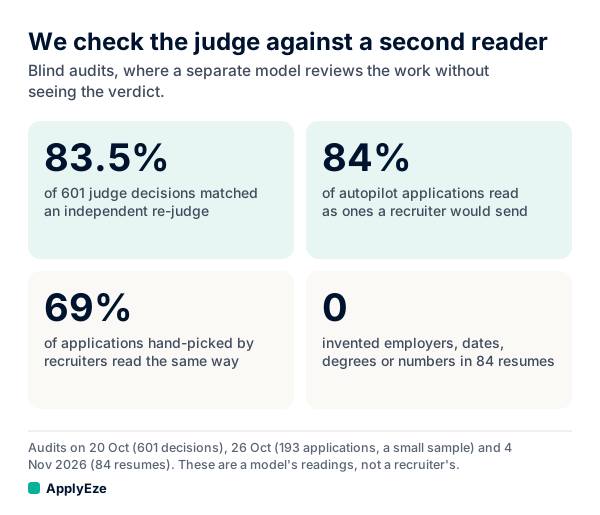
The chart puts this result beside two other checks. The first is a separate, stronger model re-judging 601 of the AI judge's decisions on 20 October 2026 and agreeing on 502, or 83.5%, covered in our AI hiring audit. The other is the resume audit: 84 sampled resumes on 4 November 2026, with 0 invented employers, dates, degrees or numbers. ApplyEze brings the posting's named skills and tools onto your skills line, even when your own record does not list them. There is no step to remove one before a live run, so use a dry run to see what it writes, and be ready to discuss anything on the page.
193 is the audit's total, and it read other groups of applications as well as these two, so each group here holds fewer. Read the 15 points as a direction, not a precise measurement.
A model's reading, not a recruiter's
A model and a recruiter see different things. Autopilot's applications had already passed an AI judge before this audit read them, and hand-picked ones had not, so only human readers could test whether a model favours a model's picks. A recruiter also knows things no document records: which hiring manager takes a chance on a career change, what a candidate really did in a role with a vague title.
A human panel would be the natural next reader, and it helps to know what one would settle. interviewing.io and Learning Collider studied 76 technical recruiters making nearly 2,200 evaluations of over 1,000 resumes. Treating a candidate's first interview as the truth, "recruiters chose correctly 55% of the time". The likelihood of two recruiters agreeing was 64%, and the median time spent was 31 seconds. Those are technical roles, and interviewing.io sells interview practice and hiring services. Still, it shows a panel would tell us what recruiters think, and that recruiters disagree too.
Real callbacks in the same season
Here is what happened to applications in the real world. A human callback is a screening call, an interview or an offer. These are applications at one staffing team from 14 September, when inbox detection began there, to 31 October 2026. Callback detection of this kind is rolling out with staffing teams first and is not part of self-serve accounts yet.
| Applied in | ApplyEze applications | ApplyEze callbacks | Per 1,000 | By hand applications | By hand callbacks | Per 1,000 |
|---|---|---|---|---|---|---|
| 14 to 30 Sep | 5,245 | 8 | 1.53 | 7,429 | 39 | 5.25 |
| 1 to 15 Oct | 17,619 | 35 | 1.99 | 3,844 | 12 | 3.12 |
| 16 to 31 Oct | 39,968 | 128 | 3.20 | 2,038 | 7 | 3.43 |
| Whole window | 62,832 | 171 | 2.72 | 13,311 | 58 | 4.36 |
Only recruiters' own applications count as by hand. Rows that exist only because an inbox reply was found, and candidates' own logged applications, are left out of both sides, because they would inflate a rate.
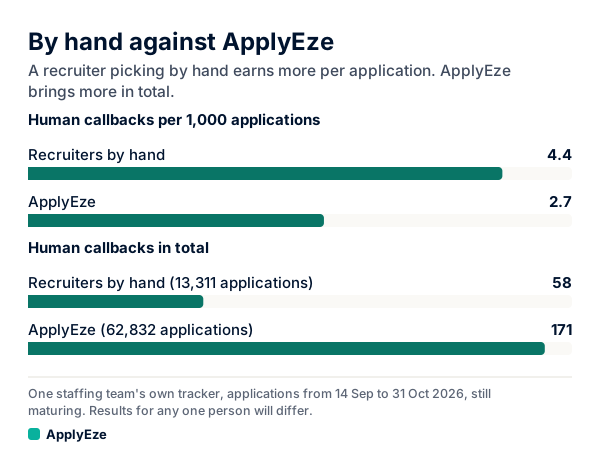
The chart shows both halves. Across the whole window, a recruiter picking by hand earned more callbacks per application, 4.4 against 2.7 per 1,000. October applications are still maturing, and the late-October by-hand figure of 3.4 rests on 7 callbacks. ApplyEze brought about three times as many callbacks in total, 171 against 58, and the gap narrowed through the fall: ApplyEze's rate rose from 1.5 to 3.2 per 1,000, close to the by-hand 3.4 in the last two weeks of October. The full version is in hand-picked vs automated applications.
How both can be true
84 against 69 on a model's reading, and 2.7 against 4.4 in replies. These do not contradict each other, because they are not measuring the same thing, or even the same applications.
| Explanation | What we can see |
|---|---|
| The groups differ | The audit's high group is Autopilot. The callback column is everything sent through ApplyEze at that team, a wider group. So 2.7 is not an Autopilot rate |
| Fit on paper and replies are different questions | The audit asks whether a decision looks sensible. A reply also depends on who else applied and what the employer needed that week |
| Recruiters know what paper omits | A hand-pick can earn more than its paper reading suggests, and the by-hand rate is consistent with that, though other causes would look the same |
| Recent applications have had less time | 64% of ApplyEze's applications sit in the last period against 15% by hand (39,968 of 62,832, and 2,038 of 13,311), so maturing holds down ApplyEze's count more |
| A model may favour a model's picks | Only human readers could test this |
The audit says Autopilot's picks look sensible on paper to a second reader. The callback table says that at one team, in one window, recruiters' own picks earned more replies per application, while ApplyEze brought about three times as many callbacks in total and the gap narrowed. Results for any one person will differ.
What would settle it is an experiment: the same candidates and the same pool of eligible roles, assigned at random to a recruiter or to the judge, with callbacks counted at the same age.
How to run a smaller version yourself
You can do this on your own applications in about an hour. It often shows you something about how you pick.
-
Pick two groups of 10. Ten applications you chose with care and ten you sent quickly. Or ten by hand and ten through any tool. Note which is which on a separate sheet, and give each a number.
-
Build a packet for each. The posting text and the resume you sent. Remove your name, your contact details, and anything showing whether you heard back.
-
Shuffle, and choose a reader who cannot tell the groups apart. A friend who hires in your field is the better reader. A chat model is fine as a second one. Start a new chat for each packet, so earlier answers do not steer later ones.
-
Ask one question. Here is a sample prompt, written for this post:
Here is a job posting and the resume sent for it. A careful recruiter knows this candidate well and cares about their time. Would that recruiter have sent this application? Answer YES or NO, then give one sentence saying why. Judge the fit only. Do not guess whether the employer would reply.
-
Only then match the numbers back to your groups, and count the yeses per group.
-
Read the NO reasons. This is where the value is. If most of them say a level gap, your search is reaching too high. If most say a different field, one of your search terms is too loose.
| Your result | What it means |
|---|---|
| Groups within about 40 points | Noise. With 10 per group, a standard 95% margin on a gap runs about 35 to 44 points (our arithmetic) |
| Groups further apart than that | Probably a real difference in how you pick. Look at what the higher group did |
| Two readers disagree on many packets | The reading itself is unstable. Do not rely on one reader |
Twenty applications rarely bring enough replies to compare groups, so read the reasons rather than waiting for replies. Keep the results in your job application tracker and repeat it when you change how you search.
If the test shows your picking is sound and the forms are what cost you the time, your first 50 applications are free, no card needed. You pick the matches and queue them in the desktop app, ApplyEze fills and submits each form while your computer stays on and awake, and Workday and Oracle roles need a connected inbox. A dry run fills the form and stops before Submit, so you can read what it would send first.