

An AI resume audit can mean several things, so here is exactly what ours was. In an audit on 4 November 2026 of 84 sampled resumes built by ApplyEze, we found 0 invented employers, dates, degrees or numbers. ApplyEze brings the posting's named skills and tools onto your skills line, even when your own record does not list them. There is no step to remove one before a live run, so use a dry run to see what it writes, and be ready to discuss anything on the page. Further down is a ten-minute audit you can run on any AI resume from any tool.
Search this phrase and you mostly find something else. Scanners, such as Resumelens, grade keyword match, skills coverage, formatting, action verbs and quantification, using the resume text and a job description you paste in. Employer tools, such as Breezy HR's Resume Audit, look at "the quality and authenticity of candidate resumes" and label them from "Looks original!" to "Likely has copied or AI-generated content". Both read the resume. Neither has your real history to compare it with, so neither can answer the question that matters when software rewrites your resume: is it still true? That takes two documents, the new resume and the record it came from.
What was audited, and what was found
| Scope | Result |
|---|---|
| Date | 4 November 2026 |
| Sample | 84 sampled resumes |
| Checked for | Invented employers, dates, degrees and numbers |
| Found | 0 |
A sample is evidence and not a promise, which is why the lock described below sits in code.
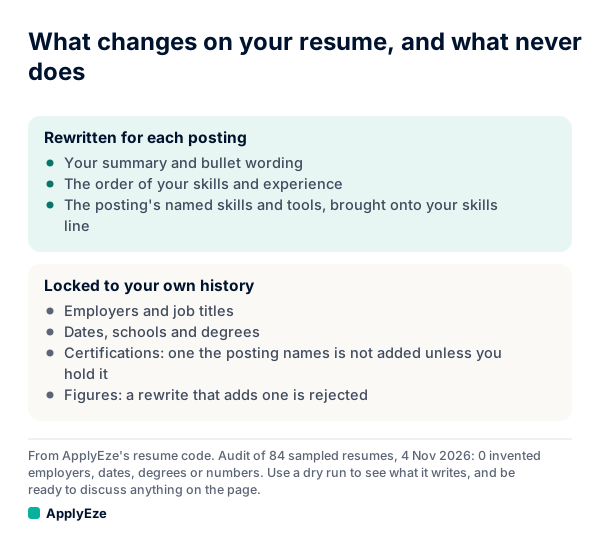
The chart shows where the line sits. The summary, bullets, order and the posting's named skills get rewritten. Employers, titles, dates, schools, degrees, certifications and figures stay locked to your record.
What sits outside that count
The audit counted four kinds of invented fact. Here is what it did not count, and how each is handled.
- The skills line. The product adds to it by design. See the next section.
- Job titles, schools and certifications. These are locked in code, and the audit's count is stated for the four things above.
- Whether a bullet overstates your role. A verb that turns "supported" into "led" invents no employer, date, degree or number. The self-audit below checks it.
- A true number in the wrong place. A check for invented figures asks whether a figure is new. The self-audit below also checks that each number sits in the right job.
- Cover letters. These are written when the form asks. Claims about you come from your record, and any name or figure about the company must appear in the posting.
- Form answers. Hard facts come from your profile. When a required question is not covered by your saved answers, ApplyEze still fills it rather than stopping the run, so that answer may not come from you. Fill in your saved answers, use dry run first, and read your receipts.
- Your record itself. A lock holds a resume to the record behind it, so keep that record right. You can change anything we read from your resume before we match you.
The skills line, plainly
ApplyEze brings the posting's named skills and tools onto your skills line. The case for carrying a posting's exact terms is that recruiter searches work on them, and our tailoring post covers that evidence. The cost is that a skill can print on your resume that your history does not prove. A certification the posting asks for is not added unless you hold it, but a tool can be.
Here is what that looks like. This is an invented sample, written for this post.
| Skills | |
|---|---|
| Your record | SQL, BigQuery, Tableau |
| The posting names | Snowflake, dbt, Looker |
| Skills line on the resume | SQL, BigQuery, Tableau, Snowflake, dbt, Looker |
Three of those are yours and three are the posting's. If you have used dbt on a side project and can talk about it, that line is defensible. If you have never opened it, the first interview question about it is where this surfaces. SHRM's article on spotting embellished resumes describes it from the other chair: such a candidate "may be unable to expand on details listed on their resume".
There is no approval step before Submit. So the practical way to check is a dry run, which fills the form and stops before Submit, plus reading the documents on your receipts. You choose which matches to queue, so if a posting's skills would put you in that position, the plainest fix is not to queue it.
How the lock works
Four steps, and the third is the one that matters.
- Your record. You upload a PDF, and an AI model reads it into a fixed shape and is told not to invent. You review what we read from your resume and confirm your details before we match you.
- The rewrite. For each application, an AI model reads that posting and your real history and writes a resume for it.
- The check, in code. Your employers, job titles, dates, schools, degrees and certifications come from your own record. Code rejects a rewrite that adds a figure, employer, school or credential your record does not hold.
- The read-back. Each resume is built as PDF and DOCX, and each file is read back the way a parser reads it. A failed read stops the run before the form.
Step 3 sits outside the model on purpose. Telling a model not to invent is a request. A check in code does not depend on the model's cooperation. If you tailor with a chatbot, nothing plays that role except you, which is why our ChatGPT resume guide ends with a fact check. For the fuller list of what changes, see AI resume rewrite.
A ten-minute self-audit for any AI resume
You need your original resume, the AI version and the posting. Open the first two side by side, or print them. Use your word processor's compare feature if it helps. The order below starts with what an employer can check against a record. Checkr describes employment verification as comparing what a candidate provides "to records maintained by employers", typically dates and job title, and its product flags "errors or inflated job titles". Education verification covers school name, degrees or certificates, dates of attendance and majors. In the US, an employer using a background check company must give you written notice and get your written consent first.
| Minutes | Check | How | A failure looks like |
|---|---|---|---|
| 0 to 2 | Employers and titles | Same names, same spelling, same titles, line by line | "Analyst" became "Senior Analyst" |
| 2 to 3 | Dates | Every start and end, to the month | A gap closed, or two jobs now overlap |
| 3 to 4 | Schools, degrees, certifications | Compare each with your original | "Coursework in" became a degree, or a certification appeared |
| 4 to 6 | Every number | Highlight each digit in the AI version. Find it in the original, in the same job | A new percentage, a rounded-up figure, or a real figure moved to another job |
| 6 to 8 | Skills line | For each term, say aloud where you used it and what you did with it | You cannot fill two minutes on it |
| 8 to 10 | Verbs and scope | Compare the verbs and team sizes in each bullet | "Helped with" became "owned", or "supported" became "led" |
If you have a spare minute, copy all the text out of the PDF and paste it into a plain text file. If the order scrambles there, a parser may read it the same way.
Tally by type, not by total. One wrong date and five unprovable skills are different problems with different fixes.
What to do when you find something wrong
| You found | Fix now | If you already sent it |
|---|---|---|
| A wrong employer, title, date or degree | Restore it from your original. This is the most serious kind | Send a short correction before any background check |
| A number you cannot source | Delete it, or replace it with one you can defend | Be ready to give the real figure if asked |
| A skill you cannot discuss | Remove it if your tool lets you. On ApplyEze, skip that posting | Say so if it comes up, and offer your closest real experience |
| An overstated verb | Put back the accurate one | Describe your real role in the interview |
| An error in your record | Fix the record first, since later resumes draw on it | Treat it as a wrong fact, above |
| The same error, repeatedly | Stop trusting that tool for that section | Check everything sent recently |
A correction can be short. This is a sample, written for this post:
Hi Dana, one correction to the resume I sent for the analyst role. It lists dbt under skills, and I have not used it in production. My closest experience is writing SQL transformations in BigQuery. I wanted you to have that before we speak. Thanks, Sam.
If you find an invented employer, date, degree or number in a resume from ApplyEze, write to hello@applyeze.com. That is exactly what this audit says should not happen, and we want the example.
You can run all of this on ApplyEze's own output. Your first 50 applications are free, once per email address, with no card, and a credit is used only when an application is confirmed as Submitted. Dry-run mode fills the form and stops before Submit, and uses no credit as long as you have one left, so you can read what it built before anything goes out. You queue the roles yourself in the desktop app, it runs while your computer stays on and awake, and Workday and Oracle roles need a connected inbox.