

An AI resume rewrite should change how your history is told and leave the history itself alone. In ApplyEze, the rewrite for each posting covers your summary, the wording of your bullets, the order of your skills and experience, and the posting's named skills and tools. Your employers, job titles, dates, schools, degrees, certifications and figures stay locked to your own record, and code enforces that lock. The clause about named skills is the one to read twice, because it means a tool you have never used can land on your skills line.
What gets rewritten for a posting
For each application, an AI model reads that posting and your real history and writes a resume for it. Four things move.
| Part of the resume | What changes | What to look for when you read it |
|---|---|---|
| Summary | Written again to speak to this posting | A claim about your level you would not make out loud |
| Bullets | Reworded, using the posting's vocabulary where it fits | A verb stronger than what you did |
| Order | The most relevant skills and experience come first | Something you wanted kept that slid off the page |
| Skills line | The posting's named skills and tools come on | A tool you cannot discuss |
Each resume comes out as a PDF and a DOCX. One page is the target, and a second page beats deleting a job. Whether tailoring is worth doing at all is a separate question, and we go through the data in should I tailor my resume for each job.
What stays locked to your record
Your employers, job titles, dates, schools, degrees and certifications come from your own record. Code rejects a rewrite that adds a figure, employer, school or credential your record does not hold. A certification the posting asks for is not added unless you hold it, so a posting that wants a PMP does not put one on your resume.
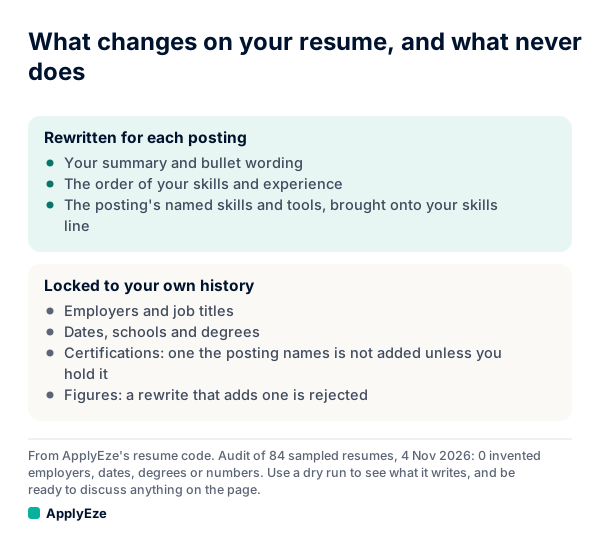
The chart holds the same two lists, one for what is rewritten and one for what stays locked.
"Your record" has a plain meaning: what was read from the PDF you uploaded, plus what you corrected afterwards. You confirm the read during setup, and all of it stays editable on the Profile tab in the desktop app. That matters because a lock protects a mistake as firmly as a fact. If the upload read a start date wrong and you did not catch it, every resume carries that date. Read your profile once, slowly, before anything else on this page.
How code enforces the lock
A prompt telling a model not to invent is a request, and models do not always honor requests. So the rule sits in code that runs after the model has written. The draft is compared with your record, and a figure, employer, school or credential the record does not hold gets the rewrite rejected.
That check covers facts. Skills have their own rule, covered below. Word choice is yours to read: whether "led" is fair to what was really "helped with" is a call only you can make.
The audit, and exactly what it covers
In an audit on 4 November 2026 of 84 sampled resumes, we found 0 invented employers, dates, degrees or numbers. ApplyEze brings the posting's named skills and tools onto your skills line, even when your own record does not list them, so use a dry run to see what it writes, and be ready to discuss anything on the page.
| Question | Answer |
|---|---|
| When | 4 November 2026 |
| How many | 84 sampled resumes |
| Checked for | Invented employers, dates, degrees and numbers |
| Found | 0 |
| Not part of this audit | The skills line, and the wording of bullets and summaries |
We found no rival that publishes a sampled result like this, on the pages we read on 9 November 2026. The full audit write-up sets out the method and includes a self-audit you can run on any AI resume.
The skills line: read this part twice
Bringing a posting's named tools onto your skills line is a deliberate choice, because the posting's own word is the one most likely to be searched, as our guide to tailoring a resume explains.
ApplyEze brings the posting's named skills and tools onto your skills line, even when your own record does not list them. There is no step to remove one before a live run, so use a dry run to see what it writes, and be ready to discuss anything on the page. A certification the posting asks for is not added unless you hold it.
Runs end, they do not pause, so your control sits before and after the run:
- Before you queue. "Why this fits" on a match lists the skills matched and missing. Treat the missing list as an early warning, though not an exact forecast of the skills line. If a posting is built around a tool you could not discuss, press Pass.
- Before going live. A dry run writes a resume for a real posting and stops before Submit, so you can see what the writer does with roles like yours. The practice run checklist goes through it line by line.
- After it goes out. The exact resume that went out is kept under Documents. Read it before you take a call about that role.
Three questions for each skill you did not put there yourself:
- Could I name a place I used it?
- Could I answer one basic question about it without looking anything up?
- Would I be comfortable if the interview opened with it?
Two noes and it should not be on a resume you send, which in practice means not queueing postings that lean on it. And if one reaches an interview anyway, say so before you are asked to demonstrate it.
Sample answer, written for this post: "I have not used Looker day to day. I built the same kind of weekly carrier dashboard in Tableau, so I know what the work needs, and I would plan to ramp up on Looker in my first few weeks."
A labelled before and after
This is a sample, written for this post. The person, employer, posting and numbers are invented, and it shows the pattern rather than a captured output. The posting asks for an Operations Analyst with SQL, Looker, demand forecasting and carrier performance reporting, PMP preferred.
| Line | Before (the record) | After (for this posting) | What happened |
|---|---|---|---|
| Employer and title | Harbor Line Freight, Operations Coordinator, 2022 to 2025 | Harbor Line Freight, Operations Coordinator, 2022 to 2025 | Locked. It does not become "Operations Analyst". |
| Summary | Organized coordinator who keeps freight moving | Operations coordinator with three years of carrier performance reporting in freight | Rewritten toward the posting, using what the record holds |
| Bullet | Built weekly carrier scorecards in Excel for 40 carriers | Built weekly carrier performance reports in Excel covering 40 carriers | Posting's vocabulary, same figure |
| Bullet | Cut late-delivery disputes by 18% by changing how claims were logged | Cut late-delivery disputes by 18% by changing how claims were logged | Moved up the list. A version reading 24% would be rejected, because 24 is not in the record. |
| Skills | Excel, Tableau, SQL, carrier management | SQL, Excel, Tableau, Looker, demand forecasting, carrier performance reporting | Looker and demand forecasting came from the posting. This is the line to check. |
| Certifications | None | None | PMP is not added, because the record does not hold it. |
The two lists decide everything on the page. If this person has never opened Looker, the rewrite did nothing wrong by its own rules and the resume still carries a claim they cannot back up. That is the reason for the three questions above.
How each file gets read back before a run
Each file is read back the way a parser reads it, checking contact details, completeness, reading order and dates. A failed read stops the run before the form, so a resume that extracts badly does not reach an employer's upload field.
There is no ATS score, because no ATS exposes one. A pass here means the file reads cleanly. It says nothing about how a recruiter will rank it. Any tool quoting you a score is estimating with its own formula.
Hold any rewriter to the same lists
Most pages that rank for this search describe speed and polish. Few say which fields the tool may touch. Here is what three of them said when we read them on 9 November 2026. We read the pages and did not test the products.
| Tool | What its page says about facts | What to notice |
|---|---|---|
| Kickresume | "rewrites weak parts (with no made-up info)", and "works only with what you've already written" | A clear promise, with no list of fields. The same sentence says it "adds relevant keywords", which is where the pressure sits. |
| Huntr | Can "create relevant job-tailored work experience achievements that are typical for the role you worked in", then you "choose the content most relevant" | Typical for a role is not the same as what you did. Your choice is the only check it describes. |
| BeamJobs | Its sample turns "Supervised restaurant closing process." into a line ending "which reduced closing time by 22%", and it also tells you to "ensure your accomplishments are accurate and not exaggerated" | The before line holds no figure, and the page does not say where the 22% comes from. |
You can run the same test on any tool, ours included, in about the time it takes to read this section.
- Save your original as its own file and rewrite a copy.
- Compare them. In Word, choose Review, Compare, Compare Documents and pick the two versions.
- Walk the locked list: every employer, title, date, school, degree, certification and number.
- For every number that is new, find where it came from. If you cannot, it goes.
- Put the skills line through the three questions.
If you are working in a general chatbot, this prompt does much of the same job. It is a sample, written for this post, and a prompt is a request rather than a check, so run the comparison anyway.
Rewrite my summary and bullets for the posting below.
Keep every employer, job title, date, school, degree,
certification and number exactly as written.
Do not add any number. Do not add anything to my skills section.
List any skill the posting names that my resume does not,
under a separate heading called "To check".
To see the two lists at work on your own history, start with a practice run. Your first 50 applications are free, with no card, and a practice run costs nothing as long as you have a credit left, so you can read what the writer does before anything goes out. You can start here.