

Blind AI job screening means the model rating a candidate is not handed certain facts about them. The AI judge in ApplyEze Autopilot is never sent location or visa status, does not receive name or contact details, and is told to ignore pay and company size. That closes one route for bias, and it is a design choice you can inspect line by line. It is one step, not a cure: in one audit of language models, hiding names and pronouns made little difference, and a randomized field trial of anonymous resumes in France left minority candidates worse off. This post lists exactly what is withheld, where each fact is handled instead, what the research shows, and which signals any brief like this still carries.
Autopilot is set up today for staffing and recruiting teams that work with ApplyEze. If you are job hunting on your own, you can start with 50 free applications on sign-up, no card needed. You pick the matches and queue them in the desktop app, and ApplyEze fills and submits each form. There is no judge on that path, so this post is about one team product, and about what to ask of any screener.
| Fact | What the judge gets | Where it is handled instead |
|---|---|---|
| Name, email, phone, date of birth | Not in the brief | The application itself, wherever the employer asks |
| Location, of the job or the person | Never sent | Rules. A company can choose to apply only in set places |
| Visa, sponsorship, citizenship | Never sent | Rules before the judge, and your saved answers on the form |
| Pay | Told to ignore it | The pay factor in the board's fit score |
| Company size | Told to ignore it | Nowhere. It is not meant to count |
| Resume file, bullets, education | Not in the brief | The board's match score uses education. The resume is written later |
| Posting date, application system | Not in the brief | The shortlist, which handles freshness and supported systems |
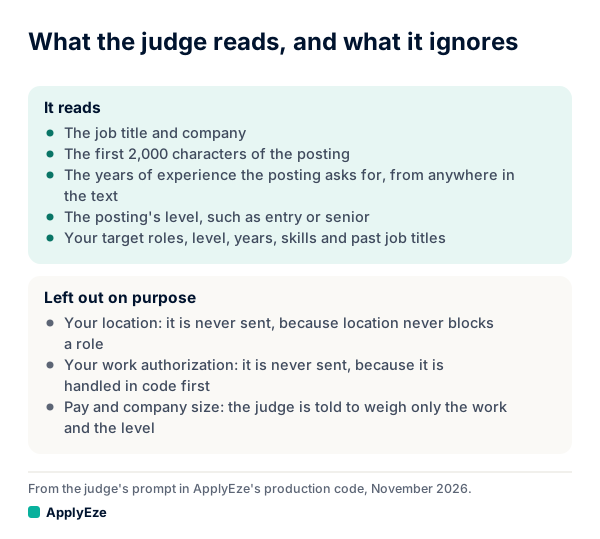
The chart shows the same split. What it reads is in how AI reads a job posting, and this post is about the other list.
What is never sent
The brief on a person holds target roles, role families, level, years, a new-grad flag, skills and past job titles. Nothing else. There is no field for name, contact details, location or work status, and roles are numbered 1, 2, 3, not by a real identifier. A fit rating has no use for a name. And as the research below shows, a name can move a model's output.
"Never sent" describes the fields about the person and the job's location. The first 2,000 characters of a description are sent as written, so if a posting says "must be based in Boston" or "we do not sponsor visas", those words reach the model. The accurate sentence is that ApplyEze does not give the judge a location or your visa status to score against, and it tells the judge to judge only the work and the level.
What it is told to ignore
The instruction reads: "Judge only the work and the level. Ignore pay, company size and anything not about the work itself."
Our reasons are plain. A role does not become a better fit because the employer is large or famous. Pay is the candidate's call, and it would be a poor signal in any case: roughly 15% of active postings state their pay, from a 1% sample on 9 November 2026.
Leaving a field out is enforced in code. An instruction is a request to a model. They are different promises, so we hold them in different columns, and you should ask any vendor to do the same.
Where location and work status are handled instead
These facts do not disappear. They move to a place where the decision is a plain rule and can be checked.
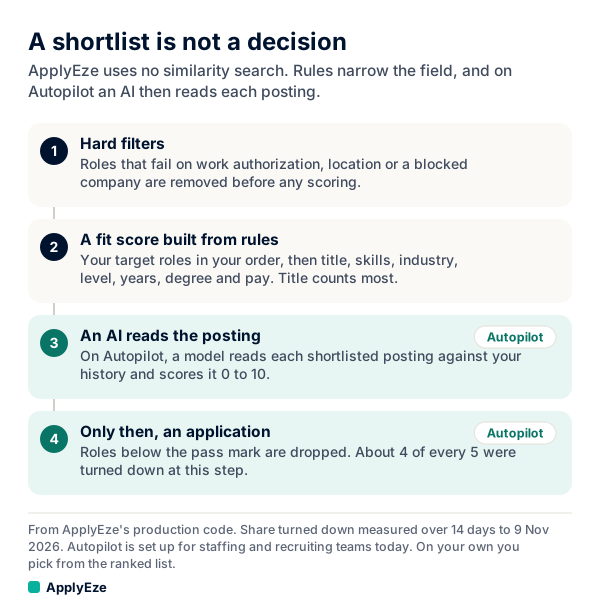
The chart shows the order: hard filters and a rules-based score first, then the judge, then an application only for roles above the pass mark. Before any AI runs, the shortlist removes:
- roles ApplyEze has flagged as requiring US-person status or citizenship, for candidates who cannot meet that
- clearance requirements ApplyEze has already seen on that posting, confirmed recently, for candidates who cannot meet them
- non-local jobs, only for a candidate whose company chose "Only apply in these places"
Location is treated as a preference, never as a reason for the AI to reject a role. A company can set that strict filter, and then the shortlist keeps only local or remote jobs. It simply is not the model's decision: every role the judge reads is scored on the work and the level.
The research on names and language models
Four studies, and they do not all point the same way.
| Study | What it tested | What it found | The limit |
|---|---|---|---|
| University of Washington, 2024 | Three language models, 550+ resumes, 500+ job listings, names varied | White-associated names favored 85% of the time, Black-associated 9%. Male names 52%, female 11% | A lab test, not real hiring. It ranked by text similarity |
| Gaebler, Goel, Huq and Tambe | Several language models, 801 real applicants to K-12 teaching jobs, names and pronouns varied | Moderate gaps, rating female, Black, Hispanic and Asian candidates higher than male and white ones | One school district. The authors say it may not generalize |
| Amazon's internal tool, reported in 2018 | An internal resume-rating tool | Reportedly penalized the word "women's" and certain all-women colleges | Press reports. Amazon scrapped the project |
| France, field trial from 2009 | Human recruiters, 598 job offers, 1,268 candidates, resumes anonymized or not | The interview gap for minority candidates widened from 2.4 to 13 percentage points | Firms volunteered. Humans, not models |
The University of Washington test is the reason to care about a name at all. The authors found no case where a typically Black male name was preferred over a typically white male name. Its setup differs from ours: it placed resumes and job descriptions in a mathematical space and took the closest 10%. Our judge does not rank by similarity, and it has no name to react to, so the result does not transfer directly.
One finding in the paper bears directly on a short brief. Resumes cut down to a name and a title produced larger gaps between groups than full ones. With little else to read, a name counts for more. If you are going to use a short brief, that argues for keeping the name out, which is what this one does.
Now read the second row against the first. Two audits of language models, with gaps in opposite directions. The setup, the job and the task seem to decide which way it runs, so nobody should assume they know the direction in advance.
What leaving something out does not fix
The Washington authors call removing names a "naive approach to mitigation", because resumes signal group membership in other ways, "including educational institutions, locations, and even lexical content choices". The teaching study tested it: passing models blinded materials "has little effect" on the gaps, and it reports that "LLMs can accurately infer a candidate's demographics even from these blinded materials". Amazon's tool shows the same thing from the other side, since it needed no name to find the word "women's".
So here is what any brief built on work history still carries, ours included.
- Years, level and a new-grad flag can stand in for age. A rubric that scores level will read a long career differently from a short one.
- Past job titles and skills can carry gender and background. The Washington paper cites work finding that resumes written by women were more likely to use words like "cared" and "volunteered", and those by men "repaired" and "competed".
- Target roles reflect a person's history and the options they had.
- Posting text passes through as written, and the company name stays in.
- The employer sees everything. The judge's blindness covers one step. Your name, address and work status answers still go on the application, and whatever the employer's own process does with them is unchanged.
The audits we publish check agreement and invented resume facts, and they are not a test for differences between groups. The France result adds a further point for anyone designing a screen: withholding information can also remove the context that helps explain a gap in a work history. That is why the questions at the end of this post matter more than the word "blind".
What this means if you need sponsorship
This is general information about how the software works, not legal advice.
The judge does not score your status, because it is not told your status.
- Citizen-only roles are removed by rule where flagged. Roles ApplyEze has flagged as requiring US-person status or citizenship are removed for candidates who cannot meet that. Flags can miss a posting.
- There is no sponsor filter. The shortlist does not select employers that sponsor visas. ApplyEze does not skip a job because the posting says it will not sponsor.
- The employer's own questions still apply. Most automatic rejection comes from eligibility questions such as work authorization, and scoring is more often used to decide who gets looked at first, according to Enhancv's interviews with 25 recruiters. That is a small sample, but it fits the mechanism. A blind judge does nothing about a knockout question on the form.
- Your saved answers carry the weight. Sponsorship questions use the answers you saved, so they are worth getting exactly right. Hard facts come from your profile. When a required question is not covered by your saved answers, ApplyEze still fills it rather than stopping the run, so that answer may not come from you. Fill in your saved answers, use dry run first, and read your receipts. Our guide to work authorization questions goes through what each status should say.
Questions to ask any AI screener
These work for a vendor you are buying from, or an employer whose process you are curious about. Ask for the answers in writing.
- What does the model literally receive? Ask for a sample with the real fields. A summary hides the question that matters.
- What is removed by code, and what is the model only told to ignore? They are different promises.
- Does free text pass through unchanged? If a resume or posting is sent as written, anything in it reaches the model, including what the field list says is excluded.
- Where do the excluded facts go? Someone or something still decides on location and eligibility. Ask who, and whether it can be checked.
- Which stand-ins remain? Graduation years, dates, schools, addresses, clubs. Ask which are in the input.
- Has anyone run a paired test? Keep everything the same and change one signal: a name, a date, the word "women's". Ask for the method, the sample size and who ran it. How to audit an AI hiring tool covers a related test you can run on any tool.
- Who can see the score, and who can correct the input? On Autopilot, the team sees the score and the reason, and the candidate does not.
A vendor that answers these with specifics has given you something to check. "Our AI is blind" is not an answer to any of them. This post is our answer to the first five.
If you are searching on your own, there is no judge between you and your list: you read each role and you decide, and sponsorship questions use the answers you saved. Your computer stays on and awake while your queue runs, and Workday and Oracle jobs need a connected application inbox. Get those saved answers right once, and your first 50 applications are free, no card needed.