

LinkedIn job matching now runs on large language models: they help retrieve and rank roles, and a related model shows a fit level beside a job. Then you decide. That last step is the difference this post is about. A job board ranks jobs and leaves the decision to you. LinkedIn now uses large language models to do it, and has described showing a fit level on job pages. ApplyEze Autopilot's review differs in one way: its verdict decides whether an application goes out.
We make that second kind of product, so this is written by a competitor. Autopilot is set up today for staffing and recruiting teams that work with ApplyEze. If you are job hunting on your own, you can start with 50 free applications on sign-up, no card needed. You pick the matches and queue them in the desktop app, and ApplyEze fills and submits each form. The app runs on your computer, so keep it on and awake until your queue finishes, and Workday and Oracle roles need a connected inbox. That self-serve path sits on LinkedIn's side of the line. It ranks, with rules and no AI, and you decide.
What LinkedIn has said about its job matching, with dates
LinkedIn's engineers publish a good deal about this, which is to their credit. Here is the record we could open. Press coverage is marked as such.
| Date | Source | What it says |
|---|---|---|
| 5 Oct 2023 | LinkedIn Engineering | "We launched this EBR model in the Job Search candidate selection stage". That is embedding-based retrieval, using a two-tower neural network |
| 15 Jan 2025 | Engadget, press | Job Match gives "detailed summaries alongside job listings", for all users, with more detail on match level for Premium |
| 7 May 2025 | Engadget, press | LinkedIn "is ditching the keywords in favor of AI" in its revamped job search, so people can search in natural language |
| 16 Jun 2025 | VentureBeat, press | The earlier approach relied on "fixed, taxonomy-based methods, ranking models, and older LLMs". LinkedIn "turned to distillation methods to cut the cost of using expensive GPUs" |
| 7 Oct 2025 | LANTERN paper, LinkedIn authors | From "a candidate profile and a job description" it predicts "a fit label (High/Medium/Low), which is shown alongside the job". "LANTERN has been deployed in production at LinkedIn" |
| 21 Jan 2026 | LinkedIn Engineering | "using large language models (LLMs) to create a semantic search experience". A fine-tuned embedding model retrieves, and a small language model scores for final ranking |
| 7 Feb 2026 | Semantic Search At LinkedIn, LinkedIn authors | In a framework shared by job search and people search, retrieval keeps the top 1,000, and a small language model reranks the top 250. A larger model acts as "a policy-aligned judge" that labels relevance for training |
| 24 Jun 2026 | Social Media Today, press | A Premium Apply Assistant pre-fills fields and drafts letters, and "LinkedIn users still have to approve all of these elements" |
Read in order, that is a company moving keyword search and fixed taxonomies toward language models, in public, over three years. Anyone writing about LinkedIn as a keyword site is out of date.
Ranking and showing a fit level
Two separate things get called "job matching", and they are easy to mix up.
Ranking decides what you see first. Per the 2026 paper, which covers job search and people search on shared infrastructure, this is a funnel. A model embeds your query and each job into the same space and keeps the 1,000 closest. A small language model reads pairs and reranks the top 250. Fast models do the wide work, and slower models read closely, because reading everything closely would cost too much.
The fit level is a label on a job you are already looking at. LANTERN reads your profile and the job description and predicts High, Medium or Low. In the paper's figure, a written explanation appears only "upon explicit user request", through a separate model. Low-fit jobs are labelled in that figure, not removed.
LinkedIn reports what the label did in its online evaluation: "+0.24% increase in apply rate and a +0.28% increase in qualified applications." The paper gives no test design beyond that. Even so, the small size suggests something useful: a label nudges behaviour and does not take it over.
Other platforms say so outright. Jobright calls its score "a decision aid", and Dice says "Dice Match scores have no determining weight when you apply to a job."
Who makes the decision in each case
This is the one real difference, so it deserves precision.
| ApplyEze self-serve | ApplyEze Autopilot | ||
|---|---|---|---|
| Who ranks | Language models | Rules, no AI | Rules build the shortlist |
| Who reads the posting against the person | A model, for the fit label | You | An AI judge, on each shortlisted role |
| Who decides to apply | You | You | The judge's score, against a pass mark |
| Who sends it | You, even with the Premium assistant | ApplyEze fills and submits what you queued | ApplyEze |
| Runs without anyone queueing roles | No | No | Yes, once a team turns it on |
Note the word "judge" in LinkedIn's 2026 paper. It uses a large model as "a policy-aligned judge" too, and the role is different. As the paper describes it, that judge grades relevance to produce training labels for the ranking models. It is not described as deciding what any member applies to. The word and the kind of model are the same, and the consequences are not.
The contrast is one of responsibility, not intelligence. Once a verdict sends an application, the verdict has to answer for it.
What a wrong call costs in each case
Every system that reads text makes mistakes, and the mistakes cost different amounts depending on who acts on them.
| The mistake | On a ranked board | With a verdict that decides |
|---|---|---|
| A poor job looks good | You lose a few seconds reading it, then scroll on | An application goes out in a person's name and cannot be recalled |
| A good job looks poor | It sits lower, and you may never reach it. You can still search for it | It is turned down, and no person sees it unless someone looks at the record |
The top row is why this raises the stakes. A wrong ranking costs a scroll. A wrong verdict costs an application, and that has knock-on effects. An employer's limit may count it, and under some employer rules a rejection from it can block other roles there for a period.
The bottom row matters too, because a person scrolling past a good job at least had the chance to notice it. So a system that decides has to be held to account in ways a ranking does not. Autopilot records a score and a one-line reason per role, and we audit its decisions with a separate model.
In the 14 days to 9 November 2026, the judge scored 259,378 roles and turned down about 4 of every 5. When a separate, stronger model re-judged 601 decisions on 20 October 2026 without seeing the verdict, it agreed on 502, or 83.5%. In another blind audit on 26 October, a model asked of 193 applications "would a recruiter have sent this?" and said yes to 84% of Autopilot applications against 69% hand-picked by recruiters. That sample is small, and it is a model's reading and not a recruiter's.
The result that counts is replies. At one staffing team, human callbacks (a screening call, an interview or an offer) rose from about 2 per candidate per month in spring to 7 for October applications, while volume more than tripled and the rate per 1,000 applications held near 3. Part of that rise is better counting, the count covers every channel at that team, and results for any one person will differ.
How Autopilot's review works, briefly
Rules build the shortlist. AI makes the call. The diagram shows the order: hard filters, then a rules-based fit score, then on Autopilot an AI reading each posting and scoring it, then an application only for roles above the pass mark.
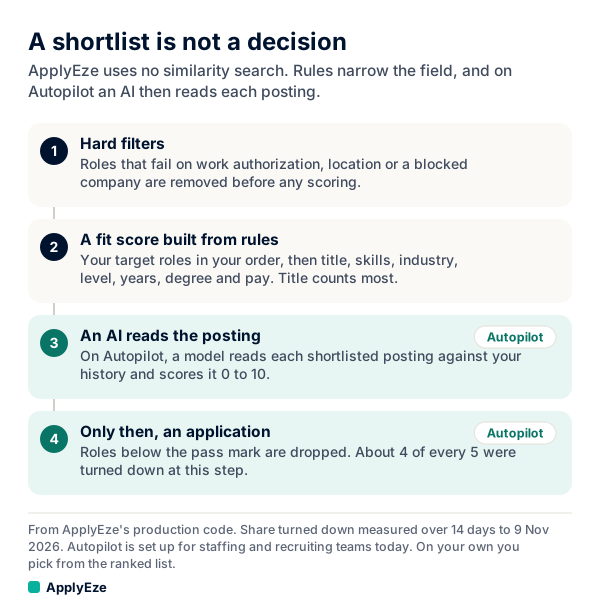
For each role, the judge reads the title, the company, the first 2,000 characters of the description, the parsed years and level, and up to three later sentences stating years of experience. About the person, it reads target roles, role families, level, years, a new-grad flag, skills and past job titles. It does not read resume bullets, and it is told to judge "as a careful recruiter who knows them would". Search finds jobs that look like you. Autopilot's AI review asks what a careful recruiter would ask.
The controls exist because the verdict has consequences. By default a role needs a 6, and a team can raise the bar per candidate. A record is kept per role, with its score and a one-line reason. Runs are applied or released, and never wait for a person.
What rules and ranking are good at
None of this makes ranking the lesser tool. Each layer does something the others cannot.
- Semantic retrieval finds what you did not think to type. This is where LinkedIn's design has the advantage over our board. "ApplyEze does not rank by text similarity. It ranks on your target titles and the requirements it reads out of each posting." So a role doing your work under a title you did not list ranks low on ApplyEze, and search by meaning can surface it.
- Scale. LinkedIn's paper describes retrieval over a corpus of up to 1.3 billion documents, across those search products. Reading each one closely against each query is not practical, which is why its design is a funnel. Autopilot only reads one candidate's shortlist, in batches of 20, which is a much smaller job.
- Rules are good at what must be exact. Work authorization, a blocked company or a location choice should not be a matter of a model's opinion. Our board applies them as hard filters. They are checkable, and you can see that zero matches means zero.
- A ranking leaves you in charge. You keep the veto on every application. Plenty of people want it. In a Greenhouse survey of 1,200 US respondents published in October 2026, 69% said they would feel comfortable using an AI agent, "only 5% would let one apply to jobs on its own". Greenhouse sells hiring software. ApplyEze's self-serve path keeps that veto with you, and Autopilot is for teams that have chosen to hand the decision over.
How to use both as a job seeker
You do not need to choose a side.
- Use LinkedIn's search for discovery. Describe the work in plain language, as its natural-language search invites, and not your job title. Look at what titles come back.
- Harvest those titles. Any title that turns out to be your work belongs on your target list. On a rule-ranked board like ours, this closes the gap above. See why order matters in target titles.
- Treat the fit level as one opinion. It reads your profile, so check that your profile is current before trusting it. A High does not clear a years requirement, and a Low does not end the conversation. Read the duties and subtract the years yourself. Our job match guide covers what any score can and cannot tell you.
- Then apply on the employer's site where you can. In Huntr's Q3 2026 data, the same 5,855 job seekers logged interviews on 6.2% of applications through employer career sites against 4.9% through job boards. Over the past 12 months, applications from LinkedIn logged 3.6%, the same as Indeed, against 9.9% from Google job search. That data is self-tracked, and Huntr says it does not prove a channel caused an interview. It is still a low-cost habit to try.
- Keep automation off LinkedIn itself. LinkedIn says "we don't permit the use of any third party software, including 'crawlers', bots, browser plug-ins, or browser extensions" that automate activity on its site, and that members risk restricted accounts. ApplyEze applies on employers' own application systems, such as Workday, Greenhouse and Ashby.
A ranking finds you the role, and the form is still yours to fill. If you want the employer-site half done without typing, you can start with 50 free applications on sign-up, no card needed. You keep the same control a LinkedIn user keeps, since you choose every role, and ApplyEze writes a resume for each posting and fills and submits the form.