

Applying to multiple jobs at the same company is allowed, common and often sensible, but each extra application tends to be worth less than the one before it. The one public measurement we could find comes from Huntr's Q3 2026 tracker data: one application to a company had a 5.9% interview rate, and eight or more had 2.4% per application, while the chance of at least one interview there still rose to 17.7%. So you get more chances, each one thinner. Separately, some employers set hard limits in their application system, and those can reject an extra application before anyone reads it.
We make ApplyEze Autopilot, which caps how many applications one candidate sends to one employer. This post shows the math behind repeat applications, what employers can enforce, and what our cap counts. It then gives you a way to set your own limit. Autopilot is set up today for staffing and recruiting teams that work with ApplyEze. If you are job hunting on your own, you can start with 50 free applications on sign-up, no card needed. You pick the matches and queue them in the desktop app, and ApplyEze fills and submits each form. The app runs on your computer, so keep it on and awake until your queue finishes, and Workday and Oracle roles need a connected inbox.
What the numbers say about repeat applications
Here is what Huntr reports:
| Applications to one company | Interview rate per application | Chance of at least 1 interview there |
|---|---|---|
| 1 | 5.9% | 5.9% |
| 8 or more | 2.4% | 17.7% |
Two pieces of arithmetic, ours and not Huntr's, make that table more useful.
Eight applications are not eight separate chances. If each one were an independent draw at 5.9%, the chance of at least one interview would be 1 - 0.941^8, or about 38.5%. The measured figure is 17.7%, less than half of that. It is the same person, the same record and often the same recruiter, so a reason that rules you out of one role tends to rule you out of the next.
The extras are worth far less than the first. Going from 5.9% to 17.7% takes at least 7 more applications, so each adds at most about 1.7 percentage points on average: (17.7 - 5.9) / 7. A first application at a different employer sits at 5.9%. By this rough measure, the average extra application adds less than a third of what a first application elsewhere does.
Hold that loosely. It is observational. People who send eight applications to one company differ from those who send one, and they may be aiming at large employers with many openings. Huntr's users log their own activity, it says they do not log everything, and heavy loggers count for more in per-application rates. Huntr also sells job search software. Its text gives only the two ends of the range, so we cannot say from it where the curve bends between 2 and 7.
That gap is why the usual advice is opinion. Career sites tend to answer this question with a round number and no data behind it. One staffing firm's guide warns of automated flags at one count in its summary and a different count in its table, cites no dataset, and concedes "It is not a written policy at most companies. It is a judgment call." That last sentence is right.
The limits employers can set themselves
Hard limits do exist. They are employer settings, so they vary, and you generally cannot see them in advance.
| Ashby | Greenhouse | |
|---|---|---|
| Limit on how often you apply | "Limit the number of times a candidate can apply to any job within a scope over a certain number of days." | "Restrict applications over a period of time": a set count in a set number of days |
| Reapplying to the same job after rejection | Can be blocked for a set number of days | Can be blocked for a set number of days |
| Reapplying to any job after rejection | "Block rejected candidates from reapplying to any role within the scope" for a set number of days | No. The rejection block covers only the job you were rejected from |
| Scope | All jobs, or chosen departments | By department |
| What you see | A message the employer wrote, and optionally a notice above the form | The application goes to rejected, marked "blocked by auto reject rule". An email goes out only if the employer turned it on |
| Exempt | "Applications submitted via Indeed" | Referrals, internal candidates, agency submissions and some others |
| Way back in | Staff can unblock an application, which moves it to review | Not described in this document |
Four things follow, and they are the part most advice misses.
- A fast rejection may be a rule. If you are rejected within moments of a second application, no person may have read it. That tells you about the employer's settings and little about your fit.
- Order matters. Under Ashby's any-role rule, a rejection from the weakest role you applied to can close the strongest one for that period. So send your best fit first.
- Departments can be separate. Both systems scope rules by department. A block in one may not reach another, though you cannot tell from outside.
- A person can get you past it. On Greenhouse, a referred application is exempt from these limits, and on Ashby, staff can unblock a blocked application. When you have already hit a limit, finding someone inside is worth more than trying again.
Even with no limit in place, assume you are visible as one person. Greenhouse flags profiles that share "the same email address, phone number, LinkedIn profile URL" by default, and lets staff "combine separate candidate applications into a single candidate profile." More on how these systems treat repeats is in duplicate job applications.
Some employers also ask applicants not to use AI or automation. Whether to apply there is your call.
Why a cap exists at all
A person applying by hand runs out of evening long before this matters. Software does not. In the 30 days to 9 November 2026, ApplyEze delivered 75,963 applications for 46 candidates, or 1,651 per candidate, across 9,278 distinct employer names. At that volume, a large employer with dozens of open roles in one family could soak up a candidate's queue and send one recruiter a stack.
So Autopilot has a cap, and its purpose is narrow: one candidate does not look like spam to one employer. We do not publish the number. Huntr's math above gives a second reason. Past a point, the next application at that employer is likely better spent elsewhere.
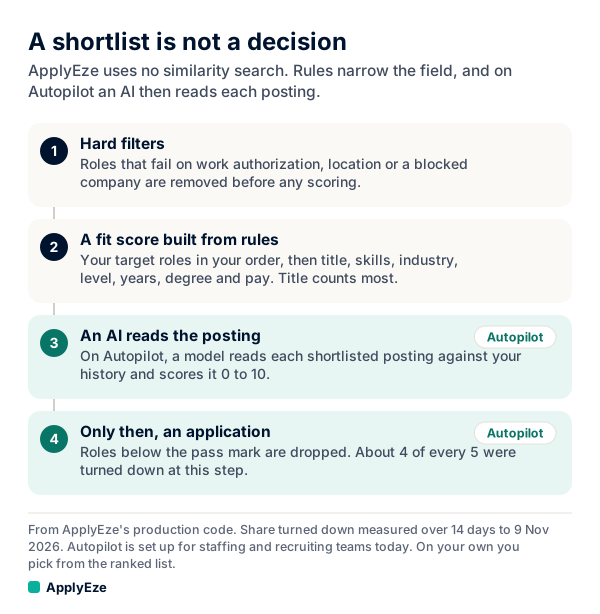
The cap is a rule, not an AI decision. In the diagram below, hard filters and a rules-based fit score come first. On Autopilot alone, an AI then reads each posting and scores it, and an application follows only for roles above the pass mark. The employer cap sits on the rules side, as one of the fences used to build the shortlist, so a capped role never reaches the AI at all.
What it counts, and what it cannot see
Knowing what a cap misses is more useful than knowing that it exists.
| The cap counts | The cap does not see |
|---|---|
| Applications sent through any ApplyEze channel for that person | Applications you sent yourself on the employer's site |
| Roles already queued or in progress at that employer | Applications a recruiter logged elsewhere |
| Every role at one employer name, across all its departments | A parent and subsidiary posting under different names, because it matches on the company name and not on the corporate family |
Two practical points come out of that table. If you are a candidate on a team's Autopilot and you also apply on your own, tell your recruiter, because the count cannot include those applications. And the cap is not a promise about any employer's rules. An employer's own limit may be tighter, or set per department, and the cap is one value we set for everyone. A company or a candidate cannot change it.
Per candidate, not per team
The cap counts per person. Two candidates at one staffing team can each apply to the same employer, and each has their own count. That is deliberate, and it matches how the employer limits above work: Ashby's rule talks about the times "a candidate" can apply. Two people are two applicants, even when one team sends both.
Why a capped role may come back later
A capped role is skipped. It is not rejected or forgotten. The count looks back over a rolling window, so as older applications age out, that employer's other roles can return to the shortlist.
A cap is first come, first served, so order matters here as it does under an employer's own limit. Whichever role goes first uses the slot, and that is the trade for not stacking one recruiter's screen.
A rule of thumb when you pick roles yourself
The cap above belongs to Autopilot. On the self-serve path you choose what to queue, so the limit is yours to set. A run does check the employer's own limit where ApplyEze has one on record: when an employer on Ashby refuses because you hit its application limit, ApplyEze remembers and skips that employer until the window ends. Everything before that first refusal is up to you.
Run this before any second application to one employer:
- The one-story test. Could a single recruiter read your applications as one story? Data Analyst, Senior Data Analyst and BI Analyst is one story. Data Analyst, Account Executive and Office Manager is three people.
- Strongest first. Send the role you fit best, and only then the next. Rejection rules and recruiter memory both reward this order.
- Beat the alternative. On the rough math above, an extra application here is worth less than a third of a first one elsewhere. So the role should beat the best role you have not yet tried at another employer by a wide margin, or the employer should be one you want badly.
- Keep your own count, including what you sent by hand. No software sees all of it.
- Read a fast no. If a rejection arrives in moments, stop applying there for now, and look for a person instead.
Then adjust for the situation:
| Situation | A sensible approach |
|---|---|
| Small company, one recruiter | Your single strongest role, plus a close sibling at most |
| Large employer, distinct fits in different departments | One per department, strongest first, since different people may read them |
| The same role listed in several cities | Only the cities you would accept. It is likely one recruiter, so more cities add little |
| You were rejected recently from a similar role | Wait, or get a referral. A near-identical application will probably get the same answer |
| Someone inside will refer you | Ask them which role to use it on, then lead with that |
For how a daily number fits around this, see how many jobs to apply to a day. The rest of the Autopilot shortlist is covered in how Autopilot picks jobs.
The hard part of this decision is choosing the role. The form is only typing. If you would rather spend your time on the choice, your first 50 applications are free, with no card, and ApplyEze writes a resume for each posting you pick and fills and submits the form.