

Auto apply vs reverse recruiter is a choice between software that costs a few cents an application and a person who costs 50 cents to $3.00 an application, or $1,500 to $3,000 a month at the full-service end. Pick software if the roles you want are plentiful and your shortage is hours. Pick a person if the roles are scarce, you are senior, or your real problem is reaching people instead of filling in forms. We have one measurement of what human judgement is worth, and it cuts both ways. At one staffing team, recruiters picking by hand earned 4.4 human callbacks per 1,000 applications against 2.7 through ApplyEze. ApplyEze brought about three times as many in total, 171 against 58, and the gap narrowed through the fall.
A disclosure: ApplyEze sells auto-apply software, so we compete with part of what these services sell. Scale.jobs, for its part, labels AI auto apply "Snake Oil" in its comparison table. Both sides here are selling something, so this page shows its arithmetic and says where a person is the better buy.
The short answer
| If this is you | Start with | Why |
|---|---|---|
| Plenty of postings fit you, and you have more targets than time | Software | The price gap is wide at volume, and your total matters more than your rate |
| Fewer than about 50 fitting roles a month | A person who checks fit, or your own hands | Volume cannot make up for a lower rate, and the price gap nearly closes |
| Manager or above, six-figure target, $1,500 a month to spend | A full-service reverse recruiter | You are paying for outreach, coaching and negotiation, not forms |
| New to the workforce, or unsure which job you want | Neither yet | A client quoted by CNBC would not recommend a service at that stage |
| Already getting about one interview per 10 applications | Neither | An agency founder told CNBC that such people may not need reverse recruiting help |
The 50 is our rule of thumb, from the arithmetic below. Our reverse recruiter guide has the fuller price ladder, and can I hire someone to find me a job starts from the beginning.
What each one does
"Reverse recruiter" covers two quite different services, and only one of them does the thing the name suggests.
| Auto-apply software | Application service | Full-service reverse recruiter | |
|---|---|---|---|
| Examples | ApplyEze, Tsenta, FastApply | Apply4Me, Scale.jobs, Careerify | Find My Profession |
| Who picks the role | You from a ranked board on ApplyEze. On Tsenta's Power plan, the software can | You at Apply4Me. A person at Scale.jobs and Careerify | A team, and you approve |
| Who fills the form | Software | A person | A team |
| Resume per posting | Yes at ApplyEze and Tsenta. A paid add-on at FastApply | Yes at Scale.jobs. No at Careerify, and you choose from up to five resumes at Apply4Me | Written for your target roles |
| Contacts hiring managers | Not listed | Not listed | Yes, it writes and sends the messages |
| Coaching and negotiation | Not listed | Not listed | One coaching session a month, plus guidance when an offer comes |
What a person buys is minutes. Careerify's rule is "1 recruiter hour ≈ 5" applications, so each gets about 12 minutes of attention (our arithmetic). In that time the recruiter checks the role against your resume, seniority, location, sponsorship needs and salary goals. Ladders says its Apply4Me team looks for and fixes errors made by the employer's resume reading software. Scale.jobs promises "a proof screenshot for every single application", which ApplyEze does not: an ApplyEze run leaves a receipt with its result, time taken, screenshots where taken and the documents sent.
Software is creeping toward the people part, but only so far. Tsenta lists 10 to 50 networking searches and email lookups a day. Finding an address is a smaller thing than someone writing to a hiring manager in your name and following up.
What each costs
Listed prices as of 9 November 2026. Per-application figures are our arithmetic at full use.
| Service | Listed price | Volume | Per application |
|---|---|---|---|
| ApplyEze | $0 once, $19 a month, $99 a month | 50, 700, 3,000 | $0, 2.7 cents, 3.3 cents |
| Tsenta | $19, $39, $99 a month | 600, 1,500, 4,500 | 3.2, 2.6, 2.2 cents |
| Simplify+ | $19.99 a week, $39.99 a month, $89.99 for 3 months | 20 a week | $1.00, about 47 cents, about 35 cents |
| Apply4Me | $49.97 a month, or $299.64 a year, plus tax | Up to 50 a month | $1.00, or 50 cents |
| Scale.jobs | $399, $599, $999, one time | 500, 1,000, 1,500 | 80, 60, 67 cents. The page prints 40 cents on the top plan, which appears to net out $398 of included add-ons |
| Careerify | $150, $280, $455, $720 a month | About 50, 100, 175, 300 a month | $3.00, $2.80, $2.60, $2.40 |
| Find My Profession | $3,000 a month, or $1,500 a month plus 8% of first-year salary | Not published | Cannot be calculated |
These are different services, so treat any per-application comparison as arithmetic, not like for like. Two things in that table mislead if you read it quickly.
"At full use" is the floor. A $19 plan costs 2.7 cents only if you send all 700. Here is what one application costs at the number you might really send.
| You send, per month | A $19 software plan | Apply4Me | Careerify |
|---|---|---|---|
| 50 | 38 cents | $1.00, or 50 cents on the yearly plan | $3.00 |
| 100 | 19 cents | Over its cap | $2.80 |
| 300 | 6.3 cents | Over its cap | $2.40 |
At 50 a month the gap with Apply4Me is only 1.3 to 2.6 times. At 300 the gap with Careerify is about 38 times. The bands even overlap: Simplify+ by the week costs $1.00 per submitted application, the same as a Ladders team member on the monthly plan.
The success fee has a crossover. Find My Profession's own table shows a 4-month search at a $100,000 salary costing $14,000 on the success-fee option and $12,000 on the flat fee. The two meet at a salary of $18,750 times the months you search (our arithmetic: 8% of salary against the $1,500 a month you save). So $75,000 at four months and $112,500 at six. The 8% is owed "ONLY after accepting a job", so if you stop without one, the lower monthly fee was the cheaper bet.
What human judgement earned, measured
We found no reverse recruiting service that publishes a callback rate. The closest evidence is our own, with its denominators.
At one staffing team, for applications from 14 September to 31 October 2026, we can set applications its recruiters picked and sent by hand beside applications sent through ApplyEze. A human callback means a screening call, an interview or an offer. Only recruiters' own applications count as by hand. Rows that exist only because an inbox reply was found, and candidates' own logged applications, are left out of both sides, because they would inflate a rate.
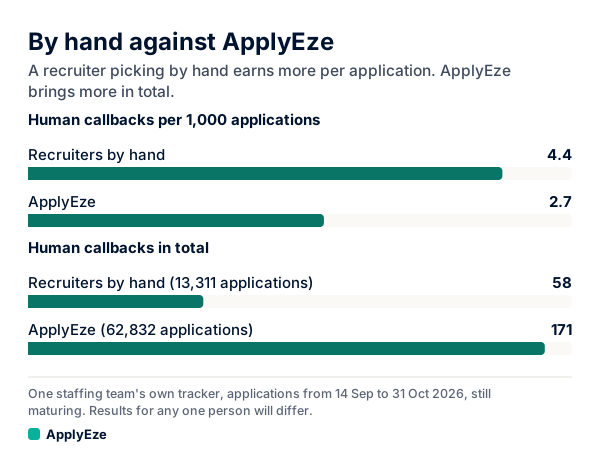
| Applied in | ApplyEze applications | Callbacks | Per 1,000 | By hand applications | Callbacks | Per 1,000 |
|---|---|---|---|---|---|---|
| 14 to 30 Sep | 5,245 | 8 | 1.53 | 7,429 | 39 | 5.25 |
| 1 to 15 Oct | 17,619 | 35 | 1.99 | 3,844 | 12 | 3.12 |
| 16 to 31 Oct | 39,968 | 128 | 3.20 | 2,038 | 7 | 3.43 |
| Whole window | 62,832 | 171 | 2.72 | 13,311 | 58 | 4.36 |
Across the whole window a recruiter picking by hand earned more callbacks per application: 4.4 against 2.7 per 1,000, an edge of 1.6 times (our arithmetic). This is one team and its own recruiters, not any service named on this page, and results for any one person will differ. ApplyEze brought about three times as many callbacks in total, 171 against 58. The gap narrowed as the fall went on, and in the last two weeks of October the rates were close, 3.2 against 3.4, though the by-hand figure there rests on 7 callbacks and October applications are still maturing.
These numbers come from a staffing team set up with ApplyEze, so they are not a free user's result. The team product, ApplyEze Autopilot, adds the part a recruiter does. An AI review reads each shortlisted role, and in the 14 days to 9 November 2026 it turned down about 4 of every 5. In a blind audit on 26 October 2026 of 193 applications, 84% of Autopilot's read as ones a recruiter would send, against 69% of those hand-picked. The sample is small, and it is a model's reading, not a recruiter's.
Autopilot is set up today for staffing and recruiting teams that work with ApplyEze. If you are job hunting on your own, you can start with 50 free applications on sign-up, no card needed. You pick the matches and queue them in the desktop app, and ApplyEze fills and submits each form.
What volume earned, measured
Read the same table the other way. ApplyEze sent about 4.7 times the applications and brought about three times the callbacks, 171 against 58. A lower rate, and a higher total.
The same team's month by month record shows what that volume did. Human callbacks per candidate per month rose from about 2 in spring to 7 for October applications, with volume more than tripled and the callback rate per 1,000 applications holding near 3. Part of that rise is better counting, it is one team, and results for any one person will differ. In all, 94,207 applications have gone through ApplyEze since 14 August 2026, to 9,769 employers, as of 9 November 2026.
An outside data set has the same shape, though not the same numbers. Huntr compared the same 4,456 job seekers across their own weeks. At three or more times their usual pace, their interview rate fell from 9.5% to 5.6%, and their interviews per month rose from 0.7 to 2.9. The definitions and the people differ, and their busiest weeks averaged 17.5 applications, so do not set those rates beside ours. Huntr also says its patterns do not prove cause.
Neither route is a sure thing. In the same report, of 68 people who had used a tool that sends applications for them, 33 saw about the same number of interviews as when applying themselves, 6 more, 17 fewer and 12 were not sure, a small, self-selected sample from a company that sells resume tools. A person is no shield against silence either: Trustpilot reviewers of Scale.jobs (September 2026) and Careerify (October 2026) describe long runs with no calls.
Where the arithmetic stops
If callbacks per dollar were the whole question, this would be short. A person's measured edge is 1.6 times per application. Scale.jobs costs about 22 to 30 times 2.7 cents, and Careerify about 89 to 111 times. Even at 50 applications a month, Careerify's $3.00 is about 8 times the 38 cents. On those numbers a person does not pay for itself on price per callback. That sets one team's measured edge beside list prices, so read it as arithmetic and not as a forecast.
That sum answers the wrong question in three cases.
When roles are scarce. Take two samples, invented for illustration. A staff accountant in a large metro might see 300 fitting postings a month. A VP of supply chain who will not relocate might see 15. The accountant can trade rate for total. The VP cannot, because there are no more applications to send, so a higher rate per application can be worth a large price gap.
When software cannot reach the form. ApplyEze applies automatically on systems holding roughly 62% of the active jobs we track, with an application inbox connected. For the rest, a person can open anything with a browser, and Scale.jobs claims "any ATS, any portal, any form", though that is its claim, not a test.
When the work is not applications. A full-service firm sells outreach, coaching and negotiation, none of which is in a per-application figure. What humans do better has the detail. The money is real, though: four months on the flat fee is $12,000.
Who should pick which
| Monthly budget | Seniority and market | Sensible pick | What you give up |
|---|---|---|---|
| $0 | Any | By hand, plus a free start such as ApplyEze's 50 or Tsenta's 25, both once, both no card | Your hours |
| About $20 | Early or mid career, plenty of postings | Software | A person's read of each role |
| About $50 | Any, and you already know which jobs you want | Apply4Me, where you choose and a person fills | Volume over 50, and a resume per posting |
| $150 to $720 | Mid career, narrow field, or fit that takes judgement, such as sponsorship | A recruiter who checks each role, such as Careerify | Resume per posting, and most of your volume |
| $399 to $999, once | You want people submitting and proof of each one | Scale.jobs | The money up front. See Scale.jobs vs ApplyEze |
| $1,500 and up | Manager to executive, six-figure target | Full service | Thousands of dollars, with no result assured |
Seniority here is not our guess. Find My Profession says most of its clients are managers through C-suite leaders pursuing six-figure roles. Its FAQ also says no legitimate company can promise you a job. Its own promise, five qualifying interviews or an accepted offer in four months or the team keeps working free, applies to eligible clients who meet participation rules. It extends the service, and it is not a refund.
Before paying any provider, human or software, ask: who picks the roles, and can I see the first week's list? Which resume goes out: one per posting, one per job type, or one for everything? Which email address does the employer see, and who else can read it? What proof do I get for each application? What are the refund terms, in writing?
Doing both
Plenty of people should. Software takes the wide list, and your hours, or a hired person's, go to the short list and to reaching people. Three rules keep it clean.
- Split by employer. Give the person one list of companies and the software another. Employers can limit repeat applications, and Ashby's tool can "automatically block excessive applications", so two senders on one posting can hurt you.
- Use one email everywhere. Apply4Me uses your account email "whenever possible", but may assign a "pass-through" address its team can also view. Know where replies will land.
- Read what each sends. Zapier's Bonnie Dilber told CNBC that "if they misrepresent your experience," you might just end up spending a lot of money without results. The same goes for software.
A small test tells you more than a sales page, and software is the cheap half to test.
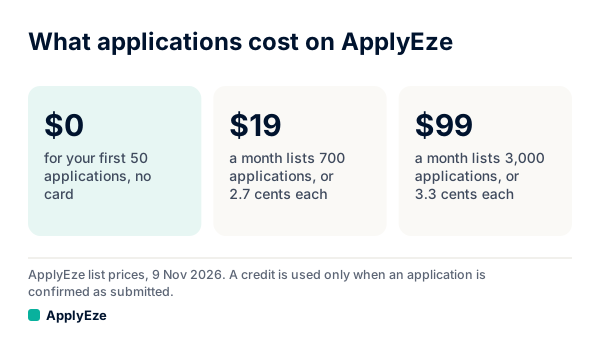
As the chart shows, plans are listed at $19 a month for 700 and $99 a month for 3,000, with a resume built for each posting in that price. Tsenta lists more for $99, 4,500, and has a $39 plan we do not. On ApplyEze's free path you queue the roles you pick, and applications run on your computer while the app is open, so keep it on and awake until your queue finishes. Workday and Oracle jobs stay hidden until you connect an application inbox, because those sites email a code.
Two things to read on what goes out. Hard facts come from your profile. When a required question is not covered by your saved answers, ApplyEze still fills it rather than stopping the run, so that answer may not come from you. Fill in your saved answers, use dry run first, and read your receipts. ApplyEze also brings the posting's named skills and tools onto your skills line, even when your own record does not list them. There is no step to remove one before a live run, so use a dry run to see what it writes, and be ready to discuss anything on the page.
Software will not call a hiring manager, coach you for an interview or negotiate your offer, and if those are the gaps in your search, a good person is worth paying for. If your gap is hours, start with the test that costs nothing: your first 50 applications are free, once per email address, no card, and a credit is used only when an application is confirmed as Submitted.