

Scale Jobs vs ApplyEze is a choice between paying people and paying software. Scale.jobs is ahead on what people do well: its assistants can fill any form on any portal, a person is involved in choosing the role, you have nothing to run, and you get a proof screenshot for every single application. ApplyEze's ground is price, by a wide margin: a listed 2.7 to 3.3 cents an application against 60 to 80 cents. At one staffing team, recruiters picking by hand earned 4.4 callbacks per 1,000 applications against ApplyEze's 2.7, and those were that team's recruiters, not this service. ApplyEze brought about three times as many callbacks in total, and the gap narrowed through the fall.
We make ApplyEze, a competing product, and Scale.jobs' pricing page labels AI auto-apply "Snake Oil" in its comparison table, so neither of us is neutral. We will answer with counts. Its facts below come from that page and its homepage, read on 9 November 2026. For the service on its own, see our Scale.jobs review.
What a person can do
The argument for a human service is mostly about things software cannot reach or cannot judge.
Any form. Scale.jobs says "Human assistants apply anywhere you can: any ATS, any portal, any form." We have not tested that, but nothing about it is implausible, since a person can use anything a browser can show. ApplyEze's reach is a named list of 12 systems on a self-serve account. Of the about 900,000 active jobs we track, roughly 38% have no automatic path for it. For those roles, a person is the route that reaches them.
Choosing the role. Each plan lists "A recruiter-matched role". The homepage says something different: "Handpick & delegate your favorite jobs in a single click." Ask which it is, because the two are different services. On a self-serve ApplyEze account you pick from a board ranked by rules on your target titles and each posting's requirements, so you carry that judgment yourself.
Nothing to run. You hand the work over. A self-serve ApplyEze account runs on your computer: "Applications run on your computer while the app is open, so keep it on and awake until your queue finishes."
Someone to talk to. Scale.jobs lists an outcome manager and team chat. On ApplyEze you have a receipt and an email address.
People also make mistakes, and a person in the loop does not by itself mean care. Scale.jobs holds 4.5 from 251 reviews on Trustpilot, which is strong. Its recent critical reviews report weak documents the reviewer took to be AI-edited, errors they had to keep checking, and no callbacks after more than 1,000 applications. A customer quote on its homepage praises "Their AI-enabled workflow for customizing resumes and cover letters", so software is part of this service too. ApplyEze has no public reviews.
What our data says about people and software
We measured this at one staffing team using ApplyEze, for applications from 14 September to 31 October 2026.
| By hand | ApplyEze | |
|---|---|---|
| Applications | 13,311 | 62,832 |
| Human callbacks | 58 | 171 |
| Per 1,000 applications | 4.36 | 2.72 |
A human callback is a screening call, an interview or an offer. Across the whole window a recruiter picking by hand earned more callbacks per application, 4.4 against 2.7 per 1,000. ApplyEze brought about three times as many in total, 171 against 58.
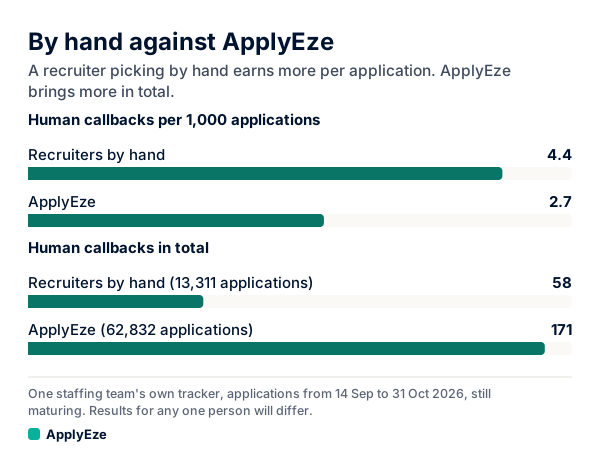
In the last two weeks of October the rates were close, 3.2 against 3.4, though the by-hand figure rests on 7 callbacks and October applications are still maturing. ApplyEze's own rate rose from 1.5 to 3.2 per 1,000 through the fall. So a person earned more per application across the window, ApplyEze brought about three times as many callbacks, and the gap narrowed. How the counts were cleaned is in hand picked vs automated applications.
Volume did not cost that team its rate. Human callbacks per candidate per month rose from about 2 in spring to 7 for October applications, while applications more than tripled and the rate per 1,000 held near 3. Part of the rise is better counting, it is one team, and results for any one person will differ.
Choosing the role is where a person should win, so that is measured too. ApplyEze Autopilot's AI judge turned down about 4 of every 5 shortlisted roles in the two weeks to 9 November 2026, and over the last 7 days it reached a verdict in a median of 4.9 minutes. In a blind audit on 26 October 2026 of 193 applications, asking "would a recruiter have sent this?", 84% of Autopilot applications passed against 69% hand-picked by recruiters. The sample is small, and it is a model's reading, not a recruiter's.
Three notes on what this tells you about Scale.jobs:
- These were not its assistants. "By hand" here means one team's own recruiters, who know their candidates, choosing roles and applying themselves. Scale.jobs' assistants may do better or worse.
- It publishes no rate we can check. A Scale.jobs blog post from March 2026 claims a callback rate of 25% to 47% for human assistants against around 2% for automated tools, from its own case study of 200 jobs. It gives no callback counts or dates, and no test behind the 2%. Treat that as a vendor claim. Its definition is also unknown, so do not set it beside the per-1,000 figures above.
- These are team numbers, not a free user's. They come from a staffing team's setup, and part of them from ApplyEze Autopilot. We publish no callback rate for self-serve accounts. Autopilot is set up today for staffing and recruiting teams that work with ApplyEze. If you are job hunting on your own, you can start with 50 free applications on sign-up, no card needed. You pick the matches and queue them in the desktop app, and ApplyEze fills and submits each form.
The price math, including the $999 tier
As of November 2026, in US dollars:
| Plan | Price | Applications | What the page prints | Price divided by applications |
|---|---|---|---|---|
| Scale.jobs Standard | $399 once | 500 | $0.80 | 80 cents |
| Scale.jobs Accelerator | $599 once | 1,000 | $0.60 | 60 cents |
| Scale.jobs Ultimate | $999 once | 1,500 | $0.40 | 67 cents |
The odd row is the last one. $999 for 1,500 is 67 cents, and the page prints 40. Ultimate includes Expert Resume Writing and a LinkedIn Makeover, each $199 on the lower plans. Take that $398 off and you get about 40 cents, which is our inference about the printed number. If you would buy both add-ons anyway, 40 is fair. If not, use 67. Scale.jobs blog posts we read also still show older prices such as $199 and $1,099, so trust the pricing page.
ApplyEze lists $0 for the first 50 applications with no card, $19 a month for 700 (2.7 cents each) and $99 a month for 3,000 (3.3 cents each).
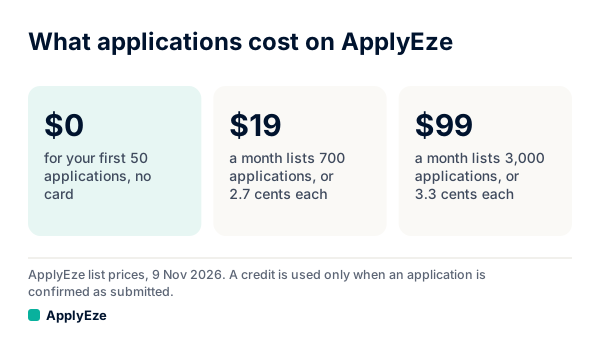
Listed prices assume full use. Scale.jobs is one payment with no clock. On ApplyEze, unused plan credits end with the month. Even sending 500 applications slowly over five months, ApplyEze costs $95, or 19 cents each, against Scale.jobs' $399, about a quarter of the bill.
Here is the number we think matters. The price gap is 18 to 30 times per application. The lowest Scale.jobs rate over ApplyEze's highest is 60 divided by 3.3. The highest over the lowest is 80 divided by 2.7. So on cost per callback alone, a person would need to earn 18 to 30 times the callbacks per application to match software. At that one team, recruiters earned about 1.6 times (4.36 divided by 2.72). That is not a measure of Scale.jobs, and it is not a forecast for you, but the distance between 1.6 and 18 is wide.
Four things can still justify paying for a person:
- Reach. Where software has no path, its cost per callback does not exist.
- Scarcity. If only a couple of hundred roles a quarter truly fit you, you cannot buy more of them. Each one's odds then matter more than its price.
- Stakes. A role you would hate to miss deserves your own hours and a search for a referral, whichever service you use.
- Your hours. Software that needs you to pick, queue and read still takes your time. For some people $399 is a fair price to stop doing that.
The refund changes the sums too. A founder reply on the homepage describes a pro-rated refund "with a one-time $100 onboarding fee", and the pricing page says leftover credits are refunded. The formula is not published. As a sample reading, stop Standard after 200 applications: 300 unused at 80 cents is $240, minus $100 is $140 back, so you paid $259 for 200, or about $1.30 each. Ask for the real formula in writing. ApplyEze has no published refund policy. "For anything else, a refund included, email hello@applyeze.com and we will sort it out."
Proof of each application
Scale.jobs is ahead. It promises "a proof screenshot for every single application". ApplyEze leaves a receipt for every run: the result, the time taken, screenshots where taken and the documents sent. On the billing side, "A credit is used only when an application is confirmed as Submitted", and "If a site never confirms, no credit is used, and ApplyEze will not apply there again by accident."
A screenshot of a confirmation page proves the application went in. It does not show that the answers were right, unless the screenshot shows the answers. Ask to see a sample before you pay.
On ApplyEze, hard facts come from your profile. When a required question is not covered by your saved answers, ApplyEze still fills it rather than stopping the run, so that answer may not come from you. Fill in your saved answers, use dry run first, and read your receipts. On the resume, both services write one per posting. Scale.jobs includes "An ATS-tailored resume" and a personalized cover letter in every plan. ApplyEze writes a cover letter when the form asks. Your employers, job titles, dates, schools, degrees and certifications come from your own record, and in an audit on 4 November 2026 of 84 sampled resumes we found 0 invented employers, dates, degrees or numbers. ApplyEze brings the posting's named skills and tools onto your skills line, even when your own record does not list them. There is no step to remove one before a live run, so use a dry run to see what it writes, and be ready to discuss anything on the page.
Seven questions for any human service
Copy these into an email before you pay. They apply to Scale.jobs and to any reverse recruiter, and some apply to us.
- Who chooses each role: me, or someone at your company? Can I veto one?
- Is my resume edited by a person, a model or both? Can I see one before it goes out?
- Can I see three real proof screenshots, showing the filled form as well as the confirmation?
- Where do verification emails and one-time codes go, and who holds the logins for sites that need an account?
- What happens when a form asks something I have not told you?
- What is the exact refund formula, with a worked example?
- What callback rate do you measure, per how many applications, and how do you count a callback?
Scale.jobs' founder says associates are based in India, as full-time staff and vetted gig workers, and that this is how the service prices at around $4 an hour. That is a plain explanation of the price, and worth knowing before you hand over your work history. Some employers ask applicants not to use AI or automation. Whether to apply there is your call, with a service or with software.
Who should pick which
| If this is you | Lean toward | Why |
|---|---|---|
| Your employers use systems outside ApplyEze's 12 | Scale.jobs | A person can reach them |
| You cannot keep a computer on, or will not read anything | Scale.jobs | Nothing to run |
| You want a screenshot for each application | Scale.jobs | It promises one |
| You would pay $399 to $999 to stop doing this | Scale.jobs | That is what it sells |
| You want a resume per posting for far less money and will choose roles yourself | ApplyEze | 2.7 to 3.3 cents listed, 50 free to start |
| You want more volume than Scale.jobs' largest pack of 1,500 | ApplyEze | $99 a month covers 3,000 |
| You want to see real output before paying | ApplyEze | Free credits and a dry run |
They are not the only two routes. Auto apply vs reverse recruiter compares the two categories, and doing both is reasonable: by hand or through a person for the roles you care about most, and software for the rest.
94,207 applications have gone through ApplyEze since 14 August 2026, to 9,769 employers, as of 9 November 2026. At 2.7 to 3.3 cents listed against 60 to 80, you can test the case for software before spending anything: your first 50 applications are free, once per email address and with no card.