

Many certified nursing assistant resume examples open with a summary about compassion. Start with your registry line instead, because that is what the law makes an employer check. Under federal rules for nursing homes, a facility "must receive registry verification" before you serve as a nurse aide, and it must seek information from every state registry it believes may hold information on you. Below are the registry lines to copy and three labelled samples for long-term care, hospital and home health, along with a way to write a first CNA resume from a training program alone.
What employers check first
Before anyone reads your bullets, four things decide whether you are employable there:
- Are you on the registry, in good standing? The Bureau of Labor Statistics says passing the state exam places you on a registry, which is required to work in a nursing home. A registry must disclose your eligibility date and any finding of abuse, neglect or misappropriation to all requesters, and findings stay permanently unless made in error or you are found not guilty in court.
- Have you lapsed? The same federal rule says that after 24 consecutive months with no paid nursing or nursing-related work, you need a new training and competency program or a new competency evaluation.
- Can you work the hours? BLS notes that care runs around the clock, so nights, weekends and holidays come with the job.
- Is the setting a match? A hospital unit, a memory care floor and a client's home ask for different things, as the samples show.
The 24-month rule is worth doing the math on. If your last paid aide shift was March 2025, your
window closes in March 2027 (our arithmetic). When you have a gap, say where you stand, because
a recruiter is doing the same count: Last paid nurse aide work: March 2025.
Registry and certification lines
Copy this block and replace the placeholders:
CERTIFICATION
Certified Nursing Assistant, [State] Nurse Aide Registry, No. [number],
active, expires [MM/YYYY]
Also listed: [Second State] Nurse Aide Registry, active, expires [MM/YYYY]
BLS Provider, American Heart Association, expires [MM/YYYY]
List every state where you have been on the registry, since the facility has to look there anyway. Use the number on a resume you send directly to an employer, and leave it off anything posted publicly.
Use your state's own title, then add the common one so that a search finds you:
| State | What it calls the credential | Write |
|---|---|---|
| Ohio | State Tested Nurse Aide | State Tested Nurse Aide (STNA, CNA equivalent) |
| Maryland | CNA is the base. Geriatric Nursing Assistant (GNA) is required in licensed comprehensive care facilities | Both lines, if you hold both |
| Washington | Nursing Assistant Certified | Nursing Assistant Certified (NAC) |
One trap: in Maryland, CMA means Certified Medicine Aide, an add-on for GNAs. It is not the medical assistant credential of the same initials, so spell it out.
Then add proof that you are current. Federal rules require at least 12 hours of in-service training a year for nursing home aides, including dementia management and resident abuse prevention. States add to that. Florida asks for 24 hours each two-year cycle and paid nursing-related work in the last 24 months to stay on the registry. Texas expires a listing after 24 months unless Form 5506-NAR documents your paid work, and charges no renewal fee. Check who files that form at your job, because if the facility does not, the rule says it falls to you.
Sample: long-term care
Skilled nursing facilities employ 36% of nursing assistants, at a median of $43,000 in May 2025. These employers want load, resident type and reliability. This sample and those below are written for this post and are not a real person's resume:
[FIRST LAST], CNA
[City, State] | [phone] | [email]
Available: 12-hour nights, every other weekend, holidays as scheduled

CERTIFICATION
Certified Nursing Assistant, [State] Nurse Aide Registry, No. [number],
active, expires [MM/YYYY]
BLS Provider, American Heart Association, expires [MM/YYYY]

EXPERIENCE
Certified Nursing Assistant, 120-bed skilled nursing facility, [City]
[Month Year] to present
- Cared for 10 to 12 residents per shift on a 30-bed memory care wing
- Assisted with bathing, dressing, toileting, feeding and two-person transfers
- Charted ADLs, intake and output each shift in [PointClickCare or your system]
- Reported skin changes to the charge nurse, starting turn schedules with the team
- Completed 14 in-service hours in [Year], including dementia management and
  resident abuse prevention
Why it is built this way: availability sits in the header, since a scheduler reads it first. The ratio and the wing give a recruiter your real workload. The in-service line uses the same subjects as the federal rule, so it reads as proof of being current and not as filler.
Sample: hospital
Hospitals employ 32% of nursing assistants, at a median of $42,310. Search under other titles too, since hospitals may call this role patient care technician or nursing assistant. The resume shifts toward units, acuity and monitoring:
[FIRST LAST], CNA
[City, State] | [phone] | [email]
Available: 7p to 7a, weekends every third week

CERTIFICATION
Certified Nursing Assistant, [State] Nurse Aide Registry, No. [number],
active, expires [MM/YYYY]
BLS Provider, American Heart Association, expires [MM/YYYY]
Basic Arrhythmia Recognition course, [Provider], [Year]

EXPERIENCE
Patient Care Technician, 32-bed telemetry unit, [Hospital]
[Month Year] to present
- Supported 2 RNs with 8 to 10 patients per shift, including post-procedure care
- Took vitals, 12-lead EKGs and point-of-care glucose, and reported out-of-range
  values straight to the RN
- Answered telemetry alarms with the monitor tech and walked patients with fall
  precautions
- Charted in [Epic or your system] and ran bedside shift report with the oncoming tech
Why it is built this way: the unit and bed count replace the resident count, and the RN ratio shows how the unit staffs. List EKG or arrhythmia training only if you actually took it, and put the course name and year beside it.
Sample: home health
Home healthcare employs just 5% of nursing assistants, at a median of $38,040. It has its own federal rule. Home health aides need at least 75 hours of training or a qualifying nurse aide program with a listing "in good standing on the state nurse aide registry", at least 12 hours of in-service each 12-month period, and, for patients getting skilled care, a supervisory assessment at least every 14 days. Some states add their own credential, so check yours. What this employer needs to know is that you can work alone and turn up:
[FIRST LAST], CNA, Home Health Aide
[City, State] | [phone] | [email]
Available: weekdays 7a to 5p. Licensed driver with own car, 25-mile radius.

CERTIFICATION
Certified Nursing Assistant, [State] Nurse Aide Registry, No. [number],
active, expires [MM/YYYY]
BLS Provider, American Heart Association, expires [MM/YYYY]

EXPERIENCE
Home Health Aide, [Agency], [City]                   [Month Year] to present
- Visited 4 to 5 clients a day, working alone between RN supervisory visits
- Helped with personal care, meals and safe transfers, following each care plan
- Reported changes in condition to the supervising nurse the same day
- Logged visits and tasks in [agency app], with [12] in-service hours completed
  in [Year]
Why it is built this way: driving and radius are in the header because they decide whether a route works. The bullet about supervision shows you know how the role is structured, and the same-day reporting line is what a supervisor hopes to see.
Here are the settings side by side, using BLS figures for May 2025:
| Setting | Share of nursing assistant jobs | Median wage | What the resume leads with |
|---|---|---|---|
| Skilled nursing | 36% | $43,000 | Residents per shift, dementia and transfer experience, in-service hours |
| Hospitals | 32% | $42,310 | Unit, patient ratio, vitals and EKG |
| Assisted living and retirement | 11% | $39,490 | Resident independence, medication reminders where your state allows them |
| Home healthcare | 5% | $38,040 | Working alone, driving, reporting |
No experience yet: training hours
Your program is your experience, and its hours say more than you might expect. The federal floor is 75 clock hours, with at least 16 of supervised practical training. But PHI's state table says 30 states and the District of Columbia go beyond 75 hours, and 32 states and DC require more than 16 clinical hours. So the same word, "certified", stands for different training:
| State (per PHI) | Minimum training hours | Minimum clinical hours |
|---|---|---|
| Ohio | 75 | 16 |
| Washington | 85 | 50 |
| Texas | 100 | 40 |
| Florida | 120 | 40 |
| Maine | 180 | 70 |
For your first resume, turn your curriculum into skill lines. The federal content list is a good checklist, because it includes communication, infection control, safety and emergency procedures, personal care, care of cognitively impaired residents, basic restorative services and residents' rights. Only list what you were checked off on. Our guide to a resume skills section covers how to group them.
[FIRST LAST]
[City, State] | [phone] | [email]
Available: all shifts, including nights and weekends, from [Month Year]

CERTIFICATION
Certified Nursing Assistant, [State] Nurse Aide Registry, No. [number],
active, expires [MM/YYYY]
BLS Provider, American Heart Association, expires [MM/YYYY]

TRAINING
Nurse Aide Training Program, [College], [Month Year]
[60] classroom hours, [40] supervised clinical hours at [Facility]
- Checked off on bathing, dressing, feeding, transfers with gait belt, range of
  motion, vital signs, and intake and output
- Supervised clinical: assisted [4 to 6] residents a shift on a long-term care unit
- Coursework: infection control, dementia care, residents' rights

OTHER EXPERIENCE
Caregiver for a family member, [Year] to [Year]
- Managed daily mobility, meals and medication reminders
Cashier, [Store], [Year] to [Year]
- Trusted with opening shifts; never missed a scheduled shift in 18 months
If you are still in training, you can still apply. The federal rule allows a nursing home to use someone in a state-approved
program, within limits including a four-month cap on full-time work for an
aide who is not yet competency-evaluated. Write it plainly: In state-approved nurse aide training, [College]. Exam scheduled [Month Year].
Do not write CNA until your name is on the registry. For more on building a first page, see our
nursing resume guide if you are heading toward an RN license later.
Shifts, location and forms
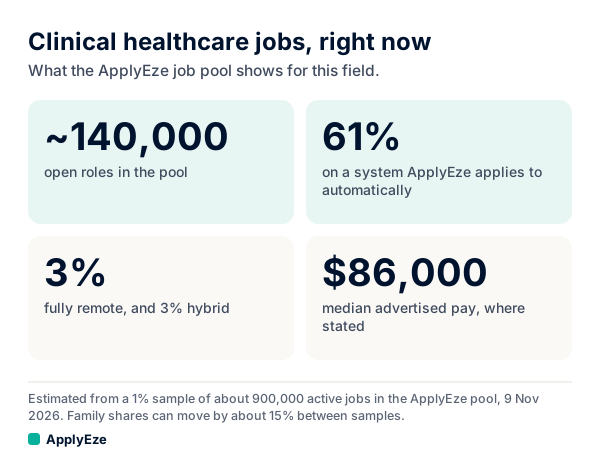
Clinical healthcare is the largest field we track, at roughly 140,000 open roles in a 1% sample of about 900,000 active jobs on 9 November 2026 (counts can move by about 15% between samples). Roughly 3% are fully remote, and for a CNA that share is effectively zero: you work where the residents are. So shift and commute do most of the filtering. The $86,000 median in the chart covers all clinical roles that state pay, including nurses and clinicians. For this job, use BLS's $42,260. BLS also projects about 203,300 openings a year across nursing assistants and orderlies, many of them to replace people who leave.
The form then asks for what your resume already says: registry state and number, status, availability, BLS, and consent to a background check. Keep those details in one place, and use the same wording each time. Our medical assistant resume guide covers the neighboring credential if you are weighing that route.
Because these fields repeat, this job suits a queue, and a queue is what ApplyEze runs. It polls more than 100,000 employer boards directly, and roughly 61% of clinical roles in our sample sit on a system it applies to. That share includes Workday and Oracle jobs, which stay hidden until you connect an application inbox, because those sites email a code. You choose matches from a board ranked on your target titles, so list nursing assistant, CNA, patient care technician and any state title that applies, and queue them in the desktop app with your computer on and awake.
For each application, an AI model reads that posting and your real history and writes a resume for it. Your employers, job titles, dates, schools, degrees and certifications come from your own record, and a certification the posting asks for is not added unless you hold it. ApplyEze brings the posting's named skills and tools onto your skills line, even when your own record does not list them. There is no step to remove one before a live run, so use a dry run to see what it writes, and be ready to discuss anything on the page. Hard facts come from your profile. When a required question is not covered by your saved answers, ApplyEze still fills it rather than stopping the run, so that answer may not come from you. Fill in your saved answers, use dry run first, and read your receipts.
Your next step is the registry block. Copy it, fill in your real dates, and check them against the 24-month rule. If you would rather spend your days off resting than retyping your registry number, your first 50 applications are free, with no card, and a credit is used only when an application is confirmed as Submitted.