
A medical assistant resume wins or loses on one line near the top: your credential, spelled out with its issuer and date. "CMA" alone is not enough, since several bodies certify medical assistants under similar names. After that, show which side of the clinic you work on, front office or back office, and name the EHR you have actually used. This post decodes the credentials employers name, gives you lines to copy, and ends with three labelled samples, including one with no paid experience.
The credential line
The Bureau of Labor Statistics says that most states do not require certification, but employers may prefer or require it. So this line often decides whether a practice calls you, and it needs to be exact. Here are three names you will run into:
| Credential | Issuer | How you qualify | How it stays current | Write it as |
|---|---|---|---|---|
| CMA (AAMA) | American Association of Medical Assistants | Graduates of CAAHEP or ABHES accredited programs are eligible | Every 60 months | CMA (AAMA), current through [MM/YYYY] |
| RMA | American Medical Technologists | Five routes: education, work-based learning, work experience, military, instructor | Annual fee and points on a 3-year cycle | RMA (AMT), certified [Year], active |
| CCMA | National Healthcareer Association | A training program within 5 years, or supervised work experience | Every 2 years, with 10 continuing education credits | CCMA (NHA), expires [MM/YYYY] |
Three things are worth knowing that a template will not tell you.
The names collide. Washington's list of recognized exams includes clinical medical assistant exams from both NHA and the American Medical Certification Association, plus a separate national exam from NCCT. In Maryland's nursing assistant categories, "CMA" means Certified Medicine Aide, which has nothing to do with your credential. So write the issuer every time.
An expired credential comes off the page. AAMA is blunt:
"Current status is required to use the CMA (AAMA) credential." It says that
if your credential expires, you cannot use the initialism until you recertify. If yours has lapsed, say so in words:
AAMA certification lapsed [MM/YYYY]. Recertification exam scheduled [Month Year].
Outside certification has had a specific meaning. A 2020 CMS specification for a Medicaid EHR program counted orders directly entered by a licensed professional or a "credentialed medical assistant", per state, local and professional guidelines. It added that credentialing "must come from an organization other than the organization employing the medical assistant." AAMA's order entry page says it continues to recommend credentialed medical assistants for those orders. That spec is old, so treat it as background and not a current rule for your clinic. But an in-house training certificate is not the same thing, and you should not list one as if it were.
State rules can sit on top. Washington's health department lists recognized exams for its medical assistant-certified credential, so a national card alone may not be the whole story there. Check your state before you write "certified".
Front office against back office
BLS says medical assistants often focus on clinical or administrative tasks, although some do both. Postings use "back office" and "front office" for the same split, so say which you do. A resume that mixes the two without saying so reads as if you have done neither in depth.
Specialty changes what proves competence. These lines are samples written for this post, with invented figures. Use only tasks you did and your state allows:
| Setting | Back-office line | Front-office line |
|---|---|---|
| Family medicine | Roomed 22 to 25 patients a day, took vitals and histories, gave injections per provider order | Verified insurance and collected copays at check-in |
| Pediatrics | Gave vaccines per CDC schedule with parent consent, plotted growth charts | Scheduled well-child visits and sent recall reminders |
| Cardiology | Ran 12-lead EKGs and fitted Holter monitors, and prepared stress test rooms | Obtained prior authorizations for imaging |
| Dermatology | Set up biopsy trays, labelled specimens, assisted with excisions | Coordinated pathology results follow-up calls |
| Orthopedics | Removed sutures and fitted splints under provider direction | Managed work notes and referral paperwork |
Note the counts. A rooming number tells a practice manager whether you can keep up, so write down your daily patient count while you still work there.
Naming EHR systems
Treat your EHR as a hard skill. NHA lists updating electronic health records among core duties, and this market is split. Definitive Healthcare's ambulatory figures, accessed October 2025, put Epic at 19.5% of installs, eClinicalWorks at 11.9%, athenahealth at 6.9%, Oracle Cerner at 5.4% and NextGen at 4.2%. Those five add up to 47.9% (our arithmetic), so more than half of ambulatory installs in that data are on something else. It is proprietary data, and it counts installs rather than clinics or users, so read it as a sense of the spread. With 56% of medical assistants in physician offices, a practice manager cannot assume what you know.
A format that works:
EHR: Epic (rooming, pending orders for provider signature, in-basket messages);
eClinicalWorks (vitals, immunization records, referrals)
Write the exact product name, because that is the string a recruiter searches for. Our guide to resume keywords covers matching a posting without overclaiming. If a posting names a system you have not used, list what you have, and say how quickly you learned the last one if you can back that up.
Sample: certified, experienced
This sample and the two below are written for this post, with placeholder names and figures. None is a real person's resume.
[FIRST LAST], CMA (AAMA)
[City, State] | [phone] | [email]

CREDENTIALS
CMA (AAMA), American Association of Medical Assistants, current through [MM/YYYY]
BLS Provider, American Heart Association, expires [MM/YYYY]

EXPERIENCE
Lead Medical Assistant, 6-provider family medicine practice, [City]
[Month Year] to present
- Roomed 22 to 25 patients a day and supported 2 providers across a 40-hour week
- Gave IM and subcutaneous injections per order, drew blood, ran CLIA-waived tests
- Reconciled medications and pended refills in Epic for provider signature
- Trained 3 new MAs on rooming standards and vaccine storage logs

Medical Assistant, urgent care, [City]               [Month Year] to [Month Year]
- Ran EKGs, splinted minor injuries under provider direction, covered front desk
  on Saturdays

EDUCATION
Medical Assisting Diploma, [CAAHEP accredited program], [Year]
Why it is built this way: the credential appears in the header and again with its issuer and date, so nobody has to look for it. The patient count sets the pace. The vaccine log detail is small, but it shows you can be trusted with something an inspection would check.
Sample: new graduate with an externship
No paid experience here, and the page says so plainly. If you have not taken the exam yet, write it as shown and do not list the letters. For more on building a page with no jobs on it, see our resume for your first job guide.
[FIRST LAST]
[City, State] | [phone] | [email]
New medical assisting graduate seeking a clinical or mixed role. Available
weekdays and Saturdays.

CREDENTIALS
CCMA (NHA) exam scheduled [Month Year]
BLS Provider, American Heart Association, expires [MM/YYYY]

EDUCATION
Medical Assistant Certificate, [College], [Month Year]

EXTERNSHIP
Medical Assistant Extern, internal medicine clinic, [City], 160 hours, [Term Year]
- Roomed 12 to 15 patients a day by week 4, under a lead MA
- Took vitals, performed EKGs, and did venipuncture on [40] patients, per log
- Entered vitals and histories in athenahealth with student access

OTHER EXPERIENCE
Pharmacy Clerk, [Store], [Year] to [Year]
- Handled insurance questions and refill requests for about 80 customers a day
Why it is built this way: the externship sits where a job would and carries hours and counts. The pharmacy job is a fair front-office argument, since it involved insurance and privacy. Check the hours against your program's record, since an employer may ask for them.
Sample: switching specialties
This one has a different problem: the experience is real but aimed elsewhere. The fix is to lead with the skills that carry over, and to be plain about what is new.
[FIRST LAST], RMA (AMT)
[City, State] | [phone] | [email]
Medical assistant with 5 years in pediatrics, moving to adult cardiology. Strong
in EKGs, patient education and high-volume rooming. Completed [12-lead EKG
course, Provider, Year].

CREDENTIALS
RMA (AMT), American Medical Technologists, certified [Year], active
BLS Provider, American Heart Association, expires [MM/YYYY]

EXPERIENCE
Medical Assistant, 8-provider pediatric group, [City]    [Month Year] to present
- Roomed 25 to 30 patients a day, ran EKGs for sports physicals and referrals
- Taught families how to use inhalers, nebulizers and glucose meters
- Maintained immunization records in NextGen and handled state registry reports
Why it is built this way: the summary names the destination and the bridge course up front. EKG goes first because that is the part a cardiology office is hiring for. Patient teaching carries over, whether the patient is a parent or a retiree.
How these jobs get applied to
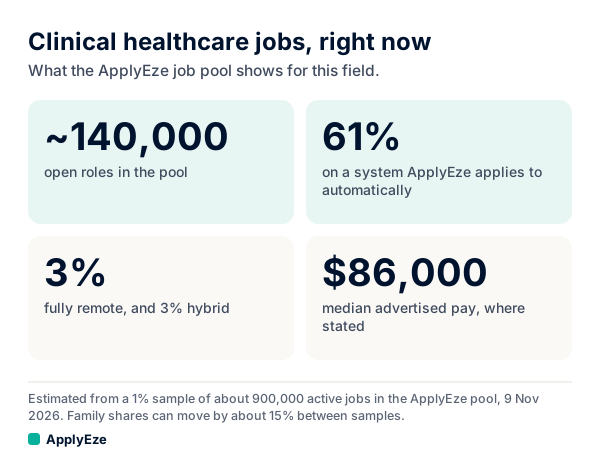
Medical assisting sits inside clinical healthcare, which our job pool puts at roughly 140,000 open roles, from a 1% sample of about 900,000 active jobs on 9 November 2026 (counts can move by about 15% between samples). Roughly 3% of those are fully remote, and a medical assistant's work happens in the building, with patients. So your commute radius sets your list before your resume does.
The chart's $86,000 median covers every clinical role that states pay, including nurses and clinicians. For this job, use BLS: a median of $45,690 in May 2025, with outpatient care centers at $48,560, hospitals at $46,910, physician offices at $45,520 and other health practitioners' offices at $38,400. BLS projects 13% growth from 2025 to 2035, so this is a field with real demand.
How you apply depends on who is hiring. A hospital system or a large group is likely to use a standard application with a credential field and a certification upload. A single-provider office may only have a posting and an email address, in which case your resume is the whole application. If you send one by email, put the credential in the subject line.
Large groups are where ApplyEze saves the most repetition. It polls more than 100,000 employer boards directly, and roughly 61% of clinical roles in our sample sit on a system it applies to. That share includes Workday and Oracle jobs, which stay hidden until you connect an application inbox, because those sites email a code. You pick from a board ranked on your target titles, so add medical assistant, clinical medical assistant, certified medical assistant and any specialty you want, and the desktop app runs your queue while your computer is on and awake. That one-provider office still gets an email from you.
For each application, an AI model reads that posting and your real history and writes a resume for it. Code rejects a rewrite that adds a figure, employer, school or credential your record does not hold, and "a certification the posting asks for is not added unless you hold it", so it will not hand you a CMA. ApplyEze brings the posting's named skills and tools onto your skills line, even when your own record does not list them. There is no step to remove one before a live run, so use a dry run to see what it writes, and be ready to discuss anything on the page. Hard facts come from your profile. When a required question is not covered by your saved answers, ApplyEze still fills it rather than stopping the run, so that answer may not come from you. Fill in your saved answers, use dry run first, and read your receipts.
Your next step is the credential line. Write it with its issuer and date, then add your EHR line beneath it. Our CNA resume guide covers the neighboring role if you are weighing it. If you would rather spend your lunch break on anything but another application form, your first 50 applications are free, with no card, and ApplyEze builds a resume for each posting.