

A good construction management resume example is built around one line: project type, dollar value, your role and how the job finished. The reader is asking whether you have run work like theirs, at their size, and they want the answer in the time it takes to scan a page. Below is that line, three labelled samples for an assistant project manager, a project manager and a superintendent, and a way to list projects without repeating a page of duties. Most guides tell you to add the contract value. This one also deals with the harder question: which value, and how much of it was yours.
The project line
Here is the pattern, followed by a sample written for this post.
[Value] [type and size], [delivery method]. [Your role]. [The result that a project executive would check].
$48M, 212-unit wood-over-podium multifamily, CM at risk. Project Manager from preconstruction through closeout. Substantial completion 9 days ahead of the contract date, $310K under budget.
Each part does a specific job. Value tells the reader your scale. Type tells them whether your experience transfers, since a hospital builder reads a tilt-wall warehouse differently from a clinic. Delivery method tells them which side of the risk you sat on. Role tells them what you were actually responsible for.
How to stop repeating your duties
The usual construction resume spends a page saying the same thing about every job: managed subcontractors, ran meetings, processed RFIs and submittals, maintained safety. Everyone in the role does those things. Say them once, then let the projects carry the page.
Before (sample, written for this post):
Project Manager, regional general contractor, 2019 to present
- Managed all phases of commercial construction projects from start to finish
- Coordinated subcontractors, architects and owners
- Processed RFIs, submittals, and change orders
- Maintained budgets and schedules
- Ensured compliance with safety requirements
After:
Project Manager, regional general contractor, 2019 to present. Ground-up commercial work from $20M to $62M, in charge from buyout through closeout.
- $62M, 5-story outpatient medical office, GMP. Finished $340K under the GMP and 9 days ahead of the contract date, with 38 subcontractors.
- $31M, 3-story lab fit-out in an occupied building, negotiated. Held the owner's phasing with no unplanned shutdowns. Approved 126 change orders worth $2.9M before the work started.
- $24M, K-8 school addition, CM at risk. Turned over 3 weeks before the start of the school year.
- Also: four tenant improvements from $1M to $6M.
That is less text with more evidence. The opening sentence covers your duties once. The last line accounts for smaller work without giving it space. Keep a separate one-page list of every project (value, type, delivery method, owner, dates, your role) for interviews and for forms that take an attachment.
Dollar value, type and your role
"$48M project" can mean several different things, and a reader who has run a $48M job will ask which one.
| Which value | When to use it | How to write it |
|---|---|---|
| Contract at award | You left before closeout, or changes were large | $45.6M at award |
| Final contract | You ran it to the end | $48.0M final ($45.6M award plus $2.4M in owner changes) |
| Your scope | You ran part of the job | $11.2M of buyout on a $48M job |
| Program total | Owner's rep or CM agency work | $120M school bond program, 9 projects |
| A range | The client or value is confidential | $40M to $50M life sciences facility, confidential client |
The rule that keeps you honest is that the value goes with the role. Here is the same sample job written at three levels.
| Your real role | Inflated | Defensible |
|---|---|---|
| Assistant PM, owned MEP and envelope buyout | Managed $48M multifamily project | APM on a $48M multifamily job; owned $11.2M of MEP and envelope buyout |
| Superintendent for the structure phase only | Superintendent, $48M project | Superintendent for podium and wood framing on a $48M job, 7 months |
| Project engineer | Delivered $48M project | Project engineer on a $48M job; ran 640 RFIs and 1,150 submittals |
Hiring managers in this field often know each other, and some of them will call. Your line has to match what your old project executive would say.
Safety and schedule lines
Before a safety number goes on your resume, ask whose number it is.
TRIR is the one you can own at project level. The BLS formula is recordable cases × 200,000 ÷ hours worked, where 200,000 stands for 100 employees working 40 hours a week for 50 weeks. Sample math: 1 recordable in 310,000 hours is 0.65, and 2 recordables in 612,000 hours is also about 0.65. A reader can check that, so it has to be right. Say whether the hours include subcontractors, because that changes the figure, and check the job's OSHA log first.
EMR is usually not yours. An experience mod compares a company's actual workers' compensation claims with the expected costs for similar firms. It uses a three-year rolling window and is calculated by NCCI or a state rating bureau, with 1.0 as the industry average. A superintendent does not earn a company's 0.78. If you ran the safety program, you can write it as context: "Safety lead during a period when the firm's EMR fell from 1.04 to 0.82". Otherwise, leave it out.
Zero is a real claim, so treat it as one. "0 recordables over 88,000 work hours" is strong if the log agrees, and "perfect safety record" is weak because nobody can check it.
Schedule lines need a baseline. "Finished ahead of schedule" could mean anything once the date has moved. Write it against the contract date, and be upfront about extensions:
Reached substantial completion 9 days ahead of the contract date, after 21 days of approved owner extensions.
That line reads better than a bare "on time", because it tells the reader you know the difference. When you recovered time, give both numbers: "Recovered 16 of 23 days lost to a late steel delivery by resequencing trades". For cost, name the reference: under the GMP, under the buyout budget, or against the original estimate.
Sample: assistant project manager
The three samples below are written for this post with invented numbers. They are not real people or employers.
Assistant Project Manager, regional general contractor, 2023 to present. Ground-up multifamily and K-12.
- $48M, 212-unit wood-over-podium multifamily, CM at risk. Owned buyout of 14 trade packages worth $11.2M, closing $186K under budget. Ran 640 RFIs in Procore with a 4.2-day average turnaround.
- $22M middle school addition on an occupied campus, design-bid-build. Managed 410 submittals and turned over closeout documents 3 weeks after substantial completion.
Field Engineer, same firm, 2021 to 2023. Layout and quality checks on a $19M tilt-wall distribution center.
B.S. Construction Science. OSHA 30-Hour Construction card, 2024. Procore, Bluebeam Revu, Excel, Microsoft Project.
At this level nobody expects you to have run the job. What gets you hired is one bounded scope you plainly owned and a measurable output. Buyout dollars and RFI turnaround are both things a project manager will care about.
Sample: project manager
Project Manager, commercial general contractor, 2019 to present. Ground-up and renovation work from $20M to $62M.
- $62M, 5-story outpatient medical office, GMP. In charge from preconstruction to closeout. Substantial completion 9 days ahead of the contract date, after 21 days of approved owner extensions. Finished $340K under the GMP.
- $31M lab fit-out in an occupied building, negotiated. Led 38 phased shutdowns with no unplanned outages. Approved 126 change orders worth $2.9M before the work started.
- $24M K-8 school addition, CM at risk. Turned over 3 weeks before the start of the school year, with 0 recordables over 96,000 hours including subcontractors.
Assistant Project Manager, same firm, 2016 to 2019. $11M to $18M education projects.
PMP. OSHA 30-Hour Construction card, 2022. Procore, Primavera P6, Bluebeam Revu.
Notice that the first project keeps the extensions in view. A project executive reading "9 days ahead" will wonder about that, and you have already answered.
Sample: superintendent
Superintendent, national general contractor, 2016 to present. Cast-in-place and steel structures on tight urban sites.
- $85M, 11-story cast-in-place hotel, urban site. Site lead with a peak of 240 workers across 27 subcontractors. 612,000 work hours including subcontractors, 2 recordables, TRIR 0.65. Recovered 16 of 23 days lost to a late rebar delivery by resequencing trades.
- $38M, 4-story steel office over one level of below-grade parking. Managed crane logistics and street closures with no violations issued. 188,000 work hours, 0 recordables.
- $19M tilt-wall distribution center. Topped out 2 weeks early, and the owner took early access for racking.
Assistant Superintendent, 2012 to 2016. Foreman, concrete, 2007 to 2012.
OSHA 30-Hour Construction card, 2021. First aid and CPR. Procore daily logs, P6 three-week look-aheads, Bluebeam.
The trade history stays visible on purpose, because it is part of the credibility. And superintendents are read on different numbers from project managers: peak headcount, hours, days recovered, logistics. You do not need to pretend the budget was yours.
For more shapes of resume by level, see our resume examples. If you are not yet in the field, how to get into construction management compares the trades and degree routes.
Software and credentials
O*NET marks Procore and Microsoft Excel as in demand for construction managers, and lists Oracle Primavera, Autodesk AutoCAD, Civil 3D and Revit as hot technologies. People check for these by name, so write "Primavera P6" rather than "scheduling software", and use the tool in a project line where you can: "Ran a 900-activity P6 schedule" says more than a skills list does. General project postings differ on tools, and our project manager keywords post shows how often each term appears.
For credentials, describe each one exactly:
| Credential | Write | Avoid |
|---|---|---|
| OSHA 10 or 30 | OSHA 30-Hour Construction card, 2024 | OSHA certified. OSHA says none of its Outreach courses "is considered a certification" |
| CCM | CCM, only while active. It recertifies every three years | CCM eligible, as if it were a credential |
| State license | Class, state, license number, if you are comfortable sharing it | "Licensed" with no state |
| NYC SST | SST card with its expiry date. Cards last five years | A card you cannot produce |
Now the field's numbers, and what they change on your page.
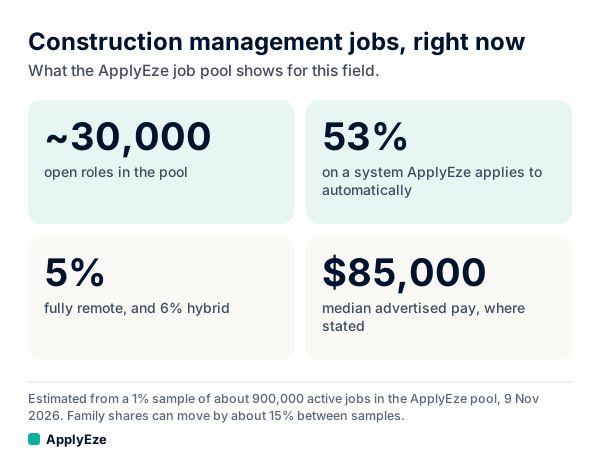
In the job pool we track, construction management is roughly 30,000 open roles, roughly 5% of them fully remote, with a median advertised pay of about $85,000. That is from a 1% sample of about 300 postings on 9 November 2026, and pay covers only the postings that state it, so treat it as rough and not as a market rate. Two of these figures change your resume. Since nearly all of this work is on site, put your metro area at the top, along with how far you will travel. And since about 53% of these postings are on systems ApplyEze applies to, the rest go through by hand, so keep your project lines in a plain-text file you can paste.
From project lines to sent applications
Your next step is the one-page project list: value, type, delivery method, owner, dates and your role for every job. Build your resume from it once, by hand, using the samples above.
ApplyEze takes over from there on the systems it covers. For each application, an AI model reads that posting and your real history and writes a resume for it, with one page as the target, so keep your full list for the interview. Your employers, job titles, dates, schools, degrees and certifications come from your own record, and code rejects a rewrite that adds a figure, employer, school or credential your record does not hold. In an audit of 84 sampled resumes on 4 November 2026, we found 0 invented employers, dates, degrees or numbers. So put your project values and hours in the resume you upload, because nothing can add them later.
ApplyEze brings the posting's named skills and tools onto your skills line, even when your own record does not list them. There is no step to remove one before a live run, so use a dry run to see what it writes, and be ready to discuss anything on the page. A certification the posting asks for is not added unless you hold it.
You pick the matches and queue them in the desktop app, and ApplyEze fills and submits each form while your computer stays on and awake. Workday and Oracle jobs stay hidden until you connect an application inbox, because those sites email a code.
If you would rather spend your evenings walking the next job than retyping the last one, your first 50 applications are free, with no card, and ApplyEze builds a resume for each posting.