

There are two real ways to get into construction management: up from the trades, or in through a degree. Each route leaves a specific gap, and most of your useful work in the first few years is closing it. The Bureau of Labor Statistics (BLS) says construction managers typically need a bachelor's degree. It also says people without one can qualify after many years in a trade, and that large firms may prefer both. Credentials matter less at the start than most guides imply. OSHA 30 is not a certification, and the best known credential in the field, the CCM, asks for at least 48 months in charge, so it cannot be your way in.
Two routes in
| From the trades | From a degree | |
|---|---|---|
| First titles | Foreman, assistant superintendent | Field engineer, project engineer, assistant project manager |
| What you bring | Sequencing, crews, quality, what really takes how long | Estimating, contracts, scheduling theory, software, writing |
| What you lack | The paper side: RFIs, change orders, cost codes, CPM schedules, reading a contract | Site judgment, and the credibility to walk a crew through a problem |
| Usual ladder | Superintendent, general superintendent | Project manager, senior project manager |
| Fastest fix | Take over the paperwork on your own job | Spend real time in the field, under a superintendent |
Those are two ladders as well as two routes. In general, a project manager runs the contract, the money and the owner relationship. A superintendent runs the site, the sequence and the crews. People cross over, but decide which one you want, because it changes what you learn first.
There are also side doors. CMAA, the construction managers' association, says holders of its associate credential are often assistant construction managers, schedule analysts, cost estimators, claims analysts, office engineers and inspectors. Estimating and inspection are ways in that value precision and do not need a crew's trust on day one.
The scale of the field is worth knowing. BLS counts 609,100 construction manager jobs in 2025, with a May 2025 median of $114,990, 9% projected growth from 2025 to 2035, and about 49,700 openings a year. It also says 38% of those jobs are held by self-employed people, and we return to that below.
From the trades
BLS is direct about this route: without a bachelor's, you "must have worked many years in carpentry, masonry, or other construction specialties". O*NET puts first-line construction supervisors at a 2025 median of $79,920 and says previous work experience is required. So the foreman step is real, and it pays.
The gap above it is paper. Here is how to close it from the job you have:
- Ask for the documents. Offer to write the daily report, build the three-week look-ahead and run the toolbox talk. None of this needs a new title.
- Read upward. Get your scope's contract language, spec sections and cost codes. Ask the project manager to walk you through one change order from field problem to signed paper.
- Take one course in estimating or scheduling. BLS says an associate's degree in construction management or construction technology, plus experience, may be typical for managers on small projects.
- Keep a project log starting now. Value, type, your role, crew size, dates, hours and who can verify it. You will need it for your resume and for any credential. Nobody can rebuild this ten years later.
Run the pay math before you jump, because the first step up can be a step down. A sample, written for this post: a foreman at $38 an hour earns $79,040 on 2,080 hours, plus $14,250 for 250 overtime hours at $57, for $93,290 in total. A salaried assistant project manager offer at $85,000 is a pay cut until the next promotion. That may still be the right move, but take it knowingly, and ask what the ladder looks like and how long the last person took to climb it.
From a degree
A construction management degree gets you past the education question, and BLS lists no related work experience as needed to enter. What it does not give you is the field. BLS says new hires typically work under an experienced manager for up to a year.
Which degree you hold matters more than people expect. The body behind the CCM, CMCI, counts these as qualifying degrees when accredited by ACCE, ABET or NAAB: construction management, construction science or technology, architecture, and civil, industrial, mechanical, electrical, chemical or architectural engineering. Any other bachelor's costs you two more years in charge before you can apply.
To close the field gap:
- Intern twice, once outdoors. A summer in the job trailer doing submittals teaches you the paper you already studied. A summer following a superintendent teaches you the rest.
- Ask for a field rotation in your first job. Field engineer is a better first title than office-bound coordinator if you have the choice.
- Learn one trade's sequence cold. Concrete or MEP coordination will do. Being useful about one thing earns more respect on site than being vaguely informed about all of them.
- Get your OSHA 30 before you start, so it is one less thing to arrange in your first week.
If you are changing careers with a bachelor's in something else, go in through estimating, project coordination or an owner's facilities team, and expect the CCM clock to run longer. Our career change plan can help you size that gap, and the project manager keywords post shows what general project postings ask for.
OSHA 30, CCM and what counts
Here is what each one is, without the marketing.
| Credential | What it really is | When it matters |
|---|---|---|
| OSHA 10 or 30, Construction | A course completion card. OSHA says the program is voluntary, "does not meet the training requirements for any OSHA standards", and that none of its courses "is considered a certification". The 30-hour class is "more appropriate for supervisors or workers with some safety responsibility". | Now. It is a low-cost signal, and sometimes required |
| CACM (CMCI) | Associate credential: 48 months of general design or construction experience, or 12 months in charge, plus an accredited degree or more experience. Fees: $300 or $400 to apply, $250 for the exam. | Mid-career. Rare so far: CMAA says nearly 100 people had earned it |
| CCM (CMCI) | Senior credential with a 175-question exam, at least two references and fees of $350 or $450 to apply and $300 for the exam. | Four or more years into running work, especially for owner-side and public work |
| State license | BLS says some states require licensing. | Check your state's board before you assume |
Two practical notes on OSHA. Requirements vary by place: New York City's Local Law 196 requires at least 40 hours of safety training for workers and 62 for supervisors at certain job sites, with cards valid for five years. And OSHA says trainers have 90 days to issue a card and keep records for only five years, so take the class before you need the card, and photograph the card when it arrives. After five years, a lost card means retaking the class.
The CCM's experience rule
The rule that matters is responsible-in-charge (RIC) experience. CMCI defines it as having "sufficient accountability to assure direct responsibility for the supervision of the construction management staff, for project decision making", plus delivering the services and coordinating with owners, designers and contractors. Being on the team does not count, and you need some experience across all fifteen boxes of its experience matrix. Contractor staff can qualify if their owner references attest to it.
Here is what that adds up to, from the January 2026 handbook.
| Your background | RIC needed | Other requirement | Minimum total in the field |
|---|---|---|---|
| Bachelor's, qualifying and accredited | 48 months | None | 4 years, after the degree |
| Associate's, qualifying and accredited | 48 months | 4 more years of general experience | 8 years |
| Bachelor's in another field | 72 months | None | 6 years |
| No degree, with an active CACM | 48 months | The CACM itself | 4 years in charge, plus the time to earn it |
| No degree, with experience | 48 months | 8 more years of general experience | 12 years |
| No degree, in charge throughout | 96 months | None | 8 years |
The last column is our arithmetic, and it is a floor, because almost nobody is in charge on day one. Put against the field's size, CMAA says more than 6,000 people had earned the CCM as of 2023, against 609,100 jobs today. That is about 1 in 100, comparing a cumulative count with a later job count, so read it loosely. The conclusion still holds: most working construction managers do not have it, and you do not need it to get hired. CMAA says holders earn about 10% more, citing a 2022 salary survey, and that many owners list a preference in their requests for proposals. That is the seller's own claim.
Software worth learning
O*NET marks Procore and Microsoft Excel as in demand for construction managers, and lists Oracle Primavera, Autodesk AutoCAD, Civil 3D and Revit, and Trimble SketchUp as hot technologies. A sensible order to learn them:
- Excel. Cost tracking, quantity takeoffs, a simple look-ahead.
- Procore. Its courses are free and open to anyone, and you can register as a guest with no company account. For a career changer, that is proof of interest that costs only your time.
- A scheduling tool. Primavera P6 or Microsoft Project, whichever your local market names. Learn what a critical path is, as well as where the buttons are.
- Plan review and estimating. Tools such as Bluebeam Revu and takeoff or estimating software vary by trade and firm, so open ten postings in your market and count the names. Learn the one that appears most.
What the numbers say about the field
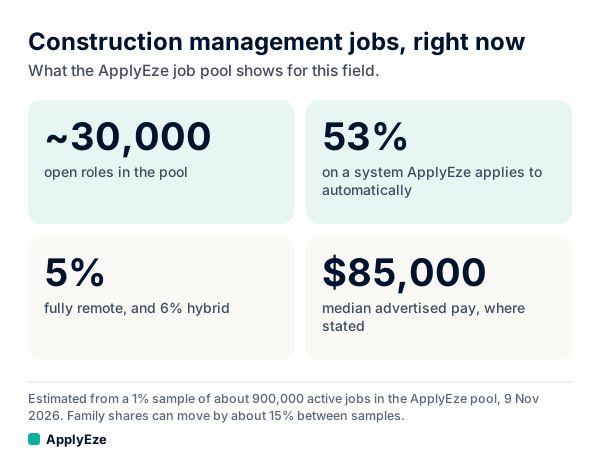
In the job pool we track, construction management is roughly 30,000 open roles. Roughly 5% are fully remote and roughly 6% hybrid, BLS says managers spend most of their time in a field office on site, and the rest of the postings are on site or do not say. About 53% are on an application system ApplyEze applies to. The median advertised pay is about $85,000.
These figures come from a 1% sample on 9 November 2026 of about 300 postings, and a second sample differed by up to about 15% per family, so round them in your head. The $85,000 is well under BLS's $114,990 for plain reasons. Only about 15% of postings across our pool state pay at all, and advertised midpoints probably also take in coordinator and assistant roles, while BLS covers working managers at every stage. Neither figure tells you what you will earn.
Why so many of these applications are by hand
Across all the jobs we track, roughly 62% are on systems ApplyEze applies to with an inbox connected. In construction management it is about 53%. So nearly half of these postings need you to apply by hand, on a system we do not cover, a firm's own form or an emailed resume.
The federal numbers offer a clue about why. BLS says 38% of construction manager jobs are self-employed and another 17% are at specialty trade contractors. A field with that many small firms and owner-operators is one where a lot of hiring never reaches a large applicant system. That is a reasonable inference, not a measurement.
Plan for it. Keep this kit ready, because you will be retyping it:
- A plain-text project list: value, type, your role, dates, one result each
- License numbers and your OSHA card date, ready to paste
- Three references who saw you on a job, each tied to a named project
- Your resume as both PDF and Word, since small firms often want it by email
- A list of contractors in your radius, built from the signs on local job fences, public bid results and contractor associations
Then go direct as well. In a field this local, a call to the office or a conversation with a superintendent can do what an online form will not. For forms, our guide to filling out a job application covers the fields that trip people up, and the construction management resume post builds the project line that every one of these applications needs.
For the part of the field on supported systems, ApplyEze takes the repetition off your hands. It polls more than 100,000 employer boards directly and ranks roles on your target titles and the requirements it reads out of each posting. List several, such as project engineer, assistant project manager and assistant superintendent, because a role doing your work under a title you did not list ranks low. You queue the matches you want in the desktop app, and ApplyEze builds a resume for each posting, fills the form and submits it while your computer stays on and awake. Workday and Oracle jobs stay hidden until you connect an application inbox, because those sites email a code. A certification the posting asks for is not added unless you hold it.
Your next step is the project list at the top of that kit. If you would rather spend your evenings on your next estimate than on retyping your last job into forms, your first 50 applications are free, with no card, and a credit is used only when an application is confirmed as submitted.