

A customer success manager resume needs three things near the top: the book you owned, what happened to its revenue, and a label on every percentage. That last one is where most resumes slip. "Retained 96%" could mean logos, gross revenue or net revenue, and a hiring manager will ask which. Most sample pages show finished bullets with impressive figures. This post shows how to calculate each number from your own book with the math written out, what to write if you never saw the dashboard, and two labelled samples.
What a hiring manager looks for
We read 20 US postings with a CSM title, from 15 employers on public Greenhouse and Ashby boards, on 9 November 2026. The boards were hand-picked and mostly software, and 20 is a small number, so treat this as a close read and not a survey.
| Term in the posting | Postings of 20 |
|---|---|
| Renewals | 16 |
| Customer retention | 16 |
| Expansion, upsell or cross-sell | 16 |
| Adoption | 15 |
| Book of business or portfolio | 13 |
| Account or customer health | 10 |
| Business reviews | 8 |
| Churn | 4 |
| Net revenue retention, by name | 2 |
| Gross retention, by name | 2 |
Two things follow. Use the posting's plain words (renewals, retention, adoption) in your bullets, and give NRR as the proof rather than the headline. And state the size of your book, because managers place you by it. Samsara's CSM manages "100-200 named accounts". Asana's owns "a portfolio of ~50 enterprise accounts". These are different jobs.
The bigger split is commercial. Some CSMs carry the renewal and some do not, and employers say so bluntly. Maven Clinic says "it's a commercial position", with "direct accountability for net revenue retention". Samsara's ideal candidate has "experience working on a Renewal + Growth Quota". Ashby lists "you shine as an exclusively commercial CSM" among its reasons not to apply, because "for renewal negotiation and upsell, we have a remarkable team of Contract Managers". Decide which you were and let your verbs say it: "owned the renewal" and "partnered with the AE on the renewal" are both fine, and only one is true for you.
Retention and expansion lines
The definitions below follow SaaS Capital's: compare what customers from the start of the period pay at the end, with new customers left out. Net retention counts upsells, cross-sells and price increases. Gross retention excludes them, which is why it cannot pass 100%.
Here is a worked example with invented figures, for a book of 40 accounts over one fiscal year.
| Item | Amount |
|---|---|
| ARR at the start of the year, 40 accounts | $1,200,000 |
| Lost: 3 accounts churned | $72,000 |
| Lost: downgrades on existing accounts | $36,000 |
| Gained: upsells and price increases on these accounts | $168,000 |
| Not counted: a new $90,000 account signed in June |
The results:
- Gross revenue retention: ($1,200,000 minus $72,000 minus $36,000) divided by $1,200,000 = 91.0%.
- Net revenue retention: ($1,092,000 plus $168,000) divided by $1,200,000 = 105.0%.
- Logo retention: 37 of 40 accounts = 92.5%.
- The common error: counting the June account gives 112.5%. That is not retention, and a careful reader will find it by asking whether new logos are in the number.
Then read your result against something real. SaaS Capital's 2025 benchmarks, from more than 1,000 private B2B software companies, put the median at 101% net and 91% gross. By contract size, the median net figure runs from 98% under $12,000 a year to 106% above $250,000. The sample book above sits right on the gross median and above the net one, which is a good year described plainly.
It also tells you which claims will draw questions. In the $25,000 to $50,000 band, where the median net figure is 102%, SaaS Capital's own example puts a company at 112% in the 75th percentile. Resume templates often print figures like 121% or more. That can be true, but know why. Since net retention includes price increases, a company-wide price rise can carry a book, and you should say so before someone asks.
Line patterns to fill with your own figures:
- Owned [N] accounts worth $[X] ARR in [segment].
- FY[Y] gross revenue retention [G]%, net revenue retention [N]%, against a team median of [M]%.
- Renewed [A] of [B] accounts up for renewal in FY[Y].
- Added $[Z] in expansion ARR across [N] accounts, working with the account executive.
- Cut time to first value from [A] to [B] days across [N] new customers.
When you do not have the numbers
Many CSMs never see a book-level dashboard. Advice on this usually stops at "use renewal rate instead", which does not help if nobody gave you that either. Work down this ladder and stop at the first rung you can honestly stand on.
| What you can see | What to write | Sample line (invented) |
|---|---|---|
| Book-level figures from your CS platform or finance | The label, the period, the number | "FY2025 NRR 105%, GRR 91% on a $1.2M book" |
| Contract values and renewal dates in your CRM or billing system | Rebuild it, and say it was calculated | "91% gross retention on a $1.2M book, calculated from CRM renewal records" |
| Only which accounts renewed | The count | "Renewed 37 of 40 accounts up for renewal in FY2025" |
| No renewal data at all | Adoption or onboarding results | "Raised weekly active seats from 41% to 68% across 22 accounts in two quarters" |
| A company-wide figure only | Mark it as context, never as yours | "One of 8 CSMs at a company reporting 112% NRR in FY2025" |
To rebuild the number, list the accounts you held on the first day of the period and the ARR of each. Find what each paid on the last day. Sort the differences into churn, downgrade and growth, and run the sums above. If you held the book for part of the year, say how many months. Ask your manager or revenue operations to sanity-check it, partly for accuracy and partly because they may be the reference someone calls.
Do this while you still work there. Save your own summary figures, not a CRM export, which belongs to your employer. If the dollars are confidential, percentages and rough scale carry the point: "a seven-figure book" is fine.
Sample: SMB book
Both samples are invented. Their math holds, so you can see how the lines check against each other.
Customer Success Manager, SMB, scheduling software company, 2023 to 2026
- Owned 160 accounts worth $1.9M ARR, about $11,900 average, with no dedicated renewals team.
- Renewed 143 of 160 accounts in FY2025 (89% logo retention). GRR 89%, NRR 99%, against team medians of 86% and 95%.
- Built a three-email onboarding sequence that cut time to first report from 19 days to 8 across 61 new customers.
- Flagged 22 at-risk accounts from usage drops; 15 of them renewed.
Why it works at this size: nobody manages 160 accounts one by one, so the reader wants to see a system (the email sequence, the usage flag). At about $11,900 a year these contracts sit in the band where SaaS Capital's median net retention is 98%, so a 99% is a solid line and says so without adjectives.
Sample: enterprise book
Senior Customer Success Manager, Enterprise, data security company, 2021 to 2026
- Owned 14 accounts worth $6.4M ARR across financial services and healthcare.
- FY2025 GRR 96%, NRR 109%: $832K expansion, $256K lost to one downgrade and one product sunset.
- Recovered a $740K account at risk after a failed rollout: active seats went from 31% to 78% in two quarters, and it renewed for three years.
- Ran 38 executive business reviews in FY2025. Partnered with the account executive on all renewals: I owned the success plan and the risk call, and the AE owned the paper.
The check: 96% of $6.4M is $6.144M, so $256K was lost. Add $832K and you get $6.976M, or 109%. The last line describes a non-commercial role accurately, and it reads better than a vague "drove renewals". Naming the $256K loss helps too. One saved account with a named cause is usually the most interesting thing on an enterprise resume, and it is what the interview will ask about.
Support to CSM: what to change
If you are moving up from support, keep one strong support line and add at least one account-level line. In these invented sample lines, "Closed 1,400 tickets at 96% CSAT" shows you are good at the old job. "Cut monthly tickets from my 20 highest-volume accounts by 40%, and 17 of them renewed" shows you can do the new one. The full route, including titles in between, is in how to become a customer success manager. For the vocabulary, see customer service resume keywords, and for the top of the page see resume summary examples.
How forms and pay work in this field
Forms ask about scope more than results. On 12 Greenhouse application forms at 9 of those employers, nobody asked for an NRR figure. They asked things like these:
- Attentive: "What size/complexity of customer accounts have you directly owned?"
- Samsara: "How many years of experience do you have in a customer success, account management, sales, or strategic consulting role?"
- Stripe: a run of yes or no questions, such as whether you have 4 years "supporting expansion of complex accounts".
- Yext: "Desired salary".
Pay needs more care than usual, because the published figures disagree widely.
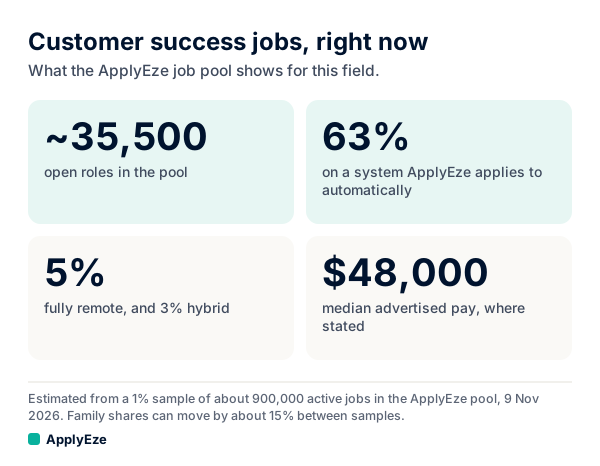
In the job pool ApplyEze polls, the customer success family is roughly 35,500 open roles, about 5% fully remote, with a median advertised pay of about $48,000 among postings that state pay. These come from a 1% sample on 9 November 2026. Our data does not say whether that family includes customer service roles, and we suspect it does. Set it beside the other figures:
| Source | Figure | What it covers |
|---|---|---|
| ApplyEze pool | About $48,000 median advertised | Everything in the family that states pay. May include service roles |
| BLS | $44,770 median, May 2025 | Customer service representatives, not CSMs |
| Customer Success Collective | $88,500 median salary, 2025 | US CSMs, derived from its 2024 salary report |
| RepVue | $105,000 base, $140,000 on-target | 1,370 self-reported ratings, updated 7 November 2026, mostly software |
| Our 20 postings | Middle midpoint about $134,000 | 16 stated a range. Hand-picked, software, some senior |
Our $48,000 sits nearer the service rep figure than anything labelled CSM, so do not anchor on it. A manager at a software company who reads "$48,000" as your expectation will wonder if you know the job.
Also check what a range includes. Samsara prints "Annual OTE Salary" of $72,887.50 to $98,000. Attentive prints $100,000 to $150,000 base "+ commission". Stripe says its range is base and that any commission would be in addition. Ashby says its strategic role "does not currently include variable pay". A form asking for desired salary, like Yext's, wants base, so answer in base.
ApplyEze polls more than 100,000 employer boards directly, and roughly 63% of these roles are on systems it applies to with an application inbox connected. Workday and Oracle jobs stay hidden until you connect one, because those sites email a code. You pick and queue the matches in the desktop app, which runs while your computer stays on and awake.
For each application, an AI model reads that posting and your real history and writes a resume for it. Your retention figures have to be in the resume you upload: code rejects a rewrite that adds a figure, employer, school or credential your record does not hold. An audit of 84 sampled resumes on 4 November 2026 found 0 invented employers, dates, degrees or numbers. ApplyEze brings the posting's named skills and tools onto your skills line, even when your own record does not list them. There is no step to remove one before a live run, so use a dry run to see what it writes, and be ready to discuss anything on the page. If a posting names a Gainsight certification, it is not added unless you hold it.
Hard facts come from your profile. When a required question is not covered by your saved answers, ApplyEze still fills it rather than stopping the run, so that answer may not come from you. Fill in your saved answers, use dry run first, and read your receipts.
Your next step is the worked example. Run it on your own book this week, while you can still see the numbers. If you would rather spend your week on renewals than on forms, your first 50 applications are free, with no card, and a credit is used only when an application is confirmed as Submitted.