

To become a customer success manager from a support role, change what you are measured on: from tickets closed to accounts retained. Rewording your resume will not do that by itself. We read 20 live CSM postings on 9 November 2026, and of the 14 that gave a number of years, 11 asked for four or more and the lowest was two. So the realistic route has three parts. Earn one account-level number in your current job, take a title in between if you need one, then apply with the proof. Set expectations with field data too: this is not the remote-first route many guides imply, and the pay figures you will read differ by about threefold.
Why support people make this move
Support is a common starting point, and the Customer Success Collective has a first-hand account of it from someone who made the switch. There is also a practical reason to look now. The Bureau of Labor Statistics projects customer service representative jobs to fall 5% from 2025 to 2035, partly "as their tasks continue to be automated", with a median wage of $44,770 in May 2025. It still projects about 289,500 openings a year, so this is no emergency. It does favor moving toward work that belongs to an account rather than a queue.
What a CSM really does
You own a set of customers for the length of their contract, and you are responsible for whether they get what they paid for and keep paying. Asana's CSM owns "the post-sales relationship for a portfolio of ~50 enterprise accounts". Samsara's handles 100 to 200. Attentive's must "maintain accurate revenue and renewal forecasts". Of the 20 postings, 16 mentioned renewals, 16 expansion and 15 adoption.
Everyone says support is reactive and success is proactive. Here is what that means on a Tuesday:
| Support | Customer success | |
|---|---|---|
| What starts the work | A customer opens a ticket | A date or a signal: a renewal in 90 days, usage falling, a new team rolling out |
| Unit of work | One issue | One account over a year |
| Who you talk to | Whoever hit the problem | Also whoever signs the renewal |
| What you are measured on | Response time, resolution, CSAT | Renewals, expansion, adoption |
| The hard conversation | "That is a known bug" | "Your team uses a third of what you bought, and renewal is in March" |
The last row is what surprises people. You will talk about money with senior customers. If that sounds awful, renewals and account titles will too, but a non-commercial CSM role may suit you. Ashby's strategic CSM leaves renewal negotiation to a separate team, while Maven Clinic calls its role "a commercial position".
From tickets to accounts
You already hold data that a CSM would want. The move is to turn it around so an account is the row, not a ticket.
| Support number you have | Account number to add | How to get it this quarter |
|---|---|---|
| Tickets closed | Tickets per month at named accounts, before and after you fixed the cause | Sort last quarter's tickets by account and pick your 20 highest |
| CSAT | Renewal outcome of accounts you worked on | Ask a CSM for renewal dates on those 20 |
| First response time | Days to first value for new customers | Volunteer for onboarding calls |
| Escalations handled | Accounts at risk that then renewed | Ask to join one save call a month |
| Bugs filed | Feature use after the fix | Pull the usage report, or ask whoever owns it |
Skills to build first
A sample 90-day plan, which you can run without changing jobs:
- Weeks 1 and 2: get the list. Ask your manager or a friendly CSM which accounts renew in the next two quarters. Cross that with your ticket data and pick 20.
- Weeks 3 to 6: find the cause. Group each account's tickets. Most will have one or two repeat problems. Fix them with a training call, a short guide or a pushed bug.
- Weeks 7 to 10: measure. Compare tickets a month before and after. Note logins or active seats if you can see them.
- Weeks 11 to 13: follow the renewals. Ask to sit in on a business review. Record which accounts renewed, and be honest about how much of that was you.
Here is the kind of line that comes out of it, with invented figures: "Cut monthly tickets from 20 high-volume accounts from 146 to 88 in 90 days (40%). 17 of the 20 later renewed, including 3 flagged at risk." The word "later" matters, since you contributed to those renewals and did not cause them alone. Ask the CSM to confirm your account of it, because they may be your reference.
Alongside that, learn these:
- Retention math. Know gross, net and logo retention cold, and which is which. Our CSM resume guide works through them with the figures written out.
- Reading a contract. Term, renewal date, seats, price. You cannot manage a renewal you cannot find.
- Running a business review. Ask to shadow one, then to present one slide.
- Saying a commercial sentence. Practice "you are on the 200-seat plan and using 70" until it stops feeling rude.
Skip paid certificates until a posting asks for one. Only 2 of the 20 named Gainsight, 3 Salesforce and 2 SQL. The tool your own company uses is the one to learn.
Titles between support and CSM
These titles exist, and they vary more than guides suggest. The easiest way to see the ladder is on one employer's board. Ashby's public listings on 9 November 2026 ran from support to strategic CSM, and two other employers fill in the entry and renewals rungs. Ashby lists several ranges per role, so its figures are the full span.
| Title | Listed pay | What it asks for or does |
|---|---|---|
| Customer Experience Associate, new grad (Ramp) | $60K to $70K, paid hourly | Troubleshooting across product areas, an entry point |
| Product Support Specialist (Ashby) | $70,000 to $104,250 | Owning complex issues from first report through resolution |
| Renewal Manager, SMB (Ashby) | $90K to $129K, with commission | Annual renewals for customers up to 100 employees |
| Renewals Associate (Airtable) | $88,000 to $115,400 on-target in most locations | 2+ years of quota-carrying post-sales work |
| SMB CSM (Ashby) | $80K to $138K | 2 years as a full-time SMB CSM, account manager or program manager |
| Mid-Market CSM (Ashby) | $110K to $161K | A larger book of varied customers |
| Strategic CSM (Ashby) | $150,000 to $198,375 | No variable pay, renewals handled elsewhere |
Ashby's own posting calls its SMB CSM a mid-level role, so even the smallest book here is not an entry job. That is why a bridge exists.
Pick one by what you can stand. Onboarding or implementation suits people who like projects with an end date, though only a few turned up in our read, so search those titles yourself. A renewals seat suits people happy with a number and a deadline, although Airtable's shows some want quota experience first. Customer success associate or specialist is the closest thing to the job itself, at a smaller scale. Technical account manager is not a shortcut: Plaid's enterprise TAM asks for 10+ years.
On timing, two figures circulate and neither measures people making this move. Career Karma says six to eight years, but that counts a four-year degree you may already have, and 15 of our 20 postings mentioned no degree at all. SeekerScore estimates 2 to 8 months, which is that site's own estimate. Treat both as guesses.
What the numbers say about the field
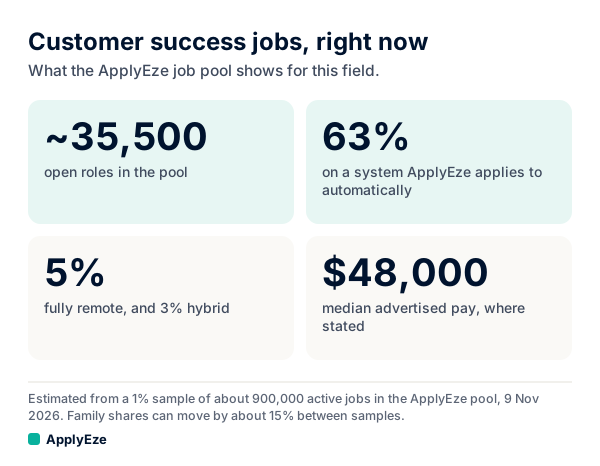
Across the employer boards ApplyEze polls, the customer success family is roughly 35,500 open roles. About 5% are fully remote and 3% hybrid. Roughly 63% sit on systems ApplyEze applies to with an inbox connected. These come from a 1% sample on 9 November 2026, and counts for a family moved by up to about 15% between samples.
Two of those figures deserve a closer look.
Remote. At 5%, this is not a remote-first field across the board. Yet 12 of our 20 CSM postings listed remote. Both are true. Remote CSM work is concentrated at software employers, and the wider family includes jobs that are mostly on site. If you want remote, you are aiming at the software part of the field, and so is everyone else.
Pay. The median advertised figure is about $48,000, among postings that state pay. Here is how it sits against other fields:
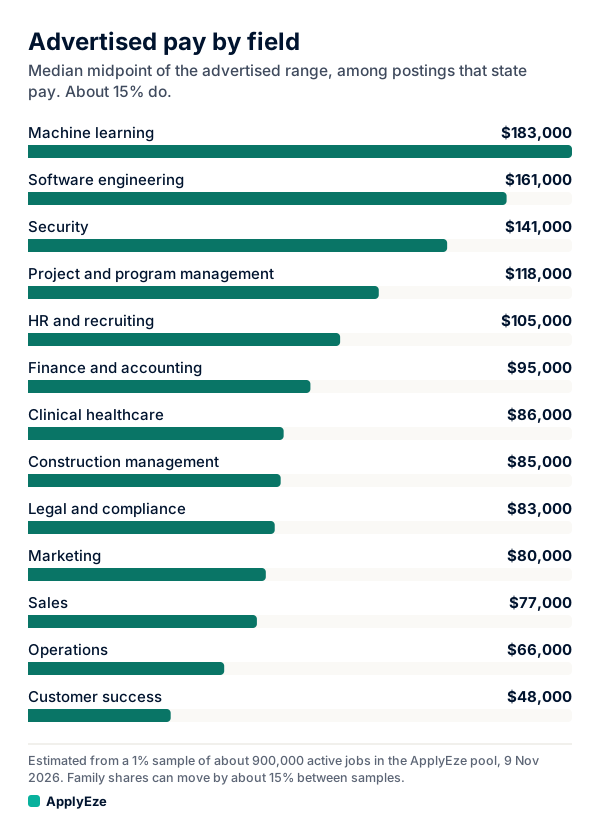
Customer success comes last on that chart, below operations at about $66,000. But our data does not say whether this family includes customer service roles, and the number suggests it might: the BLS figure for service reps is $44,770. By comparison, the Customer Success Collective reports a $88,500 median salary for US CSMs in 2025, and RepVue's self-reported medians are $105,000 base and $140,000 on-target from 1,370 ratings, mostly in software. In our 20 postings, 16 stated a range and the middle midpoint was about $134,000, some of them senior.
The useful reading is that "customer success" covers a wide spread of jobs. A CSM title at a software company and a customer success role at a local service business may have little in common beyond the words. Read the duties. If a posting has no book, no renewals and no adoption in it, you may be looking at support with a new name, and a move into it may not change what you are measured on.
Your transition resume
Keep your support history honest and add the account-level result above it. A sample, with invented figures:
| Before | After |
|---|---|
| "Customer Support Specialist. Resolved customer issues in a fast-paced environment." | "Support Specialist, mid-market queue. Closed about 1,400 tickets in FY2025 at 96% CSAT." |
| "Great relationships with customers." | "Point of contact for 20 high-volume accounts. Cut their monthly tickets from 146 to 88 in 90 days." |
| "Helped with onboarding." | "Ran 26 onboarding calls for new customers, taking median days to first report from 15 to 9." |
The CSM resume guide has fuller samples and a ladder for when you lack retention data. Customer service resume keywords helps with wording, and career change covers how to explain a switch.
How to apply
Start inside. You already know the product, which is the main thing an outside hire lacks. The Customer Success Collective's account suggests the same: look internally first and tell your manager what you have prepared. Bring your 90-day result, since it makes the request concrete. Then expect some misses outside. That author reports "well over thirty rejections" on the way.
Outside, search several titles at once, because the job goes by many names. ApplyEze polls more than 100,000 employer boards directly and ranks your matches on your target titles, so list them all, since a role doing your work under a title you did not list ranks low: customer success manager, customer success associate, client success manager, onboarding specialist, renewals specialist. You pick the matches and queue them in the desktop app, and it runs in Chrome while your computer stays on and awake. Workday and Oracle jobs stay hidden until you connect an application inbox, because those sites email a code. A credit is used only when an application is confirmed as Submitted.
For each application, an AI model reads that posting and your real history and writes a resume for it. Code rejects a rewrite that adds a figure, employer, school or credential your record does not hold, so your 146 to 88 must already be in what you upload, and a certification the posting asks for is not added unless you hold it. ApplyEze brings the posting's named skills and tools onto your skills line, even when your own record does not list them. There is no step to remove one before a live run, so use a dry run to see what it writes, and be ready to discuss anything on the page. You record employer replies yourself on each application, which lets you see which titles answer.
Your next step is the list of 20 accounts. Ask for it this week and start the 90 days. When your number is on the page, your first 50 applications are free, with no card, and ApplyEze builds a resume for each posting.