
Does a recruiter call to reject? Sometimes, and mostly late in the process. Early on, a rejection is usually an automated email or nothing at all, and a call from a recruiter at that stage is more likely to be a screen. After interviews, calls do happen: in Survale's 2025 candidate experience research, 20% of rejected candidates said they got a phone call. So a late-stage call can go either way. What it means depends mostly on whether that company phones the people it turns down, and you can find that out before the call ever comes.
The short answer, by stage
| Where you are | How a no usually arrives | What a call most likely is |
|---|---|---|
| Applied, no contact yet | Automated email, or silence | A screening call. A rejection call here would be unusual |
| After a recruiter screen | A personal or template email, sometimes a call | A next step, or a brief no from a recruiter who liked you |
| After interviews | Personal email or do-not-reply email, sometimes a call | Could be either |
| After a final round | At some employers a call is the expected courtesy, at others an email | Could be either. See the table below |
| After a verbal offer or background check | Less common, and often a call when it happens | Paperwork, or bad news about the offer |
That pattern is close to how recruiters themselves describe it. In a 2025 SHRM guide, a consultant calls a standard email sufficient for people not moving past the application. SHRM's own director of talent acquisition says people who get a phone screen receive a personalized email, and anyone who sits for an in-person interview gets a phone call if not selected. The table is our summary of that kind of practice, so treat it as a typical pattern and not a rule.
What the data says
Most writing on this question offers anecdotes. There is a measured figure, though it answers a slightly different question from the one you are asking.
How often rejected people get a call. Survale runs the Candidate Experience (CandE) benchmark, which Talent Board founded in 2011. Its 2025 fact sheet, from more than 66,000 candidate surveys, says 33% of rejected candidates were notified through a do-not-reply address, 32% got a personal email from a recruiter or hiring manager, and 20% got a phone call. Its 2023 report asked specifically about the interview stage in North America: 33% do-not-reply email, 34% personal email, 17% phone call and 2% text.
How often employers require it. The same 2023 report says 36% of recruiters were required to make a phone call when rejecting external candidates with limited feedback. So roughly a third of the recruiters in that benchmark had a phone policy.
How many people never reach a person at all. In a 2026 Greenhouse survey, 81% of US candidates said they had been rejected in the past year without speaking to anyone at the company. That means it happened to them at least once in a year, not that 81% of applications end that way. It does show how normal a no without a human voice has become.
Read the Survale numbers with care. Survale sells candidate feedback software. Employers choose to join its benchmark (110 registered in 2025), and they are the ones who care about this, so the true share across all employers may be lower. The figures come from what candidates reported. The 2025 line does not state a stage, and the 2023 one does. Both describe people who were rejected and do not tell you what a call means. Nobody we could find publishes how many recruiter calls turn out to be rejections, which is the number you actually want.
Why a call means what it means
You can still reason your way there. What you want is the chance that a call is the offer. That depends on how many finalists there are, and on how often this company phones the ones it turns down.
Here is a worked example. The inputs are assumptions, not data, except where marked. Suppose there are three finalists, one offer and two rejections, and offers come by phone 90% of the time. One third times 90% is 0.3. Two thirds of finalists get a no, so the rejection calls add two thirds times this company's rate. The chance a call is the offer is 0.3 divided by the sum of the two.
| How often this company phones a rejected finalist | Chance a call is the offer |
|---|---|
| 5%, almost never | 90% |
| 20%, the 2025 survey figure | 69% |
| 36%, the 2023 share of recruiters required to call | 56% |
| 100%, it phones every finalist | 31% |
So the same phone call could mean 9 in 10 or 3 in 10. The habit of the company moves the answer more than anything about the call itself. With two finalists instead of three the odds rise, and with five they fall.
That gives you a practical move that costs nothing. At the end of your final round, ask:
Whichever way this goes, how will I hear, and by when?
(That is a sample line, so adjust it to suit.) If the recruiter says "I call everyone either way", a call now tells you little, and you can stop reading tea leaves. If they say "you will get an email if it is not a match", a call is very likely good news. You have also got a date, which is worth having on its own.
What "late" adds. A call that comes soon after your final round and a call after three weeks of silence are not the same event. Survale's 2025 fact sheet says 60% of candidates "received a job offer within one week of their final interview" (we read that as candidates who got an offer), and Huntr's Q3 2026 report puts the median wait from interview to offer at 7 days. Meanwhile, one senior recruiter told SHRM she will not reach out to runners-up until the selected candidate accepts. So a long silence can mean you were held in reserve, which ends in one of two ways: the first choice took the job and this is your no, or the first choice declined and this is your offer. We found no one who publishes the split.
Signs a call is good news, and signs it is not
These lean one way or the other. None of them proves anything.
| Leans good | Why |
|---|---|
| Earlier questions about start date, notice period or pay expectations | These are inputs to an offer |
| A request for references | Few employers spend time on someone they have ruled out |
| Consent forms for a background check | The FTC says written permission comes first, so this means they plan to run one |
| You were told rejections go by email | From the table above |
| Leans bad, or tells you little | Why |
|---|---|
| The call came only after you chased for an update | Your note may just have prompted a conversation they were putting off |
| A vague invitation "to chat" with no next step named | It fits a scheduled no as easily as a scheduled yes |
| You were told they call everyone | From the table above |
| A call in the afternoon, or a late one | Tells you nothing, as our data below suggests |
Those rows are our reading, not a measurement, and practice varies. Alison Green, writing in Slate, quotes a hiring manager whose HR requires a Zoom or phone rejection for finalists, and argues for an email first with a call on offer.
How to take the call
- You can let it go to voicemail. If you are in a meeting or on a train, you owe nobody a live reaction. Call back when you can talk.
- Buy ten minutes if you need them. "Can I call you back in ten minutes? I want to give this proper attention." Nobody minds.
- Have a pen. Whether it is a yes or a no, you will forget half of what was said.
- If it is a yes, do not accept on the call. Thank them, then ask to see it in writing and for a day or two to read it. Our salary negotiation scripts cover what comes next.
- If it is a no, do not argue. The decision is made, and the recruiter delivering it usually did not make it alone.
What to say when it is a no
The samples below are written for this post, so change them to sound like you. The aim is to leave well, get one useful thing and stop.
Sample 1. In the moment
Thank you for calling me yourself. I am disappointed, since I wanted this one, but I appreciate hearing it from you.
Sample 2. Asking for feedback, once
If you are able to say, is there one thing that would have made me a stronger candidate for this role? I understand if you cannot share that.
Do not count on much here. In the 2025 Survale fact sheet, 56% of candidates received no feedback after being rejected during screening and interviewing, and only 23% of North American candidates said they received job fit feedback as finalists. An answer of "I cannot share that" says nothing about you.
Sample 3. Keeping the door open
If a similar role opens, I would like to be considered. Is it all right if I stay in touch with you on LinkedIn?
This one is worth saying. The recruiter quoted by SHRM says she asks runners-up about other roles at the company, and that they are usually enthusiastic about it.
Then send a short note the next day. Our guide on how to respond to a rejection email has a template for a final round, and it works just as well after a call. If the call never comes, our post on being ghosted after an interview covers that.
What our callback data adds
Our callback numbers cannot settle how often a call is a no, because of how they are built.
Here is how callback detection works where it is switched on. It is rolling out with staffing teams first and is not part of self-serve accounts yet. It scans a connected application inbox and labels emails that look like an assessment, screening call, interview or offer. It does not track rejections, and rejection emails get no card. It also cannot hear a phone call.
What the numbers do show is when employers reach out with something positive.
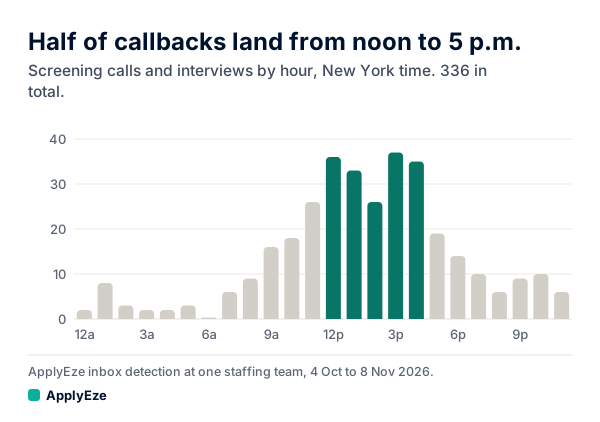
This chart counts 336 screening calls and interviews found by machine label, with no person reviewing them, in the inboxes of about 29 candidates at one staffing team, in email received from 4 October to 8 November 2026. Of those, 167, or 49.7%, arrived from noon to 5 p.m. New York time, with few overnight. These are emails, not calls, and they include no rejections. All they support is a modest point: afternoon is when employers tend to get in touch, so a call at 4 p.m. is an ordinary call, not a sign of anything.
What to do next
At your next final round, ask how you will hear either way, and write the answer down. That one question makes the phone call readable before it rings.
What helps with the wait itself is not having one call carry your whole search. At one staffing team using ApplyEze, human callbacks per candidate per month rose from about 2 in spring to 7 for October applications, with volume more than tripled and the rate per 1,000 applications holding near 3. That is one team working with us and not a self-serve account, part of the rise is better counting, and results for any one person will differ.
On your own, you pick the matches and queue them in the desktop app, which runs on your computer while it is on and awake, and it fills and submits each form. Workday and Oracle roles need a connected application inbox. If you would rather spend the wait on your next interview than on forms, your first 50 applications are free, once per email address with no card.