
"Not selected by employer" is an Indeed status, and Indeed defines it in five words: "The employer rejected your application." (Indeed). It is a final answer for that one application. It does not tell you why, and it does not tell you whether a person read what you sent.
Other systems use close to the same words. The University of Washington's Workday setup shows "Not Selected", described as "Candidate is no longer under consideration" (UW), and the same words can mean different things at another Workday employer. What follows applies to all of them, with the mechanisms taken from the documents employers and vendors use.
What the status means
Indeed shows three statuses that people mix up. Only one of them is a decision.
| Status on Indeed | Who sets it | Indeed's definition | What it tells you |
|---|---|---|---|
| Not selected by employer | The employer | "The employer rejected your application." | A decision on this application |
| Response seems unlikely | Indeed | "We don't expect the employer to reply." It appears when the employer has hired enough candidates, or after at least two weeks with no activity on your application. | A forecast, with no decision behind it |
| Job closed | Indeed | "The employer closed the job, or the job expired." | The job's state, and nothing about you |
Indeed says statuses it sets itself are "only available if you use the mobile app", and that if you applied on another site "you may not see these statuses". So many rejections never show this label at all.
Did a person see it?
Sometimes. There are several ways a rejection gets made, and the outward label is the same for all of them.
| How it was made | Where it is documented | Did a person read it? |
|---|---|---|
| You missed a required question | Indeed: "their application automatically moves to the Rejected tab" (Indeed). Ashby: "reject candidates whose application submissions match certain conditions automatically" (Ashby). | Not necessarily |
| You hit a repeat-application rule | Greenhouse: blocked applications go to rejected, "marked as 'blocked by auto reject rule'" (Greenhouse) | No |
| A recruiter decided on you alone | Larimer County's iCIMS guide: "Did Not Pass MQ/Level 1 Screening" sends an automatic email (Larimer County, 2017) | Probably |
| The whole group was closed out | Larimer warns that selecting the entire group and clicking reject sends "an automatic email to the entire group". Auburn University's workflow sends "All disposition emails" at Offer Acknowledged (Auburn). | Maybe not |
Two fair notes on Indeed. It says its tools "do not automatically delete applications before a person sees it" (Indeed), and its employer guide says an employer can still review someone in the Rejected tab and move them back. Both can be true alongside the automatic move. And Indeed's pages do not say whether that move shows you "Not selected by employer", so treat it as a likely path and not a known one.
Speed will not tell you who decided
The most repeated advice on this status is a timing rule. Resume Worded, for one, reads a rejection within 1 to 3 days as a software screen and one after 3 days as a recruiter. The page cites no source, and the documents point the other way:
- Automated rejections can be slow on purpose. Ashby's rule includes "the number of business days to delay the rejection email".
- Notices run behind decisions. LinkedIn's partner documentation says an applicant receives its rejection email "after 72 hours of the action being updated" (LinkedIn). Greenhouse marks an application inactive four days after the rejection date if no email goes out, and "Candidates are not notified about the change" (Greenhouse).
- Human rejections can wait for the end. Larimer's guide says "best practice is to not decline until the position is no longer advertised".
- A person can say no in minutes. Nothing stops a recruiter clearing a list on the day you applied.
So do not build a theory on the date. The one quick test worth running is on your own answers: if the rejection came fast and the form had a yes or no question you could have missed, reread it.
The label also hides good news. Larimer's guide has a declination reason called "Qualified but not selected", which it says is for "people that are qualified but you will not hire". From outside, that looks the same as failing.
How common it is
Very. In a Greenhouse survey published 20 October 2026, "Four in five (81%) U.S. candidates were rejected from a job in the past year without ever speaking to anyone at the company". It adds that 31% say this happens often or almost always, rising to 38% of Gen Z.
Read that with care. It is a share of people who had this happen at least once in a year. It does not mean 81% of applications end this way. Greenhouse sells hiring software, and the US sample is 1,200 job seekers. Still, the point stands: being rejected by a company you never spoke to is the ordinary experience, and it is weak evidence about you.
Can you reapply?
There are two questions here, and they have different answers: the same job, or another job at the same employer. The employer's software may decide both.
| Rule | Ashby | Greenhouse | Google, as one employer |
|---|---|---|---|
| Same job after rejection | Can be blocked "within a certain number of days" | Can require a number of days before "a rejected candidate can submit another application" | "You must wait 90 days before re-applying for the same job." |
| Other jobs after rejection | Can be blocked "to any role within the scope" | The rejection block covers the same job | No rejection block stated on this page |
| Too many applications | Can limit applications "over a certain number of days" | Can limit applications over a set period | "up to three jobs within a rolling 30 day window" |
Most employers do not publish their settings, so you often cannot know the limit in advance. Greenhouse lets an employer send a rejection email to people blocked this way, so a second rejection that comes back very fast may be the rule and not a fresh opinion. Ashby lets the employer show a message to a blocked candidate, so read what the form tells you. Applying to more than one job at the same company goes through this in detail.
Whether repeat tries pay off is a mixed picture. Huntr's Q3 2026 data found that people who applied to one company 8 or more times got interviews on 2.4% of those applications, against 5.9% for a single application. Their chance of at least one interview at that company still rose to 17.7%, against 5.9%. This is self-tracked data, Huntr sells a tracker, and people who keep applying may differ from those who do not. It fits a plain rule: applying again is worth it when the role is different or you are different. Sending the same resume to the same job again is not.
A short note worth sending
This is a sample we wrote, not a real person's email. Send something like it only to a named person, and only when you can point at a real role.
Subject: Data Analyst application (ID 4471), and your Reporting Analyst role
Hello Priya,
I saw that I was not selected for the Data Analyst role. Thank you for considering me.
I would still like to work with your team. The Reporting Analyst posting asks for SQL and monthly close reporting, which is what I have done for the last three years at my current job. If you think it is a closer fit, I would be glad to be considered for it.
Thanks, Sam Lee
It works because it is short, it accepts the decision, and it gives the recruiter one thing to do. It does not ask why. If you want to ask for feedback, or you were rejected after an interview, how to respond to a rejection email has the templates for that.
On Indeed, you may not be able to send it there at all. Messaging after an application "only works if the employer turns it on", and Indeed "does not allow unrestricted cold messaging to employers" (Indeed).
When not to send anything
- You have no named person. A no-reply address goes nowhere.
- You have no specific role. "Keep me in mind" gives a recruiter nothing to do.
- You were screened out on a real requirement, such as a license or work authorization question you answered truthfully. A note will not change it.
- You want to dispute the decision. It will not reverse it, and it may be what they remember.
- You have already sent one. One is the limit. Indeed's own advice is to "avoid sending repeated messages across multiple platforms".
What to change next time
One rejection is one data point, and most of the fixes need a batch.
Start with required questions. Reread what you answered on this form, if you can still see it. A mistaken answer here is the one cause you can fix in a minute. If a tool fills your forms, check its work on these questions in particular. With ApplyEze, hard facts come from your profile, and when a required question is not covered by your saved answers, ApplyEze still fills it rather than stopping the run, so that answer may not come from you. Fill in your saved answers, use dry run first, and read your receipts.
Give a batch time before you judge it. Our inbox data comes from callback detection, which is rolling out with staffing teams first and is not part of self-serve accounts yet. Rejection emails get no card there, so this measures the good replies, and they come slowly.
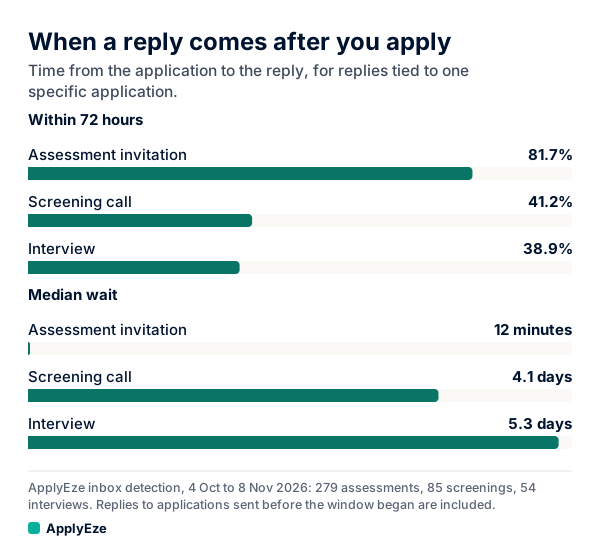
The chart shows replies tied to one application, found in the inboxes of about 29 candidates at one staffing team, in email received from 4 October to 8 November 2026. Among them, 41.2% of screening invitations and 38.9% of interview invitations arrived within 72 hours, and the medians were 98.1 hours and 126.8 hours. A scanner labelled these emails and no person reviewed the labels, so they are found, not confirmed, and the time runs from the application, not from an interview. Results for any one person will differ.
So a rejection on Tuesday says nothing yet about the other applications you sent on Monday. Wait a week or more before you rewrite anything.
Then look at the pattern. If 30 to 50 applications have produced no interviews, why am I not getting interviews walks through the likely causes in order. One no does not justify a new resume.
One no should not slow the rest of your search. At one staffing team using ApplyEze, human callbacks per candidate per month rose from about 2 in spring to 7 for October applications, while applications per candidate more than tripled and the rate per 1,000 held near 3. Part of that rise is better counting, and results for any one person will differ. If you are searching on your own and want the next applications out while you work on this, your first 50 are free, no card needed, and a form that cannot be finished costs no credit. You pick and queue the roles in the desktop app, which runs while your computer is on and awake.