

A financial analyst resume gets read for two things: what you modeled, and what changed because of it. Almost every sample online says "quantify your bullets". That advice is right and not much help, because a number by itself does not show judgment. This post gives line patterns for forecasts, variances and business partnering, with the arithmetic worked out so you can produce your own figures, then two labelled samples.
What a finance manager reads for
Real postings show the job plainly. Everlaw's Senior Financial Analyst analyzes results against forecasts and plans, investigating "material variances to their root causes and explaining key drivers to leadership", and wants models that are "transparent, automated, and easy-to-maintain". Cognitiv wants an owner for the budget and a three-year financial model. Astranis wants "timely variance analysis and actionable insights".
Those reduce to three questions a manager asks of every line:
| Question | Weak line | Line that answers it |
|---|---|---|
| What did you build or own? | Assisted with budgeting | Own the opex forecast for 6 departments, $48M a year |
| Was it right? | Improved forecast accuracy | Mean monthly error 3.4% in FY25, from 6.1% in FY24, forecasting one month out |
| What changed because of it? | Provided insights to leadership | VP cut 13 planned hires after the headcount model showed $1.6M over plan |
All sample lines in this post are invented, and the arithmetic is ours.
Model and forecast lines
The pattern is: model, owner or decision, scope, result. "Built a financial model" fails it, because it leaves out all but the first.
Many analysts have a forecast error they could report and have never worked out. Here is how. Suppose you forecast a month at $4.20M and the actual came in at $4.05M.
- Gap: $4.20M minus $4.05M is $0.15M. Ignore the sign.
- Divide by actual: $0.15M divided by $4.05M is 3.7%.
- Repeat for each month and average the results.
If twelve months average to 3.4%, you can write: Held monthly revenue forecast error to 3.4% across FY25, from 6.1% in FY24. Always be ready to say the horizon. One month out is far easier
than a year out, and a manager will ask.
Sample lines:
Built the driver-based revenue model (stores times sales per store) used to set the FY26 planRebuilt the 13-week cash forecast after a covenant scare; weekly variance fell under $200KOwn the three-statement model for a $240M business; lenders and the board use it each quarterMoved the forecast from 14 linked workbooks to one model with error checks; refresh time fell from 2 days to 3 hours
No forecast error to report? Say what the forecast was used for. A model that a named decision rested on is a good line even without an accuracy figure.
Variance and business partnering lines
Variance is where a good analyst and a report-runner look different, and the difference is whether you stopped at the total. Here is a price and volume split on a sample month:
| Units | Price | Revenue | |
|---|---|---|---|
| Budget | 10,000 | $50 | $500,000 |
| Actual | 9,400 | $53 | $498,200 |
The total variance is minus $1,800, or 0.4%. Most reports would call that on plan. Split it:
- Volume: (9,400 minus 10,000) times the budget price of $50 is minus $30,000.
- Price: ($53 minus $50) times actual units of 9,400 is plus $28,200.
- Check: minus $30,000 plus $28,200 is minus $1,800.
So a month that looked flat hid a 6% unit decline paid for by a price rise. That finding is
the resume line: Traced a flat month to a $30.0K volume miss hidden by a $28.2K price gain; Sales reset discount approvals for Q3.
"Partnered with" is the emptiest verb on these resumes. Replace it with who, what they decided, and how much it was worth:
| Instead of | Write |
|---|---|
| Partnered with Operations on cost reduction | Walked the VP of Operations through overtime by site each month; she cut weekend shifts at 2 plants, $340K under plan |
| Supported the Sales team with reporting | Built a discount-by-rep view that the CRO used to change approval limits for 40 reps |
| Worked cross-functionally on headcount | With HR, tied the hiring plan to the budget, which cut 13 of 44 planned roles |
If the decision belonged to someone else, say so. Nobody expects a junior analyst to have made it, and claiming you did is the kind of thing that comes apart in an interview.
Sample: entry level
Everything in both samples is invented. Note what this one does with no full-time finance job: it labels the class project as a class project, and gives its error anyway.
NINA PATEL
Austin, TX | (555) 010-3381 | nina.patel@example.com

EDUCATION
BBA Finance, Hill Country State University (sample) | May 2026

PROJECT
Three-statement model of a public specialty retailer | class project, public filings
- Forecast revenue from store count and sales per store over 3 years
- Compared my Year 1 forecast with the reported result: 4.1% too high, mostly on new stores

INTERNSHIP
Finance Intern, Lakeshore Medical Group (sample) | Summer 2025
- Refreshed the monthly budget-to-actual pack for 11 cost centers
- Flagged $18K of miscoded supplies spend; the controller reclassified it before close
- Replaced a manual headcount tracker with XLOOKUP and a pivot table; half a day became 30 minutes

SKILLS
Excel (XLOOKUP, SUMIFS, pivot tables, data tables), PowerPoint, SQL (SELECT, JOIN, GROUP BY, class use)
Sample: FP&A
This one is the common move from accounting. It is useful because forms can treat the two as one pool: Cognitiv's asks for three to five years "in an FP&A or accounting role". Keep the accounting lines that show you know how the numbers get made, and give the most space to the planning work.
OMAR HASSAN
Chicago, IL | (555) 010-5546 | omar.hassan@example.com

EXPERIENCE
Financial Analyst, FP&A, Corvid Logistics (sample), $240M revenue | 2024 to present
- Own the rolling 12-month opex forecast for 6 departments, $48M a year; mean monthly error
  3.4% in FY25, from 6.1% in FY24, forecasting one month out
- Built the headcount model with HR; the VP cut 13 of 44 planned FY26 hires, $1.6M under draft
- Traced a flat Q2 to a $410K volume miss offset by $395K of price; Sales reset discount limits
- Moved the board pack from 14 workbooks to one model; refresh fell from 2 days to 3 hours

Staff Accountant, Corvid Logistics (sample) | 2021 to 2024
- Closed the general ledger for 3 entities in NetSuite; prepared accruals FP&A used in its forecast
- Built the first budget-to-actual bridge for the controller, which led to the move into FP&A

EDUCATION
BS Accounting, Lakeview University (sample), 2021

SKILLS
Excel (three-statement models, scenarios), Adaptive Planning (built reports, loaded forecasts),
NetSuite, SQL (read and edit queries), PowerPoint, Tableau
Tools and keywords
O*NET flags eight skills as in demand for financial and investment analysts, meaning they are frequently included in employer postings for that occupation: Excel, PowerPoint, Microsoft Office, Outlook, SQL, Tableau, Power BI and SAP. It marks Workday, R, VBA, Alteryx and Salesforce as hot across all job types. Our hard skills guide covers how to choose among lists like these.
The trap is that one keyword covers several levels. Everlaw lists "working knowledge of SQL or data-querying tools". Cognitiv wants "Strong SQL Skills: Comfortable independently querying a data warehouse", and its form asks in a text box, "How do you utilize SQL in your day-to-day role?" You may be tested before anyone meets you. So write the level you can show:
| If you write | Be ready to | If you cannot, write instead |
|---|---|---|
| Excel | Use SUMIFS, pivot tables and lookups on a shared screen | Excel (basic), and practice before you apply |
| Advanced Excel | Build a scenario model from a blank sheet, with checks | Excel (pivot tables, XLOOKUP) |
| Financial modeling | Link three statements and defend each assumption | Maintained a forecast model built by others |
| SQL | Write a join and a group by against a warehouse, unaided | SQL (read and edit queries) |
| Adaptive, Anaplan, Hyperion | Say whether you built models or loaded numbers | Adaptive Planning (loaded forecasts, ran reports) |
| Python | Show a script you wrote and explain it | Leave it off |
If you apply through ApplyEze, this table is your check before you queue a role. ApplyEze brings the posting's named skills and tools onto your skills line, even when your own record does not list them. There is no step to remove one before a live run, so use a dry run to see what it writes, and be ready to discuss anything on the page. A certification the posting asks for is not added unless you hold it. You choose the queue, so if a posting names SQL and you have never written it, leave that one out.
Hybrid roles and what forms ask
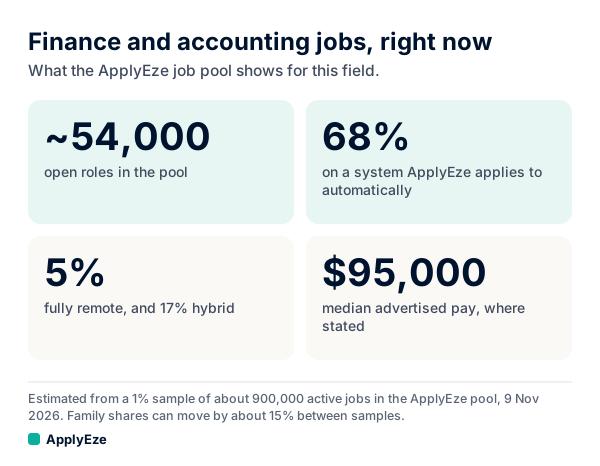
ApplyEze polls more than 100,000 employer boards directly. The chart shows finance and accounting in that pool on 9 November 2026: roughly 54,000 open roles, roughly 68% on application systems ApplyEze applies to once an inbox is connected, and roughly 5% fully remote. What it leaves out is the hybrid share. Roughly 17% of these roles are hybrid, against about 8% across all jobs. Among the five largest fields only marketing is close, at roughly 16%, and that gap is within the noise of a sample like this. Sales is roughly 7%, operations roughly 5% and clinical healthcare roughly 3%.
Hybrid matters because forms name the days, and a no may end the application there:
| Employer | Question on the form |
|---|---|
| Everlaw | "Would you be willing and able to adhere to Everlaw's coordinated hybrid work schedule of three days per week (M/W/Th) in our Oakland HQ?" |
| Everlaw | "Please confirm the city AND state you currently reside in" |
| Cognitiv | "We have a hybrid culture. Are you able to work out of our NYC office Monday, Tuesday and Wednesday?" |
| Astranis | "Are you comfortable with working onsite at our San Francisco HQ 5 days a week?" |
| Cognitiv | "Which ERP or accounting systems have you worked in directly?" |
| Cognitiv | "Describe a specific financial process you've automated" |
We read these on live forms on 9 November 2026. Keep a short note with your commute limits, your in-office days, and two or three written answers about a process you improved.
Pay fields come up too, so anchor yours.
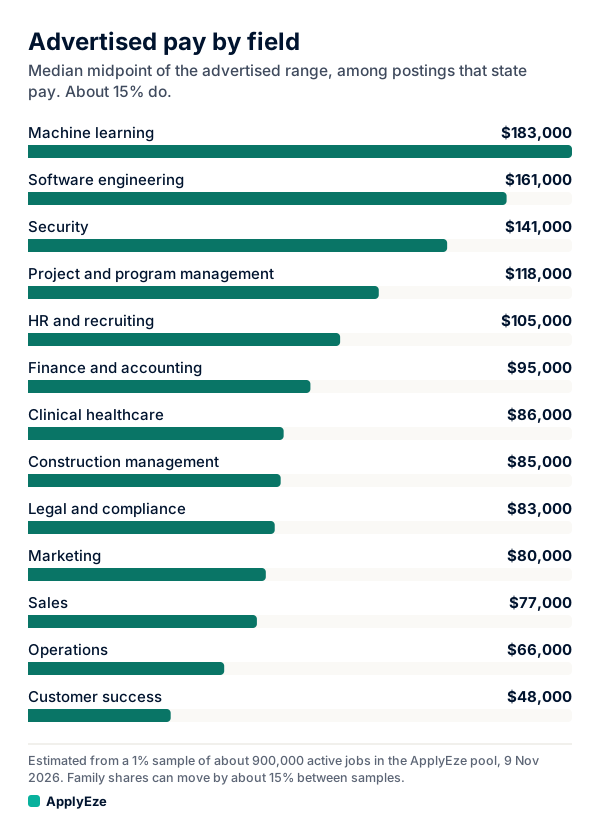
The chart ranks fields by the midpoint of advertised pay, and finance and accounting sits near the middle at about $95,000. Only about 15% of postings state pay, and this family includes accountants, so it is a rough direction and not a market rate. The Bureau of Labor Statistics reports a median of $103,570 for financial analysts in May 2025, with employment projected to grow 7% from 2025 to 2035 and about 29,500 openings a year. The posting itself beats either number when it states a range, as Cognitiv's does at $120,000 to $145,000.
Sending it
ApplyEze delivered 94,207 applications to 9,769 employers between 14 August and 9 November 2026. For each application, an AI model reads that posting and your real history and writes a resume for it, and code rejects a rewrite that adds a figure, employer, school or credential your record does not hold. An audit of 84 sampled resumes on 4 November 2026 found 0 invented employers, dates, degrees or numbers, so your forecast error and variance figures belong in the resume you upload. The skills line is the exception, as the tools section explains: it brings in the posting's named skills and tools, so read a dry run first.
Hard facts on forms come from your profile. When a required question is not covered by your saved answers, ApplyEze still fills it rather than stopping the run, so that answer may not come from you. Fill in your saved answers, use dry run first, and read your receipts. You pick the matches and queue them in the desktop app, so you decide which hybrid schedules are worth an application. It applies in Chrome on your computer, so keep the computer on and awake until the queue finishes. Workday and Oracle jobs stay hidden until you connect an application inbox, because those sites email a code.
If you are still choosing a direction, start with how to get into finance, and if the close is your background, see the accountant resume samples. Once your error figure and your best variance line are on the page, your first 50 applications are free, with no card, and a credit is used only when an application is confirmed as submitted.