
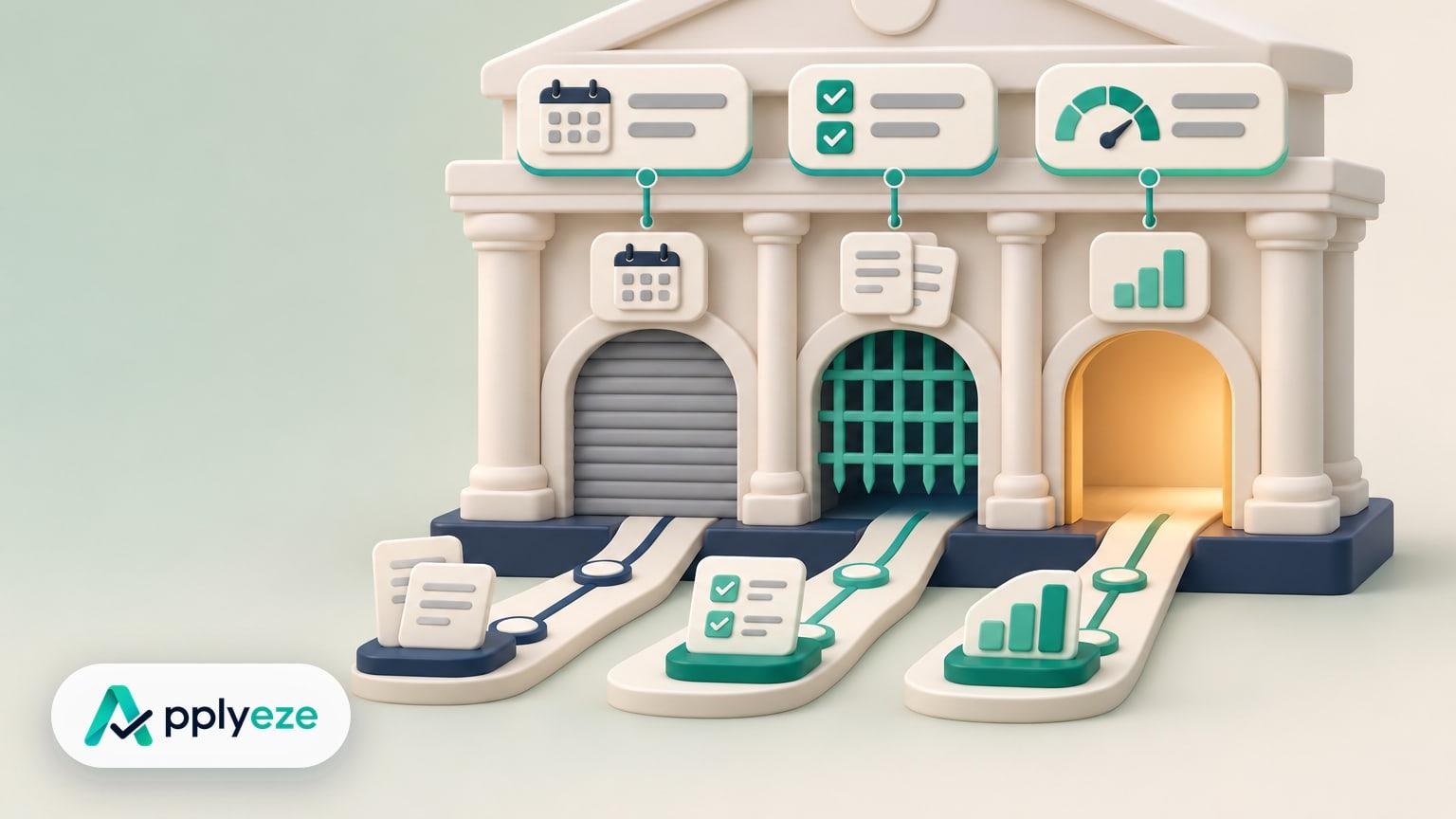
How to get into finance depends on which finance you mean, because each door has a different gate. Corporate finance hires people with Excel and some accounting, all year. Investment banking hires students on a calendar that opens more than a year before the job starts. Brokerage and advising need licensing exams, and the main brokerage exam cannot even be booked until a firm sponsors you. The CFA is a separate decision: $3,520 to $4,570 in exam fees and about 900 study hours. This post shows which gate applies to you, and what you can do this month without anyone's permission.
Which finance do you mean
| Path | Common titles | The real gate | License before you are hired? | When hiring happens |
|---|---|---|---|---|
| Corporate finance and FP&A | Financial analyst, FP&A analyst | Excel modeling, accounting basics, explaining numbers to managers | No | As roles open, plus fall windows for rotational programs |
| Investment banking | Summer analyst, analyst | The campus calendar, networking, technical interviews | No. The firm sponsors the Series 79 | A cycle that opens more than a year ahead |
| Brokerage and markets at a firm | Registered representative, financial advisor | Sales ability and licensing | Series 7 needs a sponsor. The SIE does not | Varies by firm |
| Investment advice | Investment adviser representative | Series 65 and state registration | You can sit the exam alone, but registration usually runs through a firm | Varies by firm |
| Investment management and research | Research analyst, portfolio analyst | An analytical record, often with the CFA | No | Varies by firm |
Accounting is the side door. One live form at Cognitiv asks, "Do you have 3-5 years of experience working in an FP&A or accounting role?" That question treats a staff accountant and a junior FP&A analyst as the same pool, so a finance career can start with an accountant resume and move across later.
Corporate finance and FP&A
This door has no exam. The Bureau of Labor Statistics says financial analysts typically hold a bachelor's degree in finance or a related field such as business, and that most licenses require employer sponsorship, so companies generally do not expect you to hold one before you start.
What the door does ask for shows up in live postings. Everlaw wants someone to analyze results against forecasts and plans, and investigate "material variances to their root causes". Astranis asks for "strong financial modeling, Excel, and reporting skills". Neither mentions a license.
If you have no finance title yet, build the evidence yourself. Two pieces carry most of the weight:
- A three-statement model of a public company, from its annual filing, with a forecast you can defend line by line.
- A variance analysis, even on a club budget or your current team's spend, that splits one change into its causes. Our financial analyst resume post shows the arithmetic and how to write it up.
Rotational programs are where corporate finance has a calendar. The University of Michigan's Finance Development Program is a clean example: applications ran from 3 August to 4 October 2026, full-time seats were open to seniors and recent graduates, intern seats to juniors, and the second round asks for a short presentation. Other programs set their own dates, so if you are in college, start looking in late summer and check again in the fall.
Banking and its calendar
The calendar is the gate, and it has moved. Vault reported on 22 December 2025 that banks used to open internship applications about 12 months ahead and that the cycle now runs nearly two years ahead, with applicants typically current sophomores. The deadlines it listed for summer 2027 internships:
| Bank | Program | Deadline |
|---|---|---|
| Rothschild | US global advisory summer analyst | 1 January 2026 |
| Perella Weinberg Partners | US advisory summer analyst | 18 January 2026 |
| RBC Capital Markets | Investment banking internship, current sophomores | 30 January 2026 |
| Goldman Sachs, JPMorgan, PJT Partners | No 2027 pipeline posted in mid December 2025 | Not yet open |
So a deadline of January 2026 for a job in summer 2027 is about a year and a half of lead time (our arithmetic), and banks in the same class did not open together. The next cycle is already moving. Yale's career office tells sophomores that some boutique banks may take applications for summer 2028 as early as September or October 2026. It also says applications are typically rolling, so you may be interviewed soon after applying, and to expect a mix of live and recorded interviews.
Here is what that means by where you stand today, 9 November 2026:
| You are | Your cycle | What to do this month |
|---|---|---|
| Sophomore, class of 2029 | Summer 2028 internships | Boutiques may already be open. Check them now, keep a tracker of the large banks, and start alumni calls |
| Junior, class of 2028 | Summer 2027 internships | The early deadlines passed in January. Look for what is still open, and at corporate finance internships |
| Senior or recent graduate | Full-time analyst roles | Ask your career office which banks still have seats. Apply to rotational programs and FP&A roles alongside |
| Career changer | The campus cycle is not built for you | Corporate finance is the realistic first move. An MBA is the formal reset, and it is a large cost to weigh |
We found no neutral count of seats left after the main wave. Much of the writing on this calendar comes from coaches selling prep, and their trackers disagree by months. Treat them as hints and check each bank's own careers page.
You do not need a license to apply. FINRA says the Series 79, the investment banking exam, can only be taken if a member firm sponsors you. Leave it off a student resume.
Licensed roles: SIE and Series exams
Most career guides say "get licensed". The useful question is which exams you are allowed to book on your own. Fees and formats below are from FINRA's exam list and NASAA's exam FAQ.
| Exam | Sponsor needed? | Fee | Format | What it does |
|---|---|---|---|---|
| SIE | No, open from age 18 | $100 | 75 questions, 1 h 45 min | Nothing alone. A corequisite for the exams below |
| Series 7 | Yes | $395 | 125 questions, 3 h 45 min | With the SIE, general securities registration |
| Series 79 | Yes | $395 | 75 questions, 2 h 30 min | With the SIE, investment banking registration |
| Series 63 | No | $147 | 60 questions, 1 h 15 min | State agent exam, needed in most states |
| Series 65 | No | $187 | 130 questions, 3 h | Normally needed to become an investment adviser representative |
| Series 66 | No | $177 | 100 questions, 2 h 30 min | Counts as the 63 and 65, but only with a valid SIE and Series 7 |
Four things follow from that table:
- "Get your Series 7 first" is not possible. Anyone telling you to earn it before you apply is wrong about the rule. The SIE is the only FINRA exam here that you can take without a firm.
- Passing is not a license. NASAA puts it plainly: "Passing an exam is a prerequisite to a license, not a license in and of itself." Write "Passed SIE, March 2027". Do not write "licensed" or "registered".
- The clocks run. The SIE result lasts four years. In most states, a Series 63 or 65 pass gives you two years to become registered before the exam expires. Taking the 65 long before you have a job can waste the fee. If you later leave a firm, FINRA's FAQ says your other exams stay valid for two years after registration ends, or up to five through its Maintaining Qualifications Program if you enroll and qualify.
- Two rules change in January 2027. FINRA's retake waits drop on 19 January to 15 days after a first or second failed attempt and 60 days after a third. NASAA's wait after a third failure drops from 180 to 60 days on 4 January, and remote testing for the 63, 65 and 66 ends that same day.
So should you take the SIE before applying? Take it if your target is brokerage, wealth or markets and you expect to be hired within four years. It costs $100 and gives you one true line to add. Skip it if your target is FP&A or corporate finance, since nothing there asks for it.
Forms ask about this directly, sometimes where you would not expect it. The form for an Administrative Assistant at National Life asks, "Are you licensed with a broker dealer or have a current FINRA/SEC license?" With only the SIE, the true answer is no.
Is the CFA worth it for you
Start with the math. These are CFA Institute's 2026 fees, and the totals match the $3,520 to $4,570 on its program page:
| Level | Early registration | Standard registration |
|---|---|---|
| Level I | $1,140 | $1,490 |
| Level II | $1,140 | $1,490 |
| Level III | $1,240 | $1,590 |
| Total, passing each once | $3,520 | $4,570 |
CFA Institute dropped its one-time $350 enrollment fee on 29 April 2025. Time is the larger cost. CFA Institute recommends 300 hours per level, 900 in total, which at 10 hours a week is 90 weeks of study (our arithmetic), and says the program takes three to four years. The charter also needs at least 4,000 hours of relevant work over no fewer than 36 months. Budget for a retake: in May 2026, 39 percent of 31,566 Level I candidates passed, 45 percent among first-time candidates, close to the long-term average of 40 percent.
| Your target | Verdict | Why |
|---|---|---|
| Portfolio management, research, asset management | Worth starting, ideally once you are in the field | This is the work CFA Institute describes the charter for, and the experience rule needs a relevant job anyway |
| Wealth or advice | Optional | Most states let the charter stand in for the Series 65, but the exam itself is $187 |
| FP&A and corporate finance | Usually not first | In the four live analyst postings we read on 9 November 2026, the CFA appeared once, as "bonus points". Modeling appeared in three and SQL in two |
| Banking analyst | Does not help the calendar | A three to four year program cannot beat a cycle that opens while you are a sophomore |
If you do start, word it exactly. CFA Institute's rules allow "Passed Level I of the CFA Program", and "CFA Program candidate" only while you are registered for an upcoming exam or awaiting results. They do not allow "CFA Level I", "CFA candidate", or "CFA (expected 2028)".
What the numbers say about the field
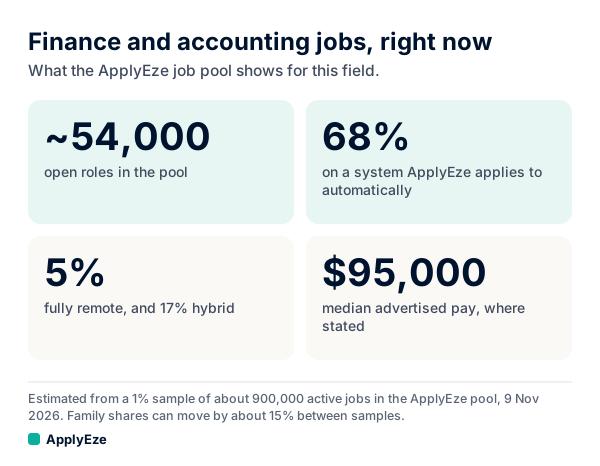
ApplyEze polls more than 100,000 employer boards directly. The chart shows what its pool held for finance and accounting on 9 November 2026: roughly 54,000 open roles, roughly 5% remote, a median advertised pay of about $95,000, and roughly 68% on application systems ApplyEze applies to once an inbox is connected. Roughly 17% are hybrid, about double the 8% across all fields.
These are rough figures from a 1% sample of about 900,000 active jobs, and only about 15% of postings state pay. The family also mixes accountants and analysts, which is why government figures help:
| Occupation (BLS, May 2025 pay, 2025 to 2035 outlook) | Median pay | Growth | Openings a year |
|---|---|---|---|
| Financial analysts | $103,570 | 7% | About 29,500 |
| Accountants and auditors | $83,680 | 5% | About 115,300 |
| Personal financial advisors | $105,070 | 1% | About 17,100 |
The accountant line is the one to notice if you just want in: nearly four times the yearly openings of financial analysts (our arithmetic), with a route across to FP&A later.
How to apply in finance
- Pick the door before you edit anything. A banking application and an FP&A application are read for different things, and a resume that tries to be both reads as neither.
- Search several titles. The same work is posted as financial analyst, finance analyst, FP&A analyst and business analyst. Our guide to getting a job fast covers widening the search without spamming.
- Put calendar windows in your tracker if you are a student: boutiques in early fall, rotational programs in late summer, large banks whenever they post.
- Answer location questions before you apply. Everlaw's form asks about three named days in its Oakland office, Cognitiv's about Monday to Wednesday in New York, and Astranis's about five days on site. With roughly 1 in 6 roles hybrid, you will meet these often.
- Answer license questions literally. A pass is a pass, a registration is a registration, and a sponsor is not a thing you can claim in advance.
- Talk to people. Yale calls networking an important step for banking, so start your alumni calls early.
Choosing the door and making the calls are yours. The form filling does not have to be. For corporate finance and accounting roles, where much of the work is applying widely with a resume that fits each posting, ApplyEze carries that load. It delivered 94,207 applications to 9,769 employers between 14 August and 9 November 2026. For each application, an AI model reads that posting and your real history and writes a resume for it. Your employers, job titles, dates, schools, degrees and certifications come from your own record, and code rejects a rewrite that adds a figure, employer, school or credential your record does not hold. An audit of 84 sampled resumes on 4 November 2026 found 0 invented employers, dates, degrees or numbers. ApplyEze brings the posting's named skills and tools onto your skills line, even when your own record does not list them. There is no step to remove one before a live run, so use a dry run to see what it writes, and be ready to discuss anything on the page. A certification the posting asks for is not added unless you hold it.
You pick the matches and queue them in the desktop app, and it fills and submits each form in Chrome on your computer, so keep the computer on and awake until the queue finishes. Workday and Oracle jobs stay hidden until you connect an application inbox, because those sites email a code. Hard facts come from your profile. When a required question is not covered by your saved answers, ApplyEze still fills it rather than stopping the run, so that answer may not come from you. Fill in your saved answers, use dry run first, and read your receipts.
So choose your door this week and start the one piece of evidence it asks for. If that door is FP&A or accounting, your first 50 applications are free, once per email address with no card, and a credit is used only when an application is confirmed as submitted.