

Find My Profession reviews look close to perfect: 4.8 from 786 on Trustpilot as of 9 November 2026. Read the recent ones, though, and most praise its resume writing, not the reverse recruiting service that costs $3,000 a month, or $1,500 a month plus 8% of first-year salary. That service is a team of people who run your search. This post works out what it costs in five scenarios, reads the interview promise clause by clause, and sorts the recent reviews by what they are about.
A disclosure: ApplyEze makes software that applies to jobs, which competes with one part of this service and not the rest. This is a person, not software, and comparing the two on price alone would mislead, so the case for paying is here too. We read Find My Profession's public pages on 9 November 2026. We have not bought the service.
What they do
Find My Profession says both payment options include the same service:
- Your resume, LinkedIn profile and cover letter, written for your target roles.
- Roles identified for you, which you approve or decline. The team then submits the approved applications.
- Research on hiring managers, and personalized outreach it writes and sends.
- One interview coaching session a month, salary negotiation guidance when an offer arrives, and unlimited messages to a career coach.
- A client portal showing jobs sourced, applications submitted, and contacts and emails sent.
It says its reverse recruiters are all US-based, and it lists 15 of them with 2 managers. Most clients, by its account, are managers, directors, vice presidents and executives pursuing six-figure roles.
The number most reviews miss is volume. Its FAQ says it typically targets 5 to 10 roles a week and explains why it does not apply to more. Over four months, about 17.3 weeks, that is roughly 87 to 173 roles (our arithmetic). Another full-service firm, Reverse Recruiting Agency, told CNBC it submits 50 to 100 a week. If what you want is applications sent, this is not the service that sells them. You are paying for targeting and outreach.
What it costs, with the math
There are two prices. Fixed: $3,000 times the months you pay for. Success fee: $1,500 times the months, plus 8% of first-year salary once you accept a job.
Set them equal and one rule falls out. The two options cost the same when your salary equals $18,750 times the months you pay for.
| Months paid | Salary where both cost the same |
|---|---|
| 2 | $37,500 |
| 4 | $75,000 |
| 6 | $112,500 |
| 8 | $150,000 |
Above that line, the fixed fee costs less if you accept a job. Below it, the success fee does.
Find My Profession's own table, set to four months, shows $12,000 fixed against $14,000 at a $100,000 salary, $18,000 at $150,000 and $22,000 at $200,000. Those are right. The sentence under the table is half right. It says the longer your search takes or the higher your salary, the more the fixed fee saves. Salary, yes. Length runs the other way, because each extra month costs $3,000 on fixed and $1,500 on the success fee. At $100,000, the fixed fee wins by $2,000 at four months and loses by $1,000 at six ($18,000 against $17,000).
Here is what you would actually pay in five situations (our math, from the listed prices):
| What happens | Fixed | Success fee, $100,000 salary | Success fee, $150,000 salary |
|---|---|---|---|
| You stop after 2 months with no job | $6,000 | $3,000 | $3,000 |
| You accept a job in month 4 | $12,000 | $14,000 | $18,000 |
| You accept a job in month 6, paying monthly throughout | $18,000 | $17,000 | $21,000 |
| You accept a job in month 6, with the promise covering months 5 and 6 | $12,000 | $14,000 | $18,000 |
| No job after 10 months, with the promise covering months 5 to 10 | $12,000 | $6,000 | $6,000 |
Two rows assume the promise waives the monthly fee and leaves the 8% in place, which is how we read "no additional monthly service fee". Ask to confirm that.
So the success fee is partly insurance. At $150,000 it costs more in every row where you take a job and half as much in the rows where you do not.
Three things are not on the public pages, and each can move these numbers:
- Whether 8% applies to base salary or to total pay.
- Whether you owe it on a job you found yourself.
- Whether it still applies if you cancel and accept a job later, and for how long.
Those terms sit in a Reverse Recruiting Service Agreement, which the Terms of Use say overrides them. Ask to read it before you pay.
On refunds, plan for none. The FAQ says payments are non-refundable once submitted. The terms say a period with a confirmed launch date cannot be paused or refunded, and each 30-day period holds about 20 business days of active service. "Cancel anytime" means you can decline the next period.
The interview promise, with its conditions
The price card says: "5 Interviews or an Accepted Offer in 4 Months, or We Keep Working for Free", with a note that it is for eligible clients and that participation requirements apply. The full page describes it as a summary of the service agreement. Taken clause by clause:
What you get. Up to six more service months at no additional monthly fee. There is no money back. That makes ten service months the most it can run.
What you must do. Stay enrolled for the full four months. Use the materials it prepares or approves. Keep substantially the same search criteria. Reply to your reverse recruiter within 48 hours. Approve or decline recommended jobs within 48 hours. Attend scheduled interviews, networking calls and strategy meetings, with at least two Zoom strategy meetings a month. Miss these in a way that materially hinders the search and you may lose eligibility. So "cancel anytime" and the promise pull against each other: leave before month four and the promise is gone.
What counts as an interview. A live interview with an employer about a role inside your approved criteria. The page says these generally include interviews with recruiters, hiring managers, executives, HR staff or panels, so a recruiter screen counts. At most two can come from one opportunity, which means at least three different opportunities.
Where it can come from. Its applications and outreach, and also materials it prepared, "including resumes and LinkedIn profiles used by the client". An interview you earn yourself, using the resume it wrote, can count.
What this means. The promise ends once you reach five, whether or not an offer follows. Five recruiter screens and no offer by month four, and further months are at full price.
How hard is five? A rough test, not a forecast: 87 to 173 applications at Huntr's logged interview rates of 3.4% through job boards and 6.0% through employer career sites gives about 3 to 10 interviews from applications alone, before any outreach (our arithmetic). Huntr's self-tracked users are a different group from this firm's clients, so treat that as scale only. It suggests five is a real bar, one a search going badly could miss. The promise is a backstop for that search. It is not insurance on reaching an offer.
What reviews say
The Trustpilot page reads 4.8 from 786 reviews, with 51 in the last 12 months, 94% five-star and 1% one-star, and replies to 66% of negative reviews. That one score covers the whole company: resume writing, coaching and reverse recruiting.
So we sorted the most recent reviews we could read, the 40 on the first two pages on 9 November 2026. This is our own rough reading, and many reviews are vague.
| What the review is about | Count | Star ratings |
|---|---|---|
| Resume or LinkedIn writing | 21 | All five-star |
| Reverse recruiting | 4 | Three five-star, one one-star |
| Both, resume and reverse recruiting | 4 | Two five-star, one two-star, one one-star |
| Cannot tell | 11 | All five-star |
The pattern matters if you are weighing the $3,000 service. Every rating under five stars in that set concerns the job search work, and it is a small set. Clients who loved it exist, and five of them are in that table. The two low mixed reviews, from March and June 2026, praise the resume work and are disappointed by the search or outreach.
Two of those low ratings are disputed. A 1-star review, updated on 18 September 2026, describes slow onboarding and a disagreement over the promise, including a recruiter screen being counted as an interview. Find My Profession replied on 21 September that it disputes the review's authenticity, that it believes the reviewer is associated with a competitor, and that Trustpilot declined to remove the review. It also replied to the March 1-star that the review is not genuine and that it has no record of the reviewer. We cannot settle either, so read both as disputed. The point about recruiter screens stands apart from the reviews, because the company's own page says they count.
Three other things to know when you read reviews of this company:
- Search results for its name include Glassdoor and Comparably pages. Those are staff ratings, which tell you about working there.
- Its site footer says some names, titles, images and identifying details in client stories may have been altered for confidentiality, and that the stories reflect real experiences. Read them as illustrations.
- Its terms disclose that "Best" articles on its blog are the opinions of its employees or contractors. Comparison content from any vendor needs that caution, this post included.
When this is worth paying for
The case for it is strong in a narrow band.
Your next job will come through people. At senior levels, the outreach is the product, and it is the work most people do not do themselves. Software cannot do it at all.
You cannot give the search the hours. If you are employed and busy, paying someone to research hiring managers and write to them is a plain trade of money for time.
The arithmetic works at your salary. Divide the fee by your monthly pay. At $150,000, or $12,500 a month before tax, $12,000 is about one month of pay. If you are out of work and the service gets you hired a month sooner, it has roughly paid for itself. At $75,000, the same fee is about two months. We found no independent evidence of how much it shortens a search. The company says clients who land a role often do so within about four to six months. Huntr's self-tracked users had a median of 102 days to a first offer. Those are different people, and the pair proves nothing either way.
When it is not
Your problem is forms or volume. At 5 to 10 roles a week, you could send that many yourself.
You are early in your career. Below about $75,000, the fixed fee is two or more months of gross pay, and the company itself says most clients pursue six-figure roles.
Your search already works. The founder of a rival firm told CNBC that people getting "a 10% interview rate" early in a search may not need this kind of help.
You want it hands-off. Two 48-hour rules and two Zoom meetings a month are real work, and they are what keeps you eligible for the promise.
You need the money back if it fails. It does not offer that.
Before paying, you can try the core of it for free. Each week, pick 5 to 10 roles you really want, find the hiring manager, apply, and send a short note. This is a sample written for this post:
Hi [Name], I applied today for the [role] on your team. I have spent [N] years doing [closest work], most recently [one concrete result with a number you can back up]. Your posting mentions [specific need], which I handled at [company]. Happy to send a short note on how I would approach it. Thanks, [you]
Log who you wrote to and follow up once. Two or three weeks of that tells you whether your problem is access to people or something else, and that is worth knowing before you spend $3,000.
How software compares, as a different service
Software is not a cheaper version of this. It does a different job. ApplyEze fills and submits application forms, and it writes a resume for each posting. It does not research hiring managers, send outreach, coach you, or help with an offer.
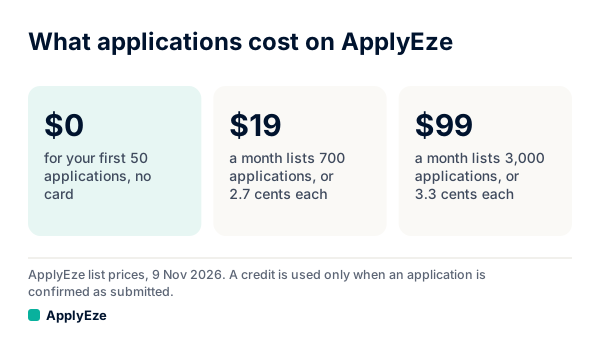
The chart shows ApplyEze's listed prices: 50 free on sign-up, then $19 a month for 700 or $99 a month for 3,000. That is 2.7 to 3.3 cents an application, and other software goes lower. Four months of Starter is $76 against $12,000 here. Only one of the two can write to a hiring manager, and only one can send 700 applications a month. 94,207 applications have gone out through ApplyEze since 14 August 2026, to 9,769 employers. Our guide to hiring someone to find you a job sets every option side by side, and the reverse recruiter guide covers other firms.
If people are the gap in your search, a good team can close it, and software will not. If you would rather keep the outreach in your own hands, there is a middle path: the free test above for the hiring managers, and software for the forms. You queue the roles you want, and ApplyEze runs on your computer, which has to stay on and awake while the queue finishes. Workday and Oracle jobs stay hidden until you connect an application inbox, because those sites email a code. ApplyEze brings the posting's named skills and tools onto your skills line, even when your own record does not list them. There is no step to remove one before a live run, so use a dry run to see what it writes, and be ready to discuss anything on the page. Before you spend $3,000, spend nothing: your first 50 applications are free, once per email address, with no card, and a credit is used only when an application is confirmed as Submitted.