

If you were ghosted by a recruiter, first work out which silence you are in, because three different things get that name. No reply to an application is usually not ghosting at all. Silence after a recruiter screen means a person spoke to you and stopped. Silence after interviews means a team spent hours on you and went quiet, which Greenhouse found to be the top complaint among US candidates who interviewed, at 45%. Each has its own clock. For all three the answer has the same shape: check a few facts, send one message at most, put a date on it, and move on when the date passes.
Three kinds of silence
| No reply to an application | Silence after a recruiter screen | Silence after interviews | |
|---|---|---|---|
| Who has spoken to you | Nobody | One person | Several people |
| What you are owed | Very little. Nobody promised anything. | A courtesy, and often a next step they named | A reply, by any fair standard |
| What it usually means | Not reviewed yet, filtered out, or the role moved on | Waiting on the manager, role paused, you did not advance, or the recruiter left | Decision pending, another finalist ahead, or a rejection nobody sent |
| Your first message | Usually none. One, around day 7, only with a strong fit and a named person. | The business day after any date they gave. Otherwise after 5 business days. | The business day after any date they gave. Otherwise after a week. |
| Your close date | Day 30 after applying | Day 21 after the screen | 14 days after your last message |
The dates are our judgement, built from the evidence below. They are not a measured rule. The point of writing them down in advance is that a date you set now is easier to honor than one you negotiate with yourself at 11 p.m.
This post covers the recruiter side and the first two columns most closely. If you have already interviewed with the team, ghosted after an interview goes deeper on that stage.
How common it is, with sources
No reply to an application. In Greenhouse's October 2026 survey, 81% of US candidates said they were rejected in the past year without ever speaking to anyone at the company. That means it happened at least once, not that 81% of applications end that way. In a United Way survey of 1,000 people, respondents recalled that 67% of their applications got no response, which is memory and not a count. The cleanest measure is an experiment: Kline, Rose and Walters sent over 83,000 fictitious entry-level applications to 108 very large firms, and 24% were contacted within 30 days. So about three in four of those applications drew no contact in a month (our arithmetic). It is a narrow setting, but it shows silence is the default outcome of an application, not a slight.
Silence after a recruiter screen. We found no survey that isolates this stage. Published numbers cover applications or interviews. That gap is why the advice online blurs the three together. Treat anyone quoting a precise figure for it with suspicion.
Silence after interviews. This is the best measured. Beyond Greenhouse's 45%, Huntr's October 2026 survey of 271 people who had interviewed found 37% said employers often or very often stopped responding afterward, 35% said about half the time, and 7% said never. It is self-selected and small. In the same survey, 116 of 272 written answers, or 43%, asked employers for a response of some kind, even a no. In Huntr's survey of 1,049 people from December 2025, nearly 90% said it had happened at least occasionally and only 10% never. Huntr and Greenhouse both sell hiring or job search products, and these are self-reports. The direction is still hard to argue with.
Why recruiters go quiet
Mostly for mechanical reasons, which is worth knowing because it changes what you send.
- The load. Greenhouse's benchmarks show recruiters per organization falling from 10.43 in 2022 to 4.62 in 2025, while applications per recruiter rose from 1,610 to 4,890 a year. A polite no is the first task to slip.
- They do not own the decision. A recruiter often cannot answer you because the manager has not answered them. An in-house recruiter may have nothing new. An agency recruiter works for the client and may be waiting on the same silence you are.
- The news is bad and nobody has sent it. On Greenhouse, an employer that shares status can mark you inactive after a rejection, or 4 days after the rejection date if no email goes out, and "Candidates are not notified about the change."
- The role changed. Budgets freeze and reorganizations move headcount. Some postings were never close to being filled, which ghost jobs covers.
- The recruiter left. It happens, and your thread goes with them.
- You missed something. Greenhouse sends automated mail, including scheduling requests, from no-reply addresses you may never have seen, and those are the kind of messages that can land in spam.
So before you write anything, take five minutes:
- Search your inbox and spam for the company name and the words "schedule" and "availability".
- Check the posting. If it has come down, the role is closed or unposted.
- Check the candidate portal, if the employer has one, for a status change.
- Check LinkedIn to see whether the recruiter still works there. If not, write to whoever else you met or the address on the posting, once.
How long to wait
Our own numbers add a clock for the first kind of silence. They come from callback detection, which is rolling out with staffing teams first and is not part of self-serve accounts yet. Where it is switched on, it reads a candidate's application inbox and labels likely employer replies. It first ran on 3 November 2026 and read mail back to 4 October, across about 29 candidates at one staffing team. These are machine labels no person reviewed, so we say found, not confirmed.
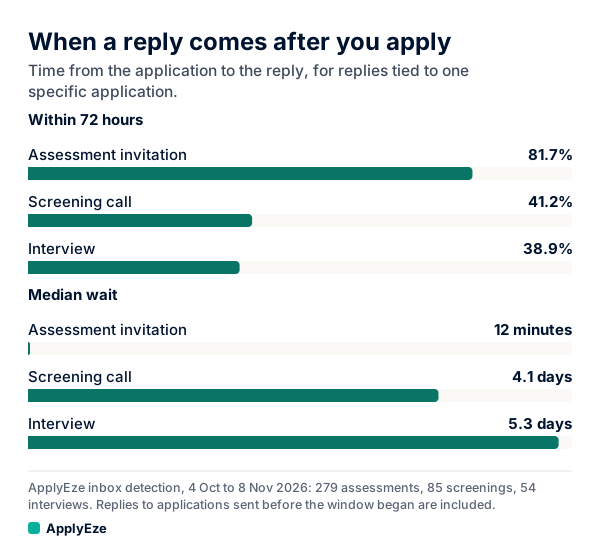
The chart shows how long replies took after an application, for replies that could be tied to one application. Assessment invitations had a median of 12 minutes, since software sends most of them. Screening emails had a median of 4.1 days, with 41.2% inside 72 hours. Interview invitations had a median of 5.3 days, with 38.9% inside 72 hours. These include replies to applications sent before the window began, which pulls those early shares down. A fuller read of applications from 12 to 23 October, with time to mature, covers 58 human callbacks: median 116 hours, 38% within 72 hours, 74% within 7 days.
Two things follow:
- Seven days of silence is not a no. In that fuller read, 26% of callbacks came after day 7 (100 minus 74, our arithmetic). Those applications had between 16 and 27 days to get a reply by 8 November, so the true late share could be higher.
- Day 30 is a fair place to stop. This part is judgement. It matches the 30-day window in the Kline experiment, and by then the replies that come quickly have long since come.
After a screen or an interview. All of that runs from the application, so use it for the first column only. For the other two, use whatever date you were given, and these outside medians for scale: Huntr's Q3 2026 data puts application to interview at 5 days and interview to offer at 7 days among users who logged them. Ashby reports a median time to hire of 30 days for business roles and 40 for technical roles, in a table covering the second and third quarters of 2025. So a process that is moving has usually done something within three weeks of a screen. That is why we set that close date at 21 days. Results for any one person will differ.
The one message to send
Send it after the wait in the table. The sample below is written for this post, with fictional names and dates.
Sample final message
Subject: Benefits Analyst: closing the loop
Hi Morgan,
We spoke on 4 November about the Benefits Analyst role. Is it still moving, and am I still being considered? A one-word answer is plenty.
If I have not heard by Friday 20 November, I will take that as a no and close it on my side, with thanks for your time.
Priya Nair
That is under 60 words. For an agency recruiter, change the question to: "Was my resume sent to the client, and have they responded?" An agency recruiter can answer that even when the client has said nothing.
It is built this way on purpose. The question can be answered from a phone in one word. It does not ask why, which is the question recruiters are least able to answer. The date gives the recruiter a reason to act and gives you an end. There is no complaint, because you may want to work with this person on another role in a year. Its job is to stop you waiting, which is the part you control.
Send it once. Reply on the existing thread if you have one, so the history sits underneath. The wording for earlier check-ins, stage by stage, is in how to ask a recruiter for an update.
When it is time to move on
Move on when any of these is true:
- The close date has passed. Any date you named in your message counts as well.
- The posting is gone, or the portal says you are out.
- The recruiter has left and the one other person you wrote to has not answered.
Moving on means something specific. Mark it closed in your tracker. Stop checking the portal. Send no more messages. Do not hold back on applying elsewhere, and do not treat any process as safe until you have a written offer.
It does not mean burning anything. Skip the angry email and the public post naming the recruiter. If they return in six weeks with an opening, as sometimes happens, reply normally and judge the role on its merits.
The best protection against all three silences is having several other things moving, so no single quiet inbox can stall your search. We have measured what that can look like. At one staffing team using ApplyEze, human callbacks per candidate per month rose from about 2 in spring to 7 for October applications, while applications per candidate more than tripled and the rate per 1,000 held near 3. Part of that rise is better counting, and results for any one person will differ.
So send your one message, set your date and get the next applications out. If you are searching on your own, your first 50 applications are free, no card needed. You pick the matches and queue them in the desktop app, and ApplyEze fills and submits each form while your computer stays on and awake.