
To ask a recruiter for an update, write two or three sentences that name the role, give the date of your last contact, and ask one question: when they expect to decide. The harder part is the day you send it. Use about a week after applying or after a phone screen, day 8 after a final round, and two business days after any date you were promised. Where a measured wait exists, those days come from it, and where none exists we say so. Every sample in this post is under 60 words, so a busy person can answer it from a phone.
| Stage | Send on | What the timing rests on |
|---|---|---|
| After applying, with a named contact | Day 7 to 10 | Our data: 74% of human callbacks had arrived by day 7 |
| After a phone screen, no date given | About day 7 | Convention, not measurement. See below |
| After a final round, no date given | Day 8 | Huntr: median 7 days from interview to offer |
| After a promised date passes | Two business days later | Our judgment |
| Final note | About two weeks after your update request | Our judgment |
When an update request is fair
A median is the point where half the answers have arrived and half have not. So a request sent before the median is one the recruiter probably cannot answer, and a request sent well after it comes when silence has started to mean something. Here is what we measured.
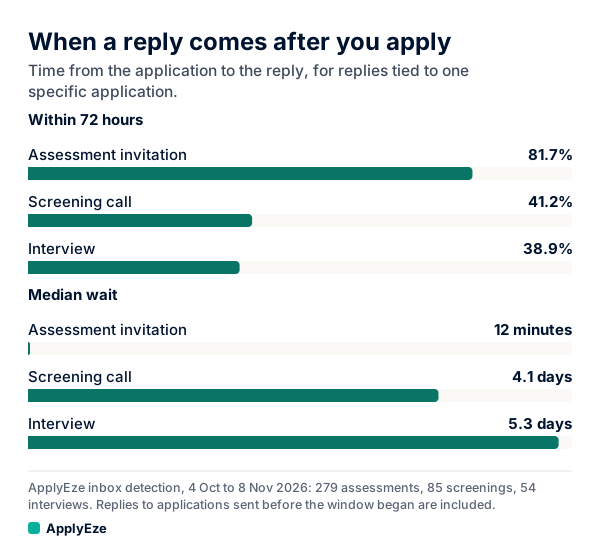
The chart covers replies found in the application inboxes of about 29 candidates at one staffing team, in email received from 4 October to 8 November 2026, and only replies that could be tied to one specific application. Clock time runs from the application.
| Reply type | Tied to an application | Median wait | Within 72 hours | Within 7 days |
|---|---|---|---|---|
| Assessment invitation | 279 | 12 minutes | 81.7% | 94.6% |
| Screening call | 85 | 4.1 days | 41.2% | 60.0% |
| Interview | 54 | 5.3 days | 38.9% | 61.1% |
Those within 7 days figures include replies to applications sent before the window began, which pulls them down. A cleaner read takes applications from 12 to 23 October, which had time to mature: 58 human callbacks (screening calls, interviews and offers), with a median of 116 hours, or 4.8 days. Of those, 38% came within 72 hours and 74% within 7 days.
These are machine labels that no person reviewed, so they are replies found, not confirmed, at one team, and results for any one person will differ. The scan behind them is rolling out with staffing teams first and is not part of self-serve accounts yet. The timing starts at the application, so it says nothing about the wait after an interview.
Two things still follow from it.
Before 72 hours, wait. Only about 4 in 10 human replies had arrived by then. A note on day 2 is asking a recruiter to report on something that has not happened yet.
By day 7, silence is informative. If about 74% of the callbacks that were coming have come, about 26% are left. So whatever your odds were on the day you applied, they are now roughly a quarter of that (1 divided by 0.26 is 3.85, our arithmetic, and it assumes your search behaves like this small sample). A note is fair at this point. It is also fair to spend your energy on the next application.
After applying
Only send this if you have a named person who has a reason to know you: someone you have spoken with, or who wrote to you. Finding a stranger just to ask for status rarely helps. Huntr reports a median of 5 days from application to interview, unchanged for four quarters, which sits close to our 4.8. Both count only applications that got a reply.
All samples below use invented names, roles and dates.
Sample 1. After applying (38 words)
Hi Dana, I applied on 2 November for the Data Analyst role (R4471) and wanted to check where it stands. Is the team still reviewing applications, and is there a date I should keep in mind? Thank you.
After the phone screen
The easiest update request is the one you make on the call: "When should I expect to hear, and from whom?" Then you have a date, and the date rule below applies.
If you have no date, we have no measured wait from a screen to the next step, and we did not find anyone who publishes one. Use a week as a convention. Robert Half's advice from 2017 is that "If you don't hear from the employer within a week of the interview" it is appropriate to follow up. That release draws on a survey of more than 300 HR managers, though the one week line is the firm's advice, not a survey finding.
Sample 2. After a phone screen (33 words)
Hi Priya, thanks again for the call on Tuesday about the Payroll Specialist role. I am still very interested. Do you have a sense of when the team will decide on next steps?
After the final round
Here the evidence is better, and it points to day 8. Huntr's Q3 2026 report says "The median wait from interview to offer fell to 7 days, from 9 in Q2." Survale's 2025 candidate experience research, from more than 66,000 candidate surveys at employers that joined its benchmark, says 60% of candidates "received a job offer within one week of their final interview". We read that as candidates who got an offer, though the fact sheet does not spell it out.
So at day 8, a good share of the offers that are coming have come, and a polite question is reasonable. But look at what those numbers also say. Half of Huntr's offers took longer than 7 days, and about 4 in 10 in Survale's took longer than a week. Huntr's figure counts any interview a user logged, not only the last one, and it has moved around: its 2025 annual figure, covered in our post on how long to hear back after an interview, was 12 days. Silence on day 8 is not a no.
There is also a mechanical reason a strong finalist can wait. One senior recruiter told SHRM she will not reach out to runners-up until the selected candidate accepts. So your recruiter may know something and not be able to say it. That is why this sample asks for a timeline, and not for a decision.
Sample 3. After the final round (38 words)
Hi Marcus, thank you again for the time on 12 November. I am still keen on the Team Lead role, and the conversation with your director made me more so. Is there an updated timeline you can share?
If you hold another offer with a deadline, add that one fact, with the date. It is the one piece of news that gives a recruiter a reason to move.
After a date passed
Give it two business days. Dates slip for dull reasons: an interviewer on leave, a budget sign-off, a preferred candidate thinking it over. The two days are our judgment, and they keep you from writing the morning after a deadline.
Count business days, not calendar days. In our data, 90.5% of human callbacks arrived on a weekday (304 of 336, from the same one staffing team and window). If you were promised an answer by Friday 20 November, your note goes on Tuesday 24 November, not on Saturday.
Sample 4. After a date passed (33 words)
Hi Lena, you mentioned a decision by Friday 20 November on the Informatics Analyst role. I know dates slip. Could you let me know where things stand and when you expect to decide?
"I know dates slip" is doing real work there. It tells the recruiter you are not keeping score, which makes it easier to admit the process has stalled.
The final note
If your update request gets nothing, wait about two weeks and send one last message. Then stop, whatever happens.
This note is mostly for you. It closes the item in your head and your log, and it leaves a good last impression if the role reopens. Robert Half's warning applies: "Persistence is laudable, but pestering can get you removed from the short list."
Sample 5. The final note (46 words)
Hi Dana, I have not heard back on the Data Analyst role, so I will assume it has moved on and keep my search going. If that is wrong, or something similar opens, I would be glad to hear from you. Thank you for your time.
Our guides to being ghosted by a recruiter and to a follow up email after no response cover what to do after this, including when a different contact is worth trying.
What a non-answer means
Some replies feel like news and are not. This is our reading of common phrases, from how hiring processes work, and not a measurement.
| They say | What it usually tells you | What to do |
|---|---|---|
| "We are still reviewing applications" | Nothing is decided, and there is no date | Do not ask again for two weeks |
| "We are still interviewing" | The process is open, and you may be in it or held in reserve | Ask once for a rough date |
| "You are still under consideration" | You have not been rejected, and may be a backup | Keep your other applications moving |
| "We will know by the 20th" | A date you can use | Apply the two business day rule |
| "The role is on hold" | Budget or priorities moved | Log it and check back in a month |
| An automatic reply, or nothing | No information at all | Send the final note on schedule |
No answer at all is common, and it is not a judgment of you. In Huntr's Q3 2026 survey, 100 of 271 people who had interviewed (37%) said employers often or very often stopped responding after an interview, and only 7% said it had never happened to them. That survey is self-selected, shared on LinkedIn and Huntr's newsletter. Keep it separate from the other kind of silence, an application nobody answered: in Survale's 2025 research, 31% of North American candidates reported not hearing back 1 to 2 months or more after applying. Different stages, different causes, and in both cases an update request may simply have nothing to report.
What to do today
Open your log, find the oldest live process, and send the sample that fits its stage. Then write down the date the next note is due, and stop thinking about it until then.
It helps to know exactly what the recruiter has in front of them. In ApplyEze, every run leaves a receipt with the result, the time taken, screenshots where taken and the documents sent, so you can see which resume went to that employer before you write. You record employer replies yourself on each application. You queue the roles you want in the desktop app, which runs on your computer while it is on and awake, and Workday and Oracle roles need a connected application inbox. If you would rather spend the wait with more applications in play, your first 50 are free, once per email address with no card.