
A follow up email after no response works best as a fixed sequence: at most two nudges, each gap at least as long as the last, then one close-the-loop note, then nothing. Decide this before you send the first one. The emails take minutes. What costs you is the weeks of checking an inbox and treating a silent employer as a live option. A stop rule ends that on a date you chose, and it frees your attention for the applications that can still answer you. Below are the rule, samples for the three common situations, and the math on what it saves.
The rule: two nudges, then close the loop
| Situation | Clock starts | Nudge 1 | Nudge 2 | Close the loop |
|---|---|---|---|---|
| Application, with a named person to write to | The day you applied | Day 7 to 10 | About 7 days later | Optional, about 7 days later |
| Application, portal or generic inbox only | The day you applied | Skip it, or send one | None | None |
| A recruiter wrote first, you replied, then silence | The day you replied | 3 to 5 business days | 5 to 7 business days later | 7 to 10 days later |
| After an interview | The interview, or a promised date | Day 7, or the day after the date | About 7 days later | About 7 days later |
Three parts make it a rule and not a mood.
- The gaps never shrink. Each wait is at least as long as the one before it. A second nudge that comes faster than the first reads as pressure.
- Each message has a different job. Nudge 1 asks for something specific. Nudge 2 asks something easier and offers a way out. The close asks for nothing.
- A real reply resets it. "We should know next week" gives you a new date. An out-of-office reply gives you a new start date. An automated receipt resets nothing.
Why two. We found no experiment on this, so the evidence is thin. The advice lines up, though. Robert Half, writing about applications, says "If you have followed up a few times and still have not heard back, that's a strong sign to move on." Indeed, writing about interviews, says one or two, about a week apart. A 2017 Accountemps survey release warns that "cluttering the employer's inbox with numerous emails is annoying."
There is a mechanism worth knowing too, from outside hiring. In a 2015 study, Kooti and colleagues looked at email between pairs of Yahoo Mail users. Half of replies came within 47 minutes, and more than 90% within a day. As daily volume rose, people answered a smaller share, from about 25% of all emails received at low load to less than 5% at high load. That is personal email and not recruiters, so carry the shape and not the numbers. People who answer tend to answer quickly, and busy people skip more. A week later, your message is not pending on anyone's list. It has sunk. So a nudge does one thing: it puts the question back on top. Once is a fair test of bad timing, and twice covers a holiday or a bad week. A third adds little evidence (our reasoning, not a finding).
After an application
Most applications should get no nudge at all. Follow up only where a named person exists and you fit the hard requirements. Our guide on how to follow up on a job application has the timing survey and a way to triage. All samples in this post were written for it, with made-up names.
Sample, nudge 1:
Subject: Senior Buyer application, req 4471
Hi Sam,
I applied for the Senior Buyer role on 3 November and wanted to check it reached you. I have run indirect procurement for a 900-person plant, which the posting lists first. Is there a rough timeline for first interviews?
Thanks, [Your name]
Sample, nudge 2, on the same thread, only if you have something new:
Hi Sam,
One addition: I finished the CPSM certification last week. If the role is filled or on hold, a one-word reply would help me plan.
Thanks, [Your name]
If you have nothing new and true to say, skip nudge 2. Do not invent a reason to write.
After a recruiter's first message
This silence is stranger, because they started it. The usual reasons are dull: the role paused, the client went another way, or your reply landed in a pile while they chased someone else. The fix is to make saying yes take one tap, and to stay on the channel they used. If they wrote on LinkedIn, nudge on LinkedIn. More on this in ghosted by a recruiter.
Sample, nudge 1:
Hi Dana,
You wrote last week about the Senior Buyer role, and I replied on Tuesday. I am interested. I can talk Thursday after 2 or Friday morning. Does either work?
[Your name]
Sample, nudge 2:
Hi Dana,
Trying once more on the Senior Buyer role. If it has moved on, "filled" is a complete answer, and I would be glad to hear about similar roles later.
[Your name]
After an interview
Here you have earned a reply, and you may have a date to quote. The day by day version, with a sample for each step, is in our follow up email samples. This is the second nudge, the one people get wrong by repeating the first:
Sample, nudge 2:
Hi Maya,
I wrote last week about the Senior Buyer role and wanted to try once more. Is the team still deciding, or has it gone another way? Either answer helps me plan.
Thanks, [Your name]
How to space them
Two of our own measurements bear on spacing. Neither measures replies to follow ups, so read them as a picture of when employers write at all. They come from an inbox scan that is rolling out with staffing teams first and is not part of self-serve accounts yet. It first ran on 3 November 2026 and read back to 4 October, across about 29 candidates' application inboxes at one staffing team. These are machine labels no person reviewed, so we say found and not confirmed.
Do not fire the first nudge early. The clock in this chart starts at the application.
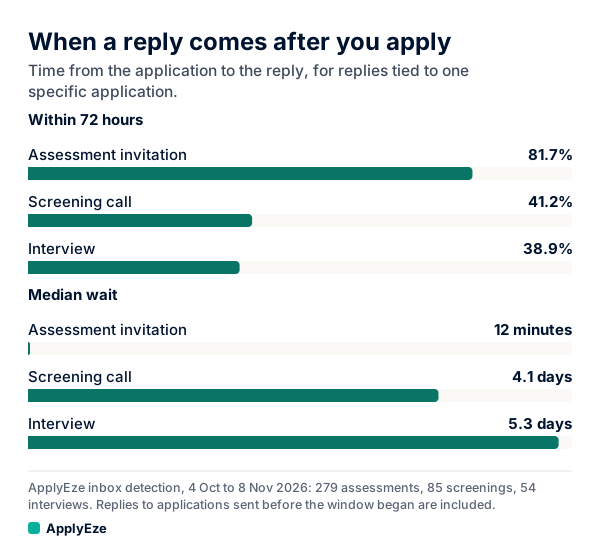
Assessment invitations come in a median of 12 minutes, mostly automatically. Screening invitations take 4.1 days and interview invitations 5.3 days, and about 4 in 10 arrive within 72 hours (41.2% and 38.9%). In applications sent from 12 to 23 October, which had time to mature, 74% of 58 human callbacks came within 7 days, so 26% came later (100 minus 74). A nudge on day 3 is mostly noise. Those timings cover only replies tied to one ApplyEze application, and they run from the application, not from an interview.
Count business days. Of 336 screening and interview invitations found, by day in New York time:
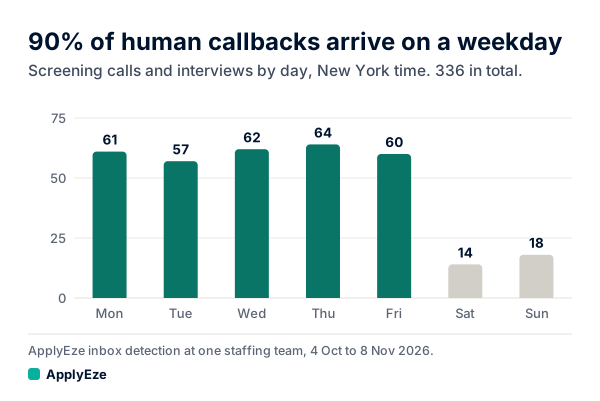
Monday to Friday held 304 of the 336, or 90.5%. Saturday had 14 and Sunday 18. So a gap that spans a weekend is two days shorter than it looks. The weekdays are level, from 57 on Tuesday to 64 on Thursday, so there is no best day to wait for. Pick one morning a week, send every nudge due that week in one sitting, and close the tab. For more on this count, see do recruiters call on weekends.
The close-the-loop note
It asks for nothing. That makes it quick to read and easy to answer, and it ends the matter for you whether or not anyone does.
Sample:
Hi Sam,
I have not heard back on the Senior Buyer role, so I will assume the search has moved on and take it off my list. Thank you for your time. If something similar opens up, I would be glad to hear from you.
Best, [Your name]
Skip it for portals and generic inboxes. Send it where a person has spoken to you. Then do these four things the same day:
- Mark it closed in your tracker, with the date. Closed does not mean rejected. It means you have stopped spending on it.
- Archive the thread. You lose nothing: Gmail says "If someone replies to a message you archive, it returns to your inbox."
- Delete the reminders. A calendar entry for a dead process keeps it alive in your head.
- Spend the slot on a new application. Moving on works better when something takes its place.
Here is what the rule saves, using outside averages as an illustration. Huntr's median job seeker sends roughly 16 applications a week. United Way NCA's 2026 survey has people recalling that 67% of their applications got no response, so call it about 11 silent ones a week (16 times 0.67). Three messages on each at an assumed 5 minutes a message is 165 minutes a week. Those same respondents put about 44 minutes on each application, tailoring included, so that time would pay for nearly four more applications (165 divided by 44). These are different groups of people and one assumption of ours, so the point is the size. Following up on everything would cost you about a morning a week, and many of those messages would go to generic inboxes.
How common silence is
Silence is normal, and three recent surveys show it. They do not measure the same thing, so do not add them up.
| Source | What it found | What it measures | What it does not tell you |
|---|---|---|---|
| Greenhouse, October 2026 | 81% of US candidates were rejected from a job in the past year without speaking to anyone at the company. 31% say it happens often or almost always | Whether it happened at least once in a year, among 1,200 US job seekers | The share of applications that end this way |
| United Way NCA, May 2026 | 94.3% applied and never heard back. On average, 67% of their applications got no response | What 1,000 US job seekers recall about their own applications | An actual count. This is people's memory |
| Huntr, October 2026 | Of 271 people who interviewed, 37% say employers often or very often stopped responding after an interview, 35% about half the time, 7% never | Silence after an interview, among people who chose to answer a survey on LinkedIn and in Huntr's newsletter | Anything about applications that never reached an interview |
Greenhouse and Huntr sell hiring and job search software, so read their numbers as a vendor's. The direction is still consistent. One line in the Huntr report says what most people in this position want: 116 of 272 open answers, or 43%, asked for "a response of any kind, even a no." You cannot make an employer give you that. You can give it to yourself, on a date of your choosing.
What to do with the slot you freed
Open your tracker today and apply the rule to every silent thread. Send what is due, and close what has had its last note.
Keep the follow ups for yourself, on the few roles where a person is reading. The slot you freed can go to a new application, and that part can be handed off. ApplyEze has delivered 94,207 applications since August, to 9,769 employers. You pick matches from a ranked board and queue them in the desktop app, which runs on your computer while it is on and awake, and it fills and submits each form. Workday and Oracle roles need a connected application inbox. If you would rather spend that morning a week on the roles that answer, your first 50 applications are free, once per email address with no card.