
A follow up email after an interview works best when it goes out on a planned day and asks one question. Send a thank you within 24 hours. Send nothing on day 3 unless you owe them something. Write your first real follow up on day 7, or on the business day after any date they gave you. Write a second on day 14, a final note about a week later, and then stop. Below are six samples keyed to those days, the one rule behind each, and the numbers behind the schedule.
A day count to work from
Count calendar days from the interview. If a day lands on a weekend, send on the Monday. Any reply resets the count: if a recruiter writes "we should know next week", that becomes your promised date.
| Day | Message | Its one job | Skip it when |
|---|---|---|---|
| 1 | Thank you | Put one detail from the conversation in writing | Never |
| 3 | Something you owe them | Deliver it and ask for nothing | You owe nothing, which is most of the time |
| 7 | First follow up | Ask for a rough date | They gave you a date that has not passed |
| 14 | Second follow up | Ask a different, easier question | You have had any reply |
| Business day after a promised date | Date check | Ask for a new date. This replaces the nearest day 7 or day 14 note | No date was given |
| About a week after your last note | Final note | Close it yourself and ask for nothing | You have had any reply |
A worked example. You interview on a Tuesday, and the recruiter says they hope to decide by Friday of next week. You send your thanks that evening or on Wednesday morning. The day 7 note drops out, because the date has not passed. That Friday is day 10, so on Monday, day 13, you send the date check. If nothing comes back, the final note goes out the following Monday, day 20. That is three messages in 20 days.
Two sets of numbers sit behind these days, and they measure different things.
The gap you are in. Huntr, which sells a job search tracker, reports a median of 7 days from interview to offer in Q3 2026, down from 9 in Q2. That covers interviews and offers its users logged themselves, and Huntr says they do not log everything. Read it this way: about half of those offers took a week or longer. On day 7 you have learned very little, which makes it a fair day to ask and a poor day to conclude anything.
A different gap, which we can measure. Our count starts at the application and not at the interview, so it does not measure your wait. It comes from an inbox scan that is rolling out with staffing teams first and is not part of self-serve accounts yet. When the scan first ran on 3 November 2026 it read back to 4 October, across the application inboxes of about 29 candidates at one staffing team. Some replies can be tied to one specific ApplyEze application, and those give the timing.
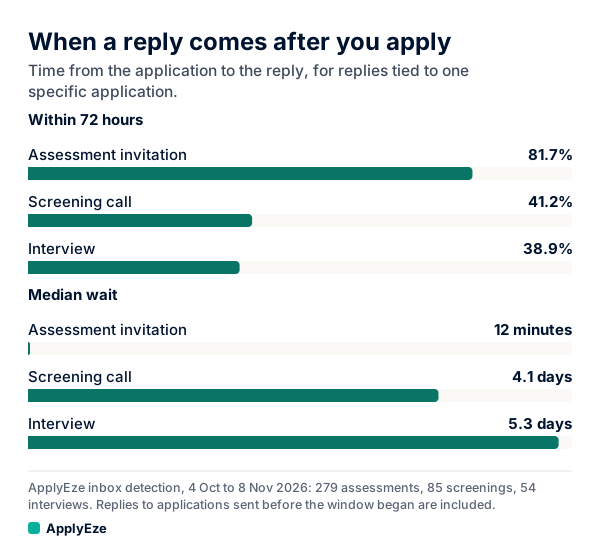
The chart shows how far apart the clocks run. Assessment invitations, most of them sent automatically, have a median wait of 12 minutes. Screening invitations take 4.1 days and interview invitations 5.3 days, and only 41.2% and 38.9% of them arrive within 72 hours. In a smaller group with time to mature, applications sent from 12 to 23 October, 74% of 58 human callbacks came within 7 days, so 26% took longer (100 minus 74).
What that adds: when a reply needs a person, it takes days, and a real share takes more than a week. These are machine labels that no person reviewed, so we say found and not confirmed, from one team, with the timing resting on 85 screening and 54 interview replies. Recent applications had less time to draw a reply, which is why the 7 day figure comes from the older group.
All six samples below were written for this post, with a made-up role and contact. Swap in your own details.
Day 1: thank you
The rule: include one detail only the two of you would recognize.
Harvard Law School's advising office says to write "within 24 hours", and that is the only hard deadline in this post. Our thank you email guide has versions for a phone screen, a panel and a final round, so here is only the short form.
Subject: Data Analyst interview, Nov 12: thank you
Hi Maya,
Thank you for your time today. Your point about the reporting backlog stayed with me, because I cleared a similar one in my last job by retiring the reports nobody opened.
I would like this role. If anything would help before the next step, I can send it.
Best, [Your name]
Day 3: only with something to add
The rule: if it needs a reply, it is too early.
Most people should send nothing on day 3. The team may still be interviewing. Ashby, an applicant tracking system, reports 11.7 interviews per hire on business roles and 17.6 on technical roles, counted across all candidates, so yours may be one of many still waiting to be compared. "Any news?" at this point asks for something that does not exist yet.
The exception is a message that delivers: the work sample you promised, the link you mentioned, a figure you got wrong in the room.
Subject: Re: Data Analyst interview, Nov 12: thank you
Hi Maya,
Here is the cohort query I mentioned on Thursday, with the customer names removed. The part you asked about is in the second tab.
No reply needed.
Best, [Your name]
"No reply needed" is what makes this one safe. Your name reappears, and nothing lands on their list.
Day 7: the first real follow up
The rule: ask one question that can be answered in a line from a phone.
Write to the recruiter, or whoever scheduled you, and reply on the thread you already have so the history sits underneath. Day 7 and "five business days" are the same day. Indeed calls five business days "a common guideline", and a 2017 Robert Half release said a week. Neither is the result of a test, and we found no test. Our post on how long to wait traces that and gives an answer by situation.
Subject: Re: Data Analyst interview, Nov 12: thank you
Hi Maya,
I am following up on last Thursday's interview for the Data Analyst role. I am still interested. Do you have a rough date for the next step?
Thanks, [Your name]
Anything you might want to add, such as a recap of your experience or an apology for writing, makes this harder to answer.
Day 14: the second
The rule: change the question, and make no an easy answer.
Repeating "any update?" tends to get what it got last time. By now you are asking whether and not when. If a date has passed or you hold another offer, use the fuller samples in our two week follow up guide.
Subject: Re: Data Analyst interview, Nov 12: thank you
Hi Maya,
I wrote last week about the Data Analyst role and wanted to try once more. Is the team still deciding, or has it gone another way? Either answer helps me plan, and a one-line reply is plenty.
Thanks, [Your name]
After a promised date
The rule: quote their date, then ask for a new one.
A promised date is the one deadline here you did not invent, so use it. Wait for the next business day, because a decision made on the day may still be reaching you that evening. Say nothing about the miss. The person who set the date knows.
Subject: Re: Data Analyst interview, Nov 12: thank you
Hi Maya,
You mentioned the team hoped to decide by Friday. Has that date moved? A rough new date is all I need.
Thanks, [Your name]
If a new date comes back, it replaces the old one, and the count starts again from there. Dates slip for dull reasons. Ashby says one more interview event on technical roles adds about a week to the process, so one extra conversation on someone's calendar can move a date without anything being wrong.
The final note
The rule: assume the answer and ask for nothing.
Send this about a week after your last message. Silence after an interview is ordinary, and it reaches people who interviewed well. In Huntr's October 2026 survey, of 271 people who had interviewed, 37% said employers often or very often stopped responding after an interview, 35% said about half the time and 7% said never. That sample chose itself, through Huntr's newsletter and LinkedIn. Greenhouse, which sells hiring software, found 61% of job seekers had been ghosted after an interview in a 2024 survey of 2,500 workers in the US, UK and Germany.
Subject: Re: Data Analyst interview, Nov 12: thank you
Hi Maya,
I have not heard back on the Data Analyst role, so I will assume the team has gone another way and take it off my list. Thank you again for your time. If something similar opens up, I would be glad to hear from you.
Best, [Your name]
Then stop writing. The note is for you as much as for them: it ends the waiting on a day you chose. If they come back a month later, reply as if nothing happened.
What not to write
| Line | What is wrong with it | Write instead |
|---|---|---|
| "Just checking in" | It holds no question, so there is nothing to answer | "Do you have a rough date for the next step?" |
| "Did I get the job?" | A recruiter often cannot say until the decision is final | "Is the team still deciding?" |
| "I haven't heard from you in two weeks" | It is a complaint about the reader | "It has been two weeks since we spoke" |
| "I need an answer by Friday" | A deadline you cannot back up costs you trust if they ask | Only with a real offer: give the date and the reason |
| Your resume again, plus a recap | They have it, and it adds reading | One new fact, if you have one |
| The same note to three interviewers | They may compare notes | One person, usually the recruiter |
| Email, phone and LinkedIn in one day | Robert Half's release warns that "pestering can get you removed from the short list" | One channel, on the planned day |
For the subject line, including when to keep the thread and when to start a new one, see 25 samples by situation.
While you wait
Put your next two dates from the table in your calendar now, then leave the thread alone until they come up.
These notes are yours to write, because the detail that makes them work came from a conversation only you were in. The forms are the part you can hand off, so one quiet process does not stall the rest of your search. ApplyEze has delivered 94,207 applications since August, to 9,769 employers. You pick roles from a ranked board and queue them in the desktop app, which runs on your computer while it is on and awake, and it fills and submits each form. Workday and Oracle roles need a connected application inbox. You record employer replies yourself on each application. If you would rather spend your evenings on interview prep, your first 50 applications are free, once per email address with no card.