

How long after an interview should you follow up? About a week if nobody gave you a date, and one business day after the date if somebody did. Send a thank you within 24 hours either way. That is the convention, and it is a reasonable one, but it is not a finding: we looked for a study comparing outcomes by follow up timing and found none. So here is an answer for each situation, where the usual numbers come from, and the employer data that makes a quiet week look ordinary.
A table by situation
These windows are our judgment, built from the sources in this post. If an employer told you how to reach them or asked you not to, that overrides everything here.
| Situation | Send your first follow up | Write to |
|---|---|---|
| They named a date | One business day after it | Whoever named it |
| They gave a range, such as "a week or two" | One business day after the end of the range | Whoever gave it |
| They said "soon", or gave no date | Day 7, the same as five business days | The recruiter or scheduler |
| You have only a hiring manager's address | Day 7 to day 10, once | The hiring manager |
| Your contact is an agency recruiter | 3 to 5 business days, and a call is fine | The agency recruiter |
| After a phone screen or first round | Day 7 | The recruiter |
| After a final round | Day 7, and expect a longer wait for the answer | The recruiter, not the panel |
| You hold another offer with a deadline | Now, whatever the calendar says | The recruiter |
| An out-of-office reply gives a return date | The day after they return | The same person |
| A holiday or shutdown falls in the window | Add those days | The same person |
Three of those rows need a reason.
Recruiter or hiring manager. A recruiter expects status questions, and telling you the timeline is part of the job. A hiring manager's day is mostly something else, so give them longer and write once. If you have both addresses, go to the recruiter.
Agency recruiter. Many agency recruiters earn their fee when a candidate is placed, so they tend to want to hear from you, and they often have a direct line to the client. Asking sooner costs little.
First round or final. The window is the same and the wait is not. After a first round, someone has to say next round or no. After a final round, Indeed notes that sign-offs from human resources and department leads can add several business days even when an employer wants to make the offer. So a quiet week after a final round says less than the same week after a phone screen.
The offer row has a source too. Indeed's advice is that with a competing offer you "can follow up immediately regardless of any discussed timeline". The wording to use is in our two week follow up guide.
If they gave you a date
Use it. Write on the next business day, not the afternoon of the date, and not a week later out of politeness. "End of next week" means you write on the Monday after. If they gave two dates, use the later one.
Then quote their date without comment and ask for a new one. Any new date replaces the old one, and the count starts again from there. A date that slips once is routine, for the reasons below. A date that slips with no reply is the point where you start counting toward your last note.
If they gave you no date
Write on day 7. It helps to know how thin the support for that is, because you will see it stated with more confidence than it deserves.
- A 2017 staffing firm's advice. A Robert Half release, built on a survey of more than 300 US HR managers about thank you notes, says that if you do not hear "within a week of the interview, it's appropriate to follow up". That line reads as the firm's advice to candidates. It is the closest thing to a source we found.
- Indeed, on two pages. One page, updated September 2026, says "A common guideline is to wait five business days" and names no source for it. Another, updated June 2026, says to send its check-in sample "if you haven't heard back after two weeks since your interview".
- Windows by industry. The Interview Guys give 3 to 5 business days for tech and marketing, 5 to 7 for healthcare, finance and manufacturing, and 7 to 10 for education. The page says these rest on surveys of "over 500 hiring managers" and "1,000+ successful candidates", and publishes no questions, dates or results to check. The same page credits a 44 day "average time-to-hire across all industries" to a Bureau of Labor Statistics report and links to JOLTS. We read the 3 November 2026 JOLTS release. It covers job openings, hires and separations, and it gives no time to hire.
So five business days against two weeks is not a dispute data has settled. What we do have is one measure of the gap itself. Huntr, which sells a job search tracker, reports a median of 7 days from interview to offer in Q3 2026, among interviews and offers its users logged. Its 2025 annual report said 12 days, and Huntr says some past figures differ from earlier reports because of its method, so treat either as rough. Both describe people who got an offer. Neither counts interviews that ended in silence.
The simplest way out of all this is to ask before you leave the room: "What is the next step, and when should I expect to hear?" A date from them replaces every number in this section.
Why processes run slowly
A slow process usually has a dull explanation, and the numbers show why.
The team is interviewing other people. Ashby, an applicant tracking system, analyzed over 109 million applications for its 2026 Talent Trends Report. Business roles average 11.7 interviews per hire and technical roles 17.6, up 36% and 52% from 2021. That counts every candidate interviewed, not your rounds. If you went early in the slate, you are waiting on everyone after you, and the wait says nothing about you.
Most of those people will not get an offer. Ashby puts offer conversion once interviewed at 10.4% for business roles and 7.3% for technical roles in Q1 2026, or about 1 in 10 and 1 in 14 (our arithmetic: 1 divided by each rate). Until it has picked someone, the team often has nothing to tell you.
One more step can cost a week. Ashby reports 4 interview events per hire on business roles and 5 on technical, and says the extra event on technical roles adds a week. That gives you a scale. One more conversation can move a date by a week with nothing wrong.
Fewer recruiters are carrying more. Greenhouse's recruiting benchmarks, from over 6,000 companies, show recruiters per organization falling from 10.43 in 2022 to 4.62 in 2025, while applications per recruiter per year rose from 1,610 to 4,890. That is about three times the queue (4,890 divided by 1,610). All of these figures come from vendors describing their own customers, so they are not the whole labor market.
A person takes days. Our own count starts at the application, so it does not measure the interview gap. What it shows is the pace of human replies. It comes from an inbox scan that is rolling out with staffing teams first and is not part of self-serve accounts yet, and it read the application inboxes of about 29 candidates at one staffing team, in email from 4 October to 8 November 2026.
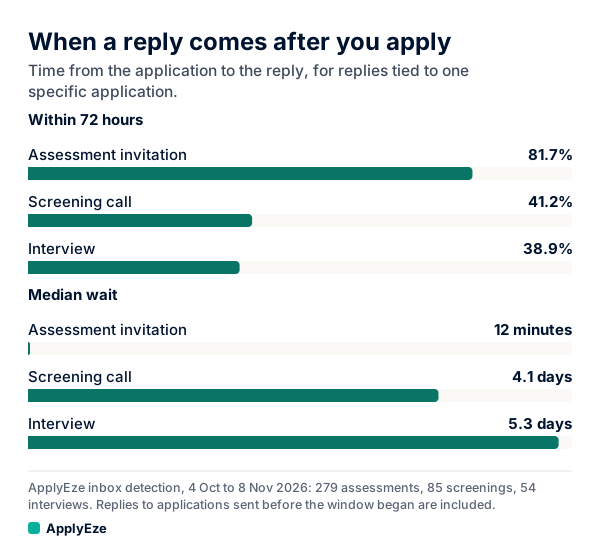
The chart splits replies by kind. Assessment invitations, mostly automatic, have a median of 12 minutes after applying. Screening invitations take 4.1 days, and interview invitations 5.3 days. Those are machine labels no person reviewed, so we say found and not confirmed, and the timing covers only replies tied to one ApplyEze application (85 screening, 54 interview). The useful part is the gulf between a machine and a person. It is why a fast acknowledgment means little, and why a few quiet days mean little too.
What to send
Keep it short enough to answer from a phone, and reply on your existing thread. A sample, written for this post:
Hi Maya,
I am following up on last Thursday's interview for the Data Analyst role. I am still interested. Do you have a rough date for the next step?
Thanks, [Your name]
Our follow up email samples have a version for each day count, including the note for a date that has passed.
When to stop
After the thank you, send two follow ups about a week apart, then one final note that asks for nothing. Indeed is close on the number: "one or two follow-ups spaced about a week apart", since more "could feel excessive". Our post on following up after no response has the full stop rule.
For what to read into signals while you wait, see how long to hear back after an interview.
Your next step is to find your row in the table, put the date in your calendar, and keep applying until then, because a second process makes any one silence matter less. That is the part ApplyEze handles. It polls more than 100,000 employer boards directly, about 900,000 active jobs, and has delivered 94,207 applications since August. You pick roles from a ranked board and queue them in the desktop app, which runs on your computer while it is on and awake, and it fills and submits each form. Workday and Oracle roles need a connected application inbox. If you would rather spend the week preparing for your next round, your first 50 applications are free, once per email address with no card.