

A follow up email two weeks after an interview asks a different question from one sent at one week. At one week you are asking when. At two weeks you are asking whether: whether the search is still live, and whether you are still in it. So the note should offer an easy no, not repeat "any update?". Spend two minutes on the checks below first, because they can answer the question without an email. Then use one of three samples, depending on whether you were given no date, a date that has passed, or a deadline from another offer.
What two weeks of silence can mean
You cannot see inside the team, but most explanations fall into six groups, and some can be checked from where you sit.
| What may be going on | What you can check | What it changes |
|---|---|---|
| Your slate is not finished. Ashby reports 11.7 interviews per hire on business roles and 17.6 on technical roles, across all candidates | Whether anyone told you interviews would run through a certain date | Ask for a new rough date |
| You are the backup, and they are waiting on a first choice | Nothing. It looks the same as silence | Keep your other processes moving |
| An approval or budget stalled | Whether the posting is still up on the employer's own site | A pulled posting means the role closed or was unposted, so ask once, plainly |
| You were rejected and nobody sent the email | The employer's candidate portal. On Greenhouse, where the employer shares status, an application goes inactive 4 days after the rejection date if no email is scheduled or sent, and "Candidates are not notified about the change." | Stop. No note needed |
| Your contact is away or has left | An out-of-office reply, or their LinkedIn | Write to someone else from the panel, once |
| A reply went astray | Your spam folder, and search for the recruiter's name | Reply to what you missed |
The posting check has one trap. A posting reposted with a new date can mean the search reopened. It does not by itself mean you are out, and it is a fair reason to write. Our guide to Greenhouse application status shows how to read that portal. Other systems differ.
What silence does not tell you is how the interview went. People who did well get the same quiet.
Sample: no date was given
The rule: ask a question with two easy answers. Two weeks is a normal time to send this. Indeed's check-in sample is written for it, "if you haven't heard back after two weeks since your interview". Write on the thread you already have. All three samples here were written for this post, with made-up names.
Subject: Re: Operations Manager interview, Oct 27
Hi Dana,
It has been two weeks since we spoke about the Operations Manager role, and I wanted to check where things stand. Is the team still deciding, or has the search gone another way? A one-line answer is plenty, and either way I enjoyed meeting you and Luis.
Thanks, [Your name]
"Still deciding" and "gone another way" are both answers a busy person can send in five seconds. A vague "any update?" asks them to compose something.
Sample: the date has passed
The rule: state their date, say nothing about the miss, and ask for a new one. This should go out on the first business day after the date. If you are only now noticing the date has passed, send it anyway.
Subject: Re: Operations Manager interview, Oct 27
Hi Dana,
When we spoke, you expected a decision by the 6th. I wanted to check whether that date has moved. I am still interested in the role, and a rough new date would help me plan.
Thanks, [Your name]
Leave out "I know you are busy" and "sorry to bother you". Neither helps, and both make the message longer to read.
Sample: you have another offer
The rule: only if it is real, and give the date. Here a new subject line helps, because it should not get buried under the old preview. Gmail starts a new conversation when the subject changes, and our subject line guide has more on when to use that.
Subject: Operations Manager: offer deadline Nov 17
Hi Dana,
I have received another offer and need to answer by Tuesday, November 17. I would still prefer this role. Do you expect the team to decide before then? If not, I understand, and knowing that would help me too.
Thanks, [Your name]
Indeed's advice is that with a competing offer you "can follow up immediately regardless of any discussed timeline", and that this "may encourage the hiring team to expedite". May is the right word: we know of no data on how often it works.
Before you send it:
- Decide what you will do if they say no. If you would take the other offer, this note costs you nothing. If you would not, you are bluffing, and they may call it.
- Keep "I would still prefer this role" only if it is true. Otherwise write "I am still interested in this role".
- Leave out the other employer and the pay. They did not ask, and this is a timing question, not a negotiation.
How long processes really run
Two public numbers help you place yourself, and they pull in opposite directions.
The employer's clock. Ashby, an applicant tracking system, reports in its 2026 Talent Trends Report a median time to hire of 30 days on business roles and 40 on technical roles, measured from application to accepted offer. 75% of roles close within 46 and 57 days. Count the days since you applied, then read across:
| Days since you applied, business role | Days since you applied, technical role | Where that puts you |
|---|---|---|
| Under 30 | Under 40 | Before the median. Two quiet weeks are unremarkable |
| 30 to 46 | 40 to 57 | Past the median, inside the range where three quarters of roles close |
| Over 46 | Over 57 | In the slowest quarter. It could still be a slow search, but plan as if it is a no |
A worked example. Huntr, which sells a job search tracker, puts the median wait from application to interview at 5 days in Q3 2026. Say you interviewed on day 5. Two weeks later is day 19 (5 plus 14), which is 11 days short of Ashby's business median and 21 short of its technical one. If you went through three rounds across a month, the same two quiet weeks put you at about day 44 (30 plus 14), past both medians. That is a very different position, and the table shows it. These come from two companies measuring different people, so read the sum as a rough placement, not a prediction.
The candidate's clock. Huntr also reports a median of 7 days from interview to offer. So at day 14 you have waited twice the median, and about half of the offers its users logged had come within the first of those weeks.
Both are true. The first says do not panic, because the process may be far from over. The second says do not wait quietly, because the fast offers have gone by. That is why you write this note and keep applying in the same week. Neither number counts interviews that ended in nothing: Ashby's covers hires and Huntr's covers offers logged. Huntr's survey fills in some of that side. Of 271 people who interviewed, 37% said employers often or very often stopped responding after an interview. It is a self-selected group.
We can add one number of our own, on a different clock.
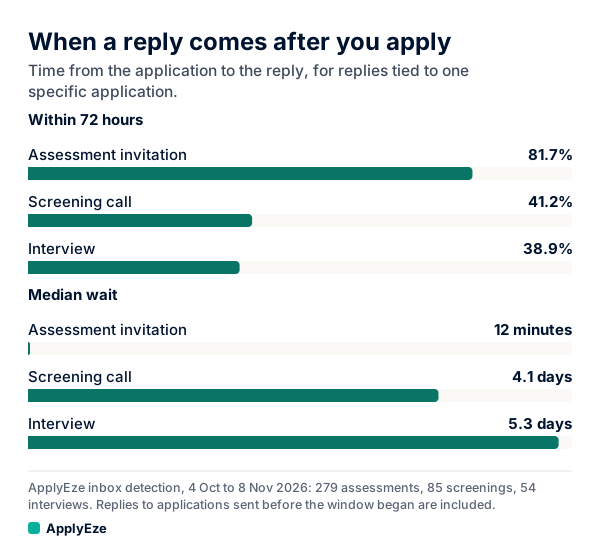
The chart shows time from the application to a reply, not from an interview, so it does not measure your two weeks. Assessment invitations, mostly automatic, take a median of 12 minutes, while screening and interview invitations take 4.1 and 5.3 days. For applications sent from 12 to 23 October, 74% of 58 human callbacks came within 7 days. That group had only 16 to 27 days to run when we read it, so it does not show how many replies arrive after two weeks. These come from an inbox scan that is rolling out with staffing teams first and is not part of self-serve accounts yet, covering about 29 candidates at one staffing team, in email found from 4 October to 8 November 2026. They are machine labels no person reviewed, so we say found and not confirmed.
After this one, what next
| Your situation | Next step |
|---|---|
| This was your first note since the thank you | One close-the-loop note about 7 days later, then stop |
| You already wrote on day 7 | This was your second. Send the close-the-loop note about a week from now, then stop |
| They replied "still deciding" with a date | Wait until the day after that date. The count starts again |
| They replied "still deciding" with no date | Wait 7 days, then ask once for a rough date |
| You hold another offer | Their answer, or the deadline, decides it. No more notes |
| You have only ever written to the recruiter | One short note to the hiring manager is fair, if you have the address from the process. Then stop |
The wording for that last message is in follow up email after no response, along with the reason to stop at two. If this has happened at a late stage, ghosted after an interview covers what silence usually means.
Send the sample that fits today, then put the next date in your calendar. The quiet weeks are a good time to send more applications, since an answer here might never come.
Here is what higher volume looked like in practice. At one staffing team using ApplyEze, human callbacks per candidate per month rose from about 2 in spring to 7 for October applications, with volume more than tripled and the rate per 1,000 applications holding near 3. That is one team working with us and not a self-serve account, part of the rise is better counting, and results for any one person will differ.
On your own, you pick matches from a ranked board and queue them in the desktop app, which runs on your computer while it is on and awake, and it fills and submits each one. Workday and Oracle roles need a connected application inbox. If you would rather spend these two weeks on your next interview than on forms, your first 50 applications are free, once per email address with no card.