
Do recruiters call on weekends? Rarely. Of 336 emails inviting someone to a screening call or an interview, 304, or 90.5%, arrived from Monday to Friday, and 32 arrived on a Saturday or Sunday. We found them in the application inboxes of about 29 job seekers at one staffing team, between 4 October and 8 November 2026, with days set to New York time. These are emails and not phone logs, and no weekday stood out from the others. So you can stop checking on Sunday, and you can stop waiting for a best day.
The pages that rank for this question on 9 November 2026 offer general advice, forum threads and recruiter job listings. We did not find one with a count behind it, so here is ours, with the work shown.
The answer, day by day
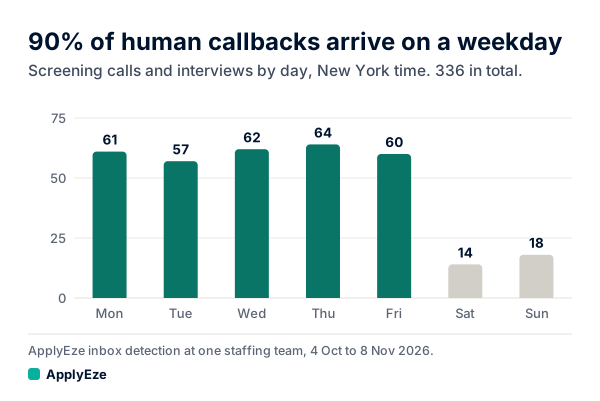
The chart shows about 60 emails on each weekday, then a drop to 14 on Saturday and 18 on Sunday. The last column of this table is the one to read:
| Day | Emails found | Share of 336 | Times that day fell in the window | Emails per day |
|---|---|---|---|---|
| Monday | 61 | 18.2% | 5 | 12.2 |
| Tuesday | 57 | 17.0% | 5 | 11.4 |
| Wednesday | 62 | 18.5% | 5 | 12.4 |
| Thursday | 64 | 19.0% | 5 | 12.8 |
| Friday | 60 | 17.9% | 5 | 12.0 |
| Saturday | 14 | 4.2% | 5 | 2.8 |
| Sunday | 18 | 5.4% | 6 | 3.0 |
The window opens on a Sunday and closes on a Sunday, so it holds six Sundays and five of every other day (our arithmetic, counting both end dates). That is the whole reason Sunday's 18 beats Saturday's 14. Per day they are level, at 3.0 and 2.8.
Across the 25 weekdays the rate was 12.2 emails a day. Across the 11 weekend days it was 2.9. So a weekday carried about 4.2 times the mail of a weekend day. Weekend days were 31% of the calendar and 9.5% of the count.
How these were counted
Here is how callback detection works where it is switched on. It is rolling out with staffing teams first and is not part of self-serve accounts yet. A scanner reads a candidate's application inbox, and code and an AI model label the likely replies from employers.
- What counts. 196 screening invitations and 140 interview invitations, 336 in all. We call these human callbacks. That names the kind of reply. It does not prove a person typed it, since a scheduling tool can send the message.
- What does not count. The 465 assessment invitations found in the same inboxes are counted apart, because most are sent automatically. Rejections are not counted at all.
- How they were found. The scanner first ran on 3 November 2026 and read back to 4 October. These are machine labels on the emails received in that window, and no person reviewed them. So we say found, never confirmed.
- Whose applications. Some could not be tied to one application sent through ApplyEze, and those may have come from the candidates' own applications. A day count does not need the tie, so all 336 are here.
- The clock. Every time is New York time, wherever the sender sat. An email sent from Los Angeles after 9 p.m. on a Friday counts as Saturday here, and one sent after 9 p.m. on a Sunday counts as Monday.
The thing the question asks about, the phone call, is not in this data. An inbox cannot see a phone log or a text, and replies sent through a job board's own messaging, such as LinkedIn or Indeed, are not picked up. Treat the pattern as a stand-in for when employers reach out. Our reasoning, not a measurement: a call needs a person at work at that moment, and an email can be queued, so we would not expect calls to lean further into the weekend than email does.
No weekday stands out
Thursday was busiest with 64 and Tuesday was quietest with 57. A gap of 7 on a base of about 60 looks like a small real difference. It is smaller than chance usually produces.
We tested that with a simulation. We dropped 304 emails at random onto five days, 200,000 times, with every day equally likely. The typical gap between the busiest and quietest day was 18. Only about 4% of runs came out as even as the real count, with a gap of 7 or less. Thursday won nothing and Tuesday lost nothing.
A holiday sat in the window and barely shows. Monday 12 October was Columbus Day, a federal holiday, and Mondays still reached 61, though not every employer closes for it.
Claims about a best day tend to measure something else. Bullhorn, which sells staffing software, reports that Tuesdays have the highest phone connect rate at 10 percent and Fridays the lowest at 8.7 percent, from a study of over 20,000 calls whose method the page does not describe. That is a vendor claim about whether candidates pick up when a recruiter dials. It says nothing about which day employers reach out, and in this count Tuesday came last, by a margin too small to mean anything.
What the weekend share means
Weekend contact is rare, and it is not zero. The scale helps here.
Eighteen Sunday emails, across six Sundays and about 29 people, is about 0.1 per person per Sunday: 18 / (6 x 29). That is one email every ten Sundays or so, on average. These are also people with a very large number of applications in play. That team's own tracker logged about 2,190 applications per candidate for October. Someone sending a few dozen a week has far fewer open, and results for any one person will differ.
The 336 are not broken down by field, so this count cannot say who sits in that 9.5%. Two outside sources suggest how weekend mail happens.
Shift-based hiring. Randall Reilly, which sells recruiting services to trucking fleets, says that 35 to 50% of truck driver applications are submitted after hours or on weekends, citing research from Tenstreet and Double Nickel. It tells fleets to have recruiters stay late or work weekends, rotate an on-call phone, or send automated texts. That is a vendor's pitch, and it is also a fair warning. If you are applying for hourly or shift work, weekend contact may be more common for you than this count shows.
Outreach tools. Vendors advising recruiters disagree about weekends. Bullhorn says two studies it does not name found higher candidate response rates on Saturday and Sunday. Pin, an AI recruiting platform, reports the opposite across more than 4,000,000 messages from June 2025 to May 2026: reply rates of 3.90% on Saturday and 4.35% on Sunday, against 5.16% on Thursday. Both describe cold outreach, not replies to applications. They do show that some recruiting mail is timed by a tactic or a tool, so a Sunday email does not prove someone is at a desk waiting on your answer.
What this data leaves open
- Whether a phone rang. There are no calls, texts or job board messages in it.
- Your field. It covers one staffing team and about 29 candidates, with no breakdown by industry.
- The rest of the year. It covers five weeks in the fall, with one federal holiday.
- When anyone decided. This is when an email arrived. A scheduled send would hide the moment someone chose to write.
- Your odds of a reply. It counts replies that came, as labelled by a machine. It says nothing about your chance of getting one.
What to do with this
- Stop checking on Sunday. If your job inbox sends alerts to your phone, mute it from Friday evening to Monday morning. One look on Monday morning catches whatever came in, and in this count that was roughly 1 email in 10.
- Stop expecting a best day. Tuesday is not lucky, and a quiet Monday tells you nothing. Friday carried as much as any other weekday, so a week is not over on Thursday.
- Make one exception. A self-booking link can lose its open slots, so if one lands on a weekend, take a minute and book. Anything else can wait. We found nothing showing that a Sunday reply beats a Monday morning one.
- Count the wait in working days. A Friday application has a weekend of thin mail straight after it, so it will look slower than it is. Our post on how long to hear back after applying gives the day counts, and what time recruiters call runs this same count by the hour.
- Check a strange weekend call the normal way. The FTC warns that in one scam "you may get a call out of the blue from a stranger offering you a job opportunity," and says honest employers "will never ask you to pay to get a job." The day alone proves nothing. Look up the company and the person before you share anything.
When you send your application is a separate question, and our post on the best time to apply for jobs traces the evidence.
The weekend is yours, so plan the search around that. On a self-serve ApplyEze account you record employer replies yourself, on each application, whenever you next look. You queue the matches you want in the desktop app, keep the computer on and awake while they run, and connect an application inbox if you want Workday and Oracle roles. If you would rather have your Sundays back, your first 50 applications are free, no card needed, and ApplyEze fills and submits each form.