

An assessment email after applying usually means a rule fired, not that someone read your resume. In five weeks of replies found at one staffing team, from 4 October to 8 November 2026, 465 of 801 were assessment invitations. Those we could tie to one application arrived a median of 12 minutes after it went in. An interview invitation took a median of 5.3 days. So do not read a fast invite as interest. Do treat it as a real step with a deadline, because the score may count even though no person chose to send you the test.
What ranks for this phrase on 9 November 2026 is mostly hiring software documentation written for employers, plus forum threads from confused applicants. Neither helps much with the decision in front of you, which is what the email tells you and whether it is worth your evening.
Most replies are not people
Here is how callback detection works where it is switched on. It is rolling out with staffing teams first and is not part of self-serve accounts yet. A scanner reads a candidate's application inbox, and code and an AI model label the likely employer replies into kinds. It first ran on 3 November 2026 and read back to 4 October, across about 29 candidates at one staffing team.
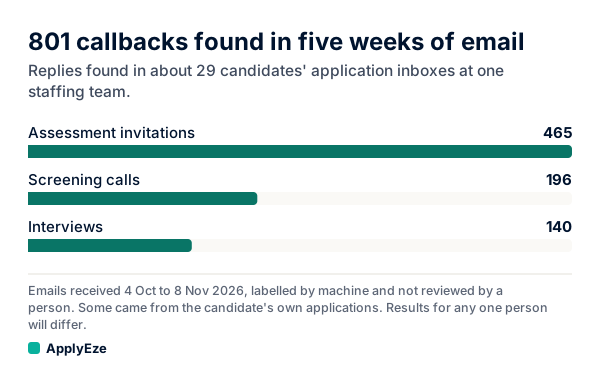
The chart shows 465 assessment invitations, 196 screening invitations and 140 interview invitations, 801 in all. Assessments are 58.1% of the total, or 1.4 for every screening or interview email.
Do not expect the same mix yourself. These people had far more applications open than one person could send by hand. The shape is the point: much of what comes back quickly from an employer is a test.
The 12 minute median
Of the 465 invitations, 279 could be tied to one specific application. Among those:
| Measure | Assessment | Screening | Interview |
|---|---|---|---|
| Median time after applying | 0.2 hours (12 minutes) | 98.1 hours (4.1 days) | 126.8 hours (5.3 days) |
| Within 72 hours | 81.7% | 41.2% | 38.9% |
| Within 7 days | 94.6% | 60.0% | 61.1% |
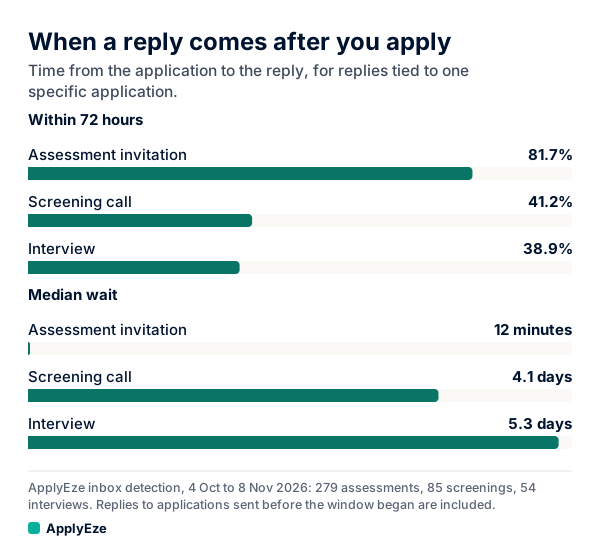
The chart makes the same point: assessments run on a clock of minutes, and the other two run on a clock of days. Half of the timed invitations came within about 12 minutes. That is too fast for a reading of the application, which points to software.
The tail deserves a look. 18.3% of timed invitations took more than 72 hours, which is roughly 51 of 279, and 5.4% took more than a week, roughly 15 (our arithmetic). Those late ones are probably a different thing, and the next section explains why.
How an invite can arrive that fast
Hiring software documents this openly. There are two common triggers.
A rule on the application itself. On CareerPlug, an applicant who gives the desired answer to a Fast Track prescreen question is sent the test without anyone acting. Its help page says "CareerPlug will automatically email them an invitation with a link to take any assessments" set for the job, immediately, wherever the assessment step sits in the hiring process. So on that system, a fast invite does tell you something: your form answers matched what the employer wanted.
A rule on a stage. Greenhouse lets an employer automatically send a test "when a candidate moves into" a test stage. One partner's setup guide on Greenhouse's help site has the employer "set the trigger to Immediately." Ashby says "automated activities will run as soon as the candidate has been moved to the specified stage", and assessments are among the activities it can automate.
A stage rule needs something to move you into that stage. It might be a person, an automation, or a bulk action on a batch. From the outside you cannot see which, and the time since you applied is the only clue you get.
Why assessments are counted apart
Any count of callbacks that includes these looks 2.4 times better than one that does not: 801 against 336, from the same inboxes. We keep them apart because most are sent automatically, and an automatic email says little about whether anyone wants to talk to you.
This matters for your own tracking and for anything you read. If you log assessments as responses, your interview rate will look healthier than it is, and you will fix the wrong thing. If a service quotes a response rate, it is fair to ask whether automated tests are in it.
What a fast invite does and does not mean
The middle column is our inference from the mechanisms above. Our data shows the timing and not the trigger.
| When it arrived | Likely trigger | What you can take from it |
|---|---|---|
| Minutes after you applied | A rule on the application or on entering the first stage | The system has your application. Your form answers may have passed a prescreen. Nobody needs to have read anything. |
| Hours to 3 days | Could be a rule, a batch or a person | Little. You cannot tell which. |
| More than 3 days | More likely a stage move, by a person or a batch | Slightly more. Something happened to your application after it arrived. Still no proof anyone chose you. |
Fast does not mean unimportant. In SHRM's survey of 1,688 HR professionals, run in February 2022, 56% said their employers use pre-employment assessments, and 79% said scores are just as important as traditional criteria or more so. That survey is dated, and there is no recent neutral number. TestGorilla's 2025 survey of 1,084 people involved in hiring, in the UK and US, puts skills test use at 76%, and TestGorilla sells tests.
SHRM adds one detail that fits the timing. Of organizations that require work samples or simulations, 82% use them for applicants "identified for further consideration". So a long hands-on task may come later than a short screening test, and it may carry a little more meaning when it does.
What the 196 and 140 tell you
They tell you the next reply runs on a slower clock. Screening invitations took a median 4.1 days and interview invitations 5.3, so an instant test followed by days of silence is a normal pattern. Our guide to how long to hear back after applying has a day by day rule for that wait.
They do not give you a pass rate. It is tempting to divide 336 by 465 and call it a 72% chance of moving on. Do not. A screening email may come from a job that never sent a test, and many tests may never have been taken. This data does not link who took which test to what happened next.
How to read this count
- Machine labels. No person reviewed them, so we say found and not confirmed.
- Partial tying. Only 279 of the 465 could be tied to one application, and the timing figures cover only those. The rest may include replies to the candidates' own applications.
- "Automatic" is a pattern, not a verdict on one email. Most are sent automatically, and the timing supports that.
- Only emailed tests. A test built into the application form sends no email, so it does not appear here.
- One team, five weeks. It covers about 29 candidates in the fall of 2026, with no breakdown by field or test type. Results for any one person will differ.
How to plan for them
Verify before you click. Check your own list: did you apply to this company, for this role? Look up the employer yourself and do not rely on the email's links for that. The FTC says "Honest employers, including the federal government, will never ask you to pay to get a job." Some real tests do ask for ID. CodeSignal's coding assessment setup asks for a webcam photo of you and a photo of a government-issued ID, so a request for ID does not settle it either way, and it is one more reason to check the sender first.
Read for four facts. The deadline, the length, the format and whether it is proctored. Put the deadline on your calendar the same day. Invitations can lapse: Coderbyte's help page, for one, describes "making screening assessment links expire after a certain number of days".
Decide if it is worth it. Ask one question: would you take this job? A test is a real cost. CodeSignal's general assessment gives you 70 minutes in one sitting, unless the company sets a different length. If the answer is no, skip it and accept that the application probably ends there.
Budget the hours. At this team, 465 invitations across about 29 people over 36 days is about 16 each, or about 3 a week (our arithmetic). At 70 minutes each, that would be about 3.5 hours a week. Those people had an unusual volume of applications open, about 2,190 per candidate for October on the team's own tracker, so your number is likely lower. The point holds at any scale: more applications bring more tests. Decide your weekly limit before the emails arrive, and spend it on the roles you most want.
Take it when you can do it well. We found nothing showing that finishing fast helps. The invitation came in 12 minutes because software sent it, and that is no reason for you to answer in kind. Start once you have the time to finish in one sitting, in a quiet room, on a device the test supports. Our guides to CodeSignal and pre-employment tests cover preparation.
Ask early if you need longer. An automated sender may not read replies, so look for a recruiter's name in the job thread or on the application portal. A sample note, with invented details, to adapt:
Subject: Assessment deadline for the Operations Analyst role
Hi Dana, thanks for the assessment invitation for the Operations Analyst role. I want to give it my full attention, and I am tied up through Thursday because of a work deadline. Could the link stay open until Monday? If it cannot be moved, let me know and I will complete it by the current date.
Your evenings should go to the tests for roles you want. ApplyEze does not take assessments for you. It fills and submits application forms: you queue the matches you want in the desktop app, keep the computer on and awake while they run, and connect an application inbox if you want Workday and Oracle roles. On a self-serve account you record replies yourself. To keep your test hours for the roles you most want, start with your first 50 applications free, no card needed.