
A pre employment test is a screening step an employer uses before hiring, and the useful question on the day you get one is which kind it is. An aptitude test, a skills test, a personality questionnaire and a one-way video each reward different preparation, and the invite usually tells you which you have if you know where to look. They are common. Of 801 next-step replies found in the application inboxes of about 29 candidates at one staffing team, from 4 October to 8 November 2026, 465 were assessment invitations. Those we could tie to one application arrived a median of 12 minutes after it went in.
Outside figures point the same way, once you read the dates. SHRM's 56% of employers comes from 1,688 HR professionals surveyed in February 2022, so it is not a current number, whatever date a blog puts on it. TestGorilla's 76% using skills tests comes from 1,084 people involved in hiring, surveyed in April 2025, and TestGorilla sells tests. We found no recent neutral figure, so read those as "more than half" and "maybe three in four".
How to tell which test you were sent
Start with the email, then the first screen behind the link. The link's address often names the vendor, and that usually settles it.
| What you see | What you have | Does practice pay? | Your move |
|---|---|---|---|
| A clock, numbers, words and patterns, "as many as you can". Names such as Wonderlic or PI Cognitive | Aptitude or cognitive test | Yes, for format and pacing | Try sample questions, then sit it rested and in one go |
| A named tool or task: Excel, typing, a coding language, a sample piece of work | Skills test | Yes, most directly | Practice the skill itself. Check length and proctoring first |
| Statements to rate or adjectives to tick, no clock, "no right or wrong answers" | Personality test | Very little | Answer as you are at work |
| "What would you do" scenarios with options to rank | Situational judgment test | Some | Reread the posting for what the job values, then answer as you would really act |
| Questions about honesty, theft or breaking rules | Integrity test | Very little | Answer truthfully, and note the state law point in our personality guide |
| A camera check, questions on a countdown, nobody on the other end | One-way video | Yes, out loud | Rehearse two or three stories. Read any notice about AI scoring |
| Short games and no questions | Game-based test | Format only | Play as you normally would |
| Several sections behind one link | A bundle | Prepare for the timed part | Plan for the whole length, not the first section |
| A drug screen, a lab visit or a physical exam | A different step | No | Check the timing rule in the next paragraph |
That last row trips people up, because the phrase also covers drug and medical screening. Under EEOC guidance, a medical exam has to wait until after a conditional job offer. A test for current illegal drug use is treated differently: such tests "are not considered medical examinations", so one can come earlier.
If the email does not say, ask. A sample note, with invented details:
Subject: Question about the assessment for the Operations Analyst role
Hi Dana, thanks for the link. So I can set aside the right amount of time, could you tell me what the assessment covers and roughly how long it takes? If it is timed or needs a webcam, I would like to plan for that.
Aptitude and cognitive tests
The EEOC's description is plain: "Cognitive tests assess reasoning, memory, perceptual speed and accuracy." The defining feature for you is the clock. Wonderlic's candidate FAQ says "The 12-minute, timed portion of the test contains 50 questions", and that candidates "are not expected to complete all these questions". That is 14.4 seconds a question (our arithmetic). So an unfinished test is normal, and one stubborn question is the expensive mistake. Our Wonderlic practice test guide has a preparation plan.
Practice has a measured effect. A meta-analysis by Hausknecht and colleagues, covering 107 samples and 134,436 participants, found an adjusted gain of .26 standard deviations on a retest. On a normal curve, that moves someone from the 50th percentile to about the 60th (our arithmetic). Coaching widened it, .64 against .21 on the study's less corrected figure, and so did seeing the identical form, .40 against .22.
Read that with care. It measures people sitting a test a second time, sometimes with instruction. It is not a measure of what any prep book does for you, and you will not see the identical form on purpose. The lesson is that format surprise costs points and is cheap to remove. Publisher samples are enough for that, as long as you remember Criteria's own warning that its practice versions are "shortened, simulated versions" that "do not reflect the exact experience or full difficulty level".
Skills tests
The EEOC groups these as "Sample job tasks (e.g., performance tests, simulations, work samples, and realistic job previews)". In an inbox they look like an Excel test, a typing test, a coding assessment or a short written exercise. Criteria's list includes Word, Excel, PowerPoint, typing speed and computer literacy.
Length varies more here than anywhere else. CodeSignal's general coding assessment gives you "70 minutes (unless a different duration has been configured by the company)" in one sitting, after a setup that can ask for a photo of your face and your official ID. Some vendors also limit retakes, so check before treating a first attempt as practice.
Timing tells you something too. In SHRM's survey, 82% of organizations requiring work samples or simulations used them for applicants "identified for further consideration". So a long task may arrive later than a short test, and may mean more when it does. If a task looks like hours of real work before anyone has spoken to you, it is fair to ask how long it should take and who will read it.
Personality tests
These ask how you tend to behave. The Predictive Index calls its version a "six-minute, untimed workplace assessment" and says "It isn't pass/fail, and there are no right or wrong answers", while also saying HR teams use results "to compare candidates against what a role needs". Both can be true, and that second part is why gaming one is guesswork. Wonderlic Select shows how these get bundled: its FAQ describes "three sections, one timed and two untimed", with 58 motivation items and 150 personality items after the cognitive section, and says most people finish in about 35 minutes.
How to answer, what consistency checks do, and when one should put you off an employer are in our guide to employment personality assessments.
One-way video
You record answers alone against a countdown. HireVue's candidate FAQ says "Most video-based assessments include between five and eight questions" and that "you should set aside 45 minutes to stay on the safe side". Rehearse out loud, because what you are doing on the day is speaking to a camera with a clock running. Our HireVue interview guide covers settings and retakes.
One law is worth knowing. For positions based in Illinois, the Artificial Intelligence Video Interview Act requires an employer using AI analysis to notify you, explain what it evaluates and get your consent before the interview. It must also delete your videos within 30 days if you ask. This is general information, not legal advice.
What the invite's speed tells you
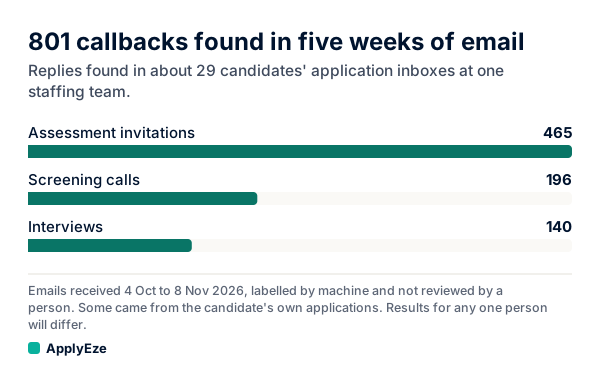
This is the mix of next steps in real application inboxes: 465 assessment invitations, 196 screening invitations and 140 interview invitations. An inbox scan found them when it first ran on 3 November 2026 and read back to 4 October. That scan is rolling out with staffing teams first and is not part of self-serve accounts yet. Assessments are counted apart from human replies because most are sent automatically.
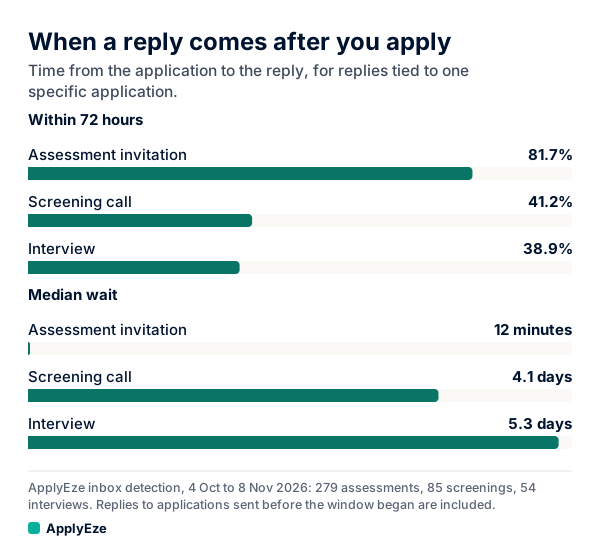
This second chart is why speed reads the way it does. Timed from the application, half of assessment invitations came within 12 minutes, and 81.7% came within 72 hours. Screening invitations took a median 4.1 days and interview invitations 5.3. Twelve minutes is too fast for much reading, so treat a fast invite as a rule firing and not as interest. Our assessment email guide goes through those triggers one by one.
These are machine labels that no person reviewed, so read them as found, not confirmed. The timing covers the 279 invitations we could tie to one application, and some of the rest may answer the candidates' own applications. It is one team, sending far more applications than one person sends by hand, and the count is not split by test type, so your mix will differ.
What a score can and cannot say
Fast does not mean unimportant. In SHRM's survey, 79% of HR professionals said skills assessment scores were as important as traditional criteria or more so. The research is more modest about what those scores predict. A 2022 reanalysis by Sackett and colleagues in the Journal of Applied Psychology revised the standard figures downward. A validity here is a correlation with job performance, where 0 means no relationship and 1 means perfect.
| Selection method | Schmidt and Hunter, 1998 | Sackett and colleagues, 2022 |
|---|---|---|
| Structured interview | .51 | .42 |
| Job knowledge test | .48 | .40 |
| Work sample | .54 | .33 |
| Cognitive ability test | .51 | .31 |
| Integrity test | .41 | .31 |
| Situational judgment test | not listed | .26 |
| Conscientiousness, overall | .31 | .19 |
| Unstructured interview | .38 | .19 |
Squaring .31 gives about 10% of the variation in job performance (our arithmetic), which leaves most of it unexplained. The authors conclude these procedures "remain useful" but that the relationships are "considerably lower than previously thought". So a rejection after a test says less about your ability than it feels like it does. It may still end that application.
Should you do every one?
No. Tests are a real cost, and the publishers' own numbers let you price them:
| Test | Stated length |
|---|---|
| PI Behavioral Assessment | Six minutes, untimed |
| Wonderlic Select | About 35 minutes for most people |
| HireVue video assessment | Set aside 45 minutes |
| CodeSignal general coding assessment | 70 minutes, one sitting, unless the company changes it |
One of each in a week is 156 minutes, or 2.6 hours (our arithmetic). Three questions decide it:
- Would I take this job? If not, skip the test and accept that the application probably ends there.
- Does the cost fit what I know about the role? Six minutes is easy to give a role you are unsure about. Seventy minutes deserves a look at the posting first.
- Does anything look wrong? The FTC says "Honest employers, including the federal government, will never ask you to pay to get a job." Questions about diagnoses or medication also deserve a pause, because before an offer they raise a legal question.
Then pick your moment. We have no data showing that finishing fast helps, so take the test when you can do it well, in one sitting, on a device the vendor supports. Watch the deadline, though. Wonderlic says its links generally stay active for at most 14 days, and that a new invitation has to come from the hiring organization.
If you have a disability, ask before you start. The EEOC says "It is best to let an employer know as soon as you realize that you will need a reasonable accommodation", and that tests should be given in a format "that does not require use of your impaired skill, unless the test is designed to measure that skill". The request goes to the employer: Wonderlic says "testing accommodations are provided by the prospective employer", and HireVue says to ask your recruiter.
Write your three answers down once, and the next invite takes a minute to sort. The tests stay yours, because ApplyEze does not take assessments for you. The forms are what it handles: 94,207 applications have gone through ApplyEze since 14 August 2026, to 9,769 employers. You queue the roles you want in the desktop app, and it fills and submits each form while your computer is on. If you would rather spend your evenings on the tests worth sitting, your first 50 applications are free, with no card, and a credit is used only when an application is confirmed as submitted.