
An employment personality assessment scores how you tend to behave at work, and the way to answer one is plainly: as you act on an ordinary working day, at a steady pace, without trying to play the ideal candidate. The practical argument for this is simple. You are being compared with a profile the employer set, and you cannot see it. This guide uses publishers' own descriptions, three practice items we wrote ourselves, and the US rules on what employers can do with the results.
You may well meet one. SHRM's 2022 survey put pre-employment assessment use at 56% of employers, across all kinds of test. In real application inboxes, assessment invitations outnumbered screening and interview invitations combined.
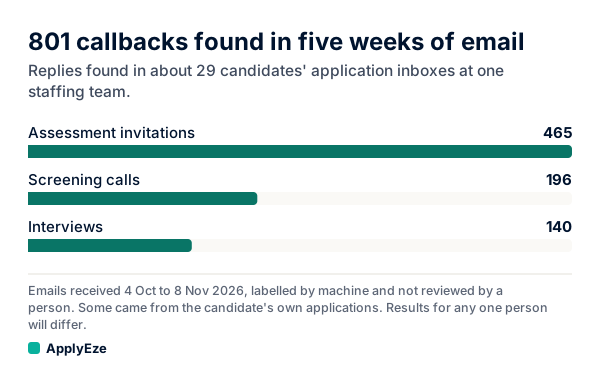
The chart shows 465 assessment invitations among 801 next-step replies found in about 29 candidates' application inboxes at one staffing team, from 4 October to 8 November 2026. The inbox scan behind that count is rolling out with staffing teams first and is not part of self-serve accounts yet. Those are machine labels nobody reviewed, so read them as found, not confirmed, and the count covers every kind of test without splitting them. For sorting one kind from another, start with our pre-employment test guide.
What a personality assessment measures
The EEOC describes these tools as assessing "the degree to which a person has certain traits or dispositions", such as dependability, cooperativeness and safety, or as predicting conduct such as theft or absenteeism. Most research sorts traits into five broad groups. The largest reanalysis of hiring research we found, Sackett and colleagues in 2022, reports how well each predicts job performance, where 0 is no relationship and 1 is perfect:
| Trait | General items | Items framed around work |
|---|---|---|
| Conscientiousness | .19 | .25 |
| Emotional stability | .09 | .23 |
| Extraversion | .10 | .21 |
| Agreeableness | .10 | .19 |
| Openness | .05 | .12 |
Two things follow for you. The numbers are modest, so a personality result is one weak signal among several. And every trait predicts better when the item is framed around work. So read each statement as a question about your working self, even when it does not say so. The Canadian Psychological Association adds that "only the traits from the personality-oriented work analysis should be considered", while noting research suggesting "Conscientiousness is helpful in nearly every job". In a well-run process, the traits that count depend on the role. That is why there is no single best profile to copy.
Common tests and who publishes them
Check the name in your invitation against this table. The last column is the publisher's position, and two of the most famous tools fail it.
| Test | Publisher | What the publisher says it is | Meant for hiring? |
|---|---|---|---|
| Hogan Personality Inventory | Hogan Assessments | Includes a 14-item Validity scale for careless responding | Yes, it gives guidance for selection use |
| PI Behavioral Assessment | The Predictive Index | A "six-minute, untimed workplace assessment": two questions on one list of adjectives, measuring dominance, extraversion, patience and formality | Yes |
| Wonderlic Select, personality section | Wonderlic | 150 untimed items, alongside cognitive and motivation sections | Yes |
| Myers-Briggs Type Indicator | The Myers-Briggs Company | A measure of psychological type | No. The publisher "believes it is unethical and we do not condone the use of the MBTI tool" for hiring or selection |
| DiSC | Wiley | Describes work behavior styles | No. They are "not recommended for pre-employment screening", because DiSC "does not measure specific skills, aptitudes, or other factors critical for a position" |
Game-based tools work differently, and our Pymetrics guide covers them. So does the cognitive half of a PI invitation, which has its own format and prep plan.
Consistency and why gaming backfires
Tests try to spot a pattern that does not make sense. Hogan's validity FAQ is the clearest public description we found. Its scale exists to "identify assessment takers who have responded in a potentially careless or random manner". It has 14 items with very high or very low endorsement in general working populations, at 90% or higher for the high group. In other words, nearly everyone answers them the same way, so missing many of them looks odd.
Three details from that FAQ are worth remembering:
- It is not a lie detector. "A flagged Validity scale does not mean the person was inattentive; it means that their response pattern was unusual."
- Careful test takers can be flagged too, so rushing is the avoidable risk.
- In hiring, you may not get a second go. Hogan says "The best approach is often to use results as they are rather than reassessing or interpreting results differently."
Whether faking works is disputed, and you should know that. A 2006 meta-analysis of 33 studies found applicants scored higher than non-applicants, most of all on emotional stability and conscientiousness, and that in jobs such as sales the traits seen as most relevant moved most. The authors read that as distortion, though comparing two groups cannot isolate it. Hogan's 2009 post, by contrast, says "the data show that people can't or don't fake their answers", citing over 5,000 rejected applicants retested six months later. Hogan sells the test. The Canadian Psychological Association sides with the concern: "Faking is an important concern, as it reduces the ability of the test to accurately forecast job performance." It points to forced-choice formats and genuine warnings to applicants.
The practical case against gaming has four parts:
- You are guessing at a hidden target. The Predictive Index says employers "define what a role needs and compare candidates against it". You cannot see that definition. High on everything is a guess, and it may be the wrong one.
- Some formats make it hard. In a forced-choice block, picking one good trait costs you another.
- The result may follow you into the interview, where you will have to back it up in your own words.
- It can work. Then you are hired for a job built around someone you were pretending to be.
Labelled samples, read aloud
We wrote these three items for this post. They are samples, not from any publisher's test, and real ones will read differently. The method is the point: read the statement aloud, then say "for example" and finish the sentence. If an example comes easily, agree. If it does not, do not.
Sample 1: a rating item. "I finish routine tasks before starting more interesting ones." Rate from strongly disagree to strongly agree.
Read aloud, then finish: "For example, last week I..." Base it on last month, not on the worker you would like to be. A middle answer is a real answer. This style of item points at conscientiousness, and later in a test you might see the same idea reversed: "I often leave dull tasks until the last minute." Agreeing strongly with both is the kind of mismatch these checks exist to notice. Answering from the same real week makes that unlikely, with no effort or memorizing.
Sample 2: an absolute statement. "I have never lost patience with a coworker."
Read aloud, this sounds wrong, and that is useful. Words like never and always are rarely true of anyone. Agreeing because you think it is the safe answer is what an unusual pattern looks like. Choose what is true, even if it feels slightly unflattering, because almost everyone has lost patience at work.
Sample 3: a forced choice. Pick the statement most like you and the one least like you.
- A. I keep plans on track when others lose interest.
- B. I enjoy persuading people who disagree with me.
- C. I stay calm when priorities change at short notice.
All three sound good, which is the design. Read each aloud with "for example". Pick as most like you the one where the story comes first, and as least like you the one where it comes last. Being last here does not mean you lack that trait. It only ranks these three.
Two practical rules cover the rest. Do not overthink any single item, because a trait score comes from many items and not from one answer. And follow the instructions you were given: if the test says to answer for work, answer for work.
What employers can and cannot do with results
This section is general information about US rules, not legal advice. State law varies.
They can generally use one. Title VII allows tests unless they are "designed, intended or used to discriminate". The EEOC's page on this dates from 2007, and it was still posted when we read it on 9 November 2026.
A test that screens out a protected group needs a reason. Under that guidance it must be "job-related and consistent with business necessity". This area changed recently. An April 2025 executive order told federal agencies to step back from disparate impact, and in September 2025 the EEOC moved to close charges based only on that theory. Lawyers at Venable note that the theory remains viable under Title VII and that people may still sue. A federal judge dismissed one challenge to the closures in November 2025, for lack of standing.
A test that works as a medical exam must wait for an offer. The EEOC's 1995 guidance says "Psychological examinations are medical if they provide evidence that would lead to identifying a mental disorder", while a test "designed and used to measure only things such as honesty, tastes, and habits" is not. Three cases show where that line has bitten:
- Karraker v. Rent-A-Center, 2005. A federal appeals court held that the MMPI, a test designed at least in part to reveal mental illness, was a medical exam under the ADA when used to screen employees for promotion, even with no psychologist interpreting it.
- Target, 2015. Target agreed to pay $2.8 million after an EEOC finding that included an assessment "performed by psychologists on behalf of Target" treated as a pre-employment medical exam.
- Aon, 2024. The ACLU filed a complaint with the FTC, alleging that the ADEPT-15 personality test works as a proxy for mental health disabilities, and citing an item about reading how someone feels from their face. Aon says its tools are meant to be fair to everyone and follow industry best practices and EEOC guidelines. That is an allegation, and we found no ruling.
Massachusetts goes further on honesty tests. State law defines a lie detector test to include any "written examination" whose results are used or interpreted by an examiner for "the rendering of a diagnostic opinion regarding the honesty of an individual", and bars employers from requesting one. Applications for work there must carry a notice saying so. Whether a given integrity test falls inside that definition is a question for a lawyer.
If you think a test crossed a line, keep the invitation and screenshots of what you can. The EEOC's deadline for a charge is generally 180 calendar days, extended to 300 where a state or local agency enforces a similar law.
If you need an accommodation
Ask the employer, not the test vendor. Wonderlic's FAQ says "testing accommodations are provided by the prospective employer". On timing, the EEOC says "It is best to let an employer know as soon as you realize that you will need a reasonable accommodation", and you can ask "orally or in writing".
You do not need legal words. EEOC guidance says you may use "plain English" and need not mention the ADA. If the need is not obvious, the employer may ask for reasonable documentation about the disability, and it generally cannot require your complete medical records.
A sample, with invented details, to adapt:
Subject: Assessment for the Account Manager role
Hi Dana, I received the assessment link, thank you. I have a disability that affects how I work through online questionnaires, and I would like to ask for an accommodation before I start. Could you tell me what format it takes and who handles these requests? A screen reader compatible version would help. I can share documentation if you need it.
Say what you need, not your history. If a test's items seem to measure your condition more than the job, you can say that too, and ask whether another way of assessing you is available.
When to decline
Most personality tests are not a reason to walk away. A short, untimed questionnaire is a small cost for a job you want. These are the cases we would treat differently:
| What you see | What it suggests | What to do |
|---|---|---|
| Questions about diagnoses, medication or mental illness before any offer | It may work as a medical exam | Stop and ask what the instrument is. Decline if the answer does not settle it |
| A fee to take it | Likely a scam. The FTC says "Honest employers, including the federal government, will never ask you to pay to get a job." | Decline, and do not click further |
| MBTI or DiSC used to screen you out | The employer is ignoring the publisher's own guidance | Ask how it is used. It is a fair mark against the employer |
| The test is the only step before rejection | Even a publisher warns against this. The Myers-Briggs Company says these tools "shouldn't be used as the sole determinant in hiring decisions" | Ask. Weigh the answer when you decide how much effort the role deserves |
| You asked for an accommodation and got no real answer | How they treat applicants may be how they treat staff | Follow up once in writing, then decide |
| A long test for a job you would not take | Your time is the cost | Skip it. It will probably end that application, and that is fine |
One question does a lot of work, and it is safe to ask: "Could you tell me which assessment this is, and how the results are used alongside interviews?" A clear answer is reassuring. Silence is information too.
Give these tests your attention and leave the forms to software. ApplyEze builds a resume for each posting and fills and submits each form, and it does not take assessments for you, so every answer on one of these tests stays yours. You queue the roles you want in the desktop app, it applies while your computer is on, and you record each reply on its application. If you would rather spend your evenings on the roles worth a 35-minute test, your first 50 applications are free, with no card, and a credit is used only when an application is confirmed as submitted.