
The Predictive Index cognitive assessment is a timed test of general mental ability: 50 multiple-choice questions in 12 minutes, across verbal, numerical and abstract reasoning. Only correct answers count. PI's own example gives the same score to someone who attempted 20 questions and someone who attempted 40 if both got 15 right. It is a different instrument from PI's untimed behavioral assessment, and an employer may send you both. What ranks for this phrase is PI's product page, plus prep sites. The most useful material sits in PI's support articles written for employers, which tell you how the score is built, what the employer is told to do with it, and what you can ask for. This post puts those in candidate terms. It contains no test questions.
Cognitive against behavioral
These are easy to confuse because they share a name, and the preparation is opposite.
| Cognitive Assessment | Behavioral Assessment | |
|---|---|---|
| What it measures | General cognitive ability: how fast you can be expected to acquire new knowledge | Work-related personality: Dominance, Extraversion, Patience, Formality, plus Objectivity |
| Format | 50 multiple-choice questions | Two questions, each with a list of 86 adjectives. You select at least 6 and up to 79 |
| Time | 12 minutes, strictly timed | Untimed, about 6 minutes on average |
| Right answers | Yes | No. "A high score does not equate to a 'better' score" |
| Can you practice | Yes, for format and pace | There is little to practice. Answer honestly |
Watch the order. An employer can set the cognitive test to go out after the behavioral one, and a candidate link can be set to send it automatically once the behavioral one is finished. So a relaxed six-minute task can be followed by a timed test you were not expecting. Check for it, and do not open the second one until you are ready. For the behavioral side, see our guide to employment personality assessments.
Format and timing
The numbers come from PI's introduction and its scoring article.
- The mix. At most 16 verbal, 18 numerical and 16 abstract questions. Abstract questions involve recognizing patterns or differences in shapes.
- The pace. 12 minutes across 50 questions is 14.4 seconds each (our arithmetic). PI says the time limit is part of what is being measured.
- Your questions are your own. They come from a larger pool through what PI calls a linear-on-the-fly engine, so two people get equivalent but different tests, and you will not see the exact same test twice. Memorized answers from a forum will not help.
- Your device. It runs on computers, tablets and smartphones, and you can typically use your own. Use the one where you can read and click fastest.
- Stay on the page. PI says the test blurs the screen and blocks copy and paste if you navigate away.
- Resources. PI's accommodations page says there are "no restrictions" on a resource or tool such as scratch paper, so keep paper beside you. It does not name calculators. If a proctor is present, ask.
- Language. You can change the language before you begin.
- The invitation expires. It lapses a set number of days after sending, depending on the employer's settings. It comes from a PI address, and PI's guide suggests safelisting that address.
What the score means
This is the section prep sites tend to blur, and PI spells it out for employers.
Correct answers are all that count. The total correct is converted to a scaled score between 100 and 450. PI says the number of questions attempted "is irrelevant" to interpreting scores. A wrong answer therefore appears to cost you only the seconds it took. PI does not put it that way, but its example with two equal scores implies it. So when a question stalls you, choose your likeliest answer and move on, and do not leave easy ones unreached.
250 is the population average. PI says the score is referenced against a general population norm that averages 250, and the norm for a given job may differ.
What matters is the job's target. If your score matches or passes the target, your cognitive match score is 10. There is no penalty and no bonus for going past it. Below the target, points come off on a sliding scale. A sample, with invented numbers:
| Job target | Your scaled score | Match score |
|---|---|---|
| 270 | 270 | 10 |
| 270 | 340 | 10, the same |
| 270 | 240 | Below 10. PI does not publish the exact scale |
You will not usually know the target. So the aim is your own steady pace, and chasing a number from a forum makes little sense.
Section scores do not count, or should not. PI says subscores "are not valid or reliable enough to support any hiring decisions", and that it would be a misuse to treat the numerical score as more important for an accounting job. So do not over-drill one section because of the role you applied for.
You may never see the number. PI recommends employers keep scores confidential and speak in terms of fit, such as "a moderate fit to the job". Its software labels fit as strong, moderate or cautionary. Ask what the employer shares, but do not count on a score.
A one-week plan
PI's product page says the test does not require "any test preparation". Its sample questions article also says samples can eliminate the "shock" some people feel with a cognitive test. That second point is the goal of a week's work: removing the surprise and finding your pace. It is a little over two hours in all. If your invitation expires sooner, keep days 1, 2 and 6.
| Day | What to do | Time |
|---|---|---|
| 1 | Read the invitation: deadline, sample link, whether the behavioral test comes first. Raise any accommodation now | 15 min |
| 2 | Do the sample questions under a timer. If there is no link in the invitation, ask for one | 20 min |
| 3 | Review what you missed. Name your slowest of the three types | 20 min |
| 4 | Drill number work without a calculator: percentages, ratios, series | 20 min |
| 5 | Drill your weakest of verbal or abstract. For shapes, practice naming what changes | 20 min |
| 6 | One full 12-minute timed run, from a source you have not used, with paper to hand | 25 min |
| 7 | Check your device and connection and clear a quiet slot. Then take it, or rest and take it the next morning | 15 min |
Where to practice
First, look in your invitation. PI's sample questions are found in the administrator's invitation, if the administrator chose to include them. Anyone with the link can use it, and no personal information is requested or stored. You get no score, but you see which you got right and the correct answers. PI says there is no overlap with the real question pool, and that the two have not been equated, so a good sample run is not a prediction.
If there is no link, ask for one. PI tells employers that if one candidate gets the sample questions, all candidates should. That is a reasonable basis for asking. A sample note, with invented details:
Hi Elena, thanks for the PI Cognitive Assessment invitation. Is there a link to PI's sample questions I could use first? I would like to see the format before the timed test.
Other free practice. PredictivePrep offers free original practice questions and states it is "not owned or affiliated with the Predictive Index company". Treat it as format practice from a third party. For raw pace, Wonderlic's free timed drill runs at the same 14 seconds a question, though it is a different publisher's test with its own question types.
Paid packs. Many sites sell them. Nothing we read from PI suggests you need one, and none can tell you which questions you will get, given how PI assembles each test. Try the free options first.
Asking about accommodations and retakes
Both of these go through the employer, and both are easier before you start.
Accommodations. PI offers 18-minute and 24-minute versions, and says they report on the same scale as the standard format, so a comparison with other candidates stays fair. In the US, PI notes it is primarily the assessment taker's responsibility to tell the administrator about a need, because employers generally cannot ask about disability before hiring. So raise it before you begin. PI says neither it nor the employer should suggest the accommodation, and that this is typically a medical professional's decision. Other options it lists are a quiet private space and scratch paper.
PI also says two things plainly that most guides skip. The test is not appropriate for someone whose visual impairment prevents recognizing shapes on a screen. And it does not recommend readers or scribes for this test. In those cases PI tells employers to use alternative selection procedures, so you can ask for one by that name.
Retakes. PI's documentation, dated 17 July 2026, sets out the rules an employer is working with:
- By default you get one attempt. The software allows up to three in total, and it is the employer's decision.
- Only your highest score should count, and the report defaults to it. So a retake should not be able to hurt you.
- PI names technical problems such as a bad connection, and interruptions such as a fire alarm, as reasons to allow a retake even under a one-attempt policy.
- If an employer grants you a retake, PI says it should offer the same to all candidates. Some employers may say no for that reason, so state your reason plainly.
A retake is worth asking for if your first attempt went wrong. A 2007 meta-analysis of 50 studies found scores rose about a quarter of a standard deviation on a second sitting of a cognitive test. Those studies mostly used older, paper-based tests, so treat that as a rough guide, and as an average that may not hold for you.
How employers use the score
PI's guidance is clear. The score "is not intended as the sole determining factor in the hiring process", and it should sit alongside the resume, interviews and other data. Its documentation adds that "no single assessment alone should be used to make hiring decisions". It even says the test may not be needed for a job with low cognitive demand.
What employers do can be a different matter. SHRM surveyed 1,688 HR professionals in February 2022, and 56% said their employers use pre-employment assessments. Of those surveyed, 79% said scores count as much as other criteria or more. That is 2022 data, and it covers all kinds of tests. So treat "one input" as the publisher's instruction, and prepare as if the score could decide whether a person ever reads your resume. If you want to compare it with the other common formats, our guides to pre-employment tests and the SHL assessment cover them.
We can add one measure of how common these invitations are. It comes from callback detection, which scans a candidate's application inbox where it is switched on. It is rolling out with staffing teams first and is not part of self-serve accounts yet. It first ran on 3 November 2026 and read back to 4 October, across about 29 candidates at one staffing team.
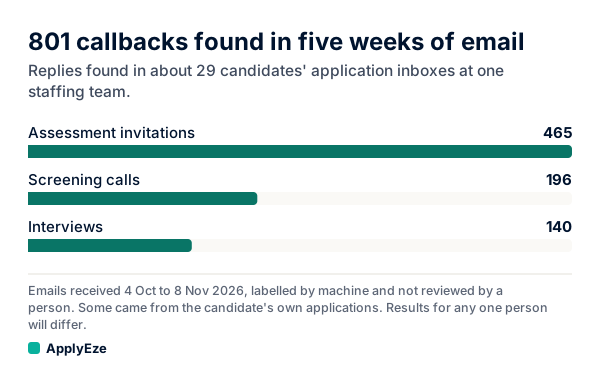
The chart shows 465 assessment invitations, 196 screening invitations and 140 interview invitations, so tests were 58% of the 801 found (our arithmetic). Those cover every kind of test, not PI alone, and they are machine labels, so found and not confirmed. It is one staffing team, and results for any one person will differ. The shape is the point: when replies come back, many of them are tests, and one may be the first thing you hear from an employer.
Where ApplyEze fits
ApplyEze does not take assessments for you, so the test stays yours. What it takes on is the form in front of it. On a self-serve account you queue the roles you want from a board that draws on more than 100,000 employer boards polled directly, and the desktop app fills and submits each form on your computer while it is on and awake. Workday and Oracle jobs need a connected application inbox. You record replies yourself.
So check your next invitation for a sample link and a deadline, and keep a week clear for the plan above. If you would rather spend that week on practice than on application forms, your first 50 applications are free, no card needed, and ApplyEze builds a resume for each posting.