

A Wonderlic practice test drills the one part of the real assessment that has right answers: the cognitive section, 50 questions in 12 minutes. Wonderlic's own practice test is free with no sign-up, and gives you 5 questions in 72 seconds, about 14 seconds each. For a full-length run, third-party sites offer a free 50-question timed test, though those questions are not Wonderlic's. We do not host a test on this page or write our own questions, because a made-up item would teach you nothing about the real one. What this post adds is what the results page leaves out: where Wonderlic's own pages contradict the common advice and each other, how to tell which version you were sent, and a plan built around the 14-day limit on most test links.
The results for this phrase on 9 November 2026 are mostly prep sites, several of them selling study packs. Wonderlic's position is blunt: "Be cautious of any website asking for money for test prep", and "You should never have to pay to take a Wonderlic assessment. This includes any practice or preparation."
Where to find real practice
| Source | What you get | Cost | The catch |
|---|---|---|---|
| Wonderlic test taker hub | Timed test, 5 questions in 72 seconds, instant feedback, questions drawn from a larger pool. Three worked samples on the page | Free, no sign-up | Too short to test your stamina over 12 minutes |
| Wonderlic Select sample PDF | Sample items and instructions for all three sections | Free | A sample, with no timer. Set your own |
| WonderlicTestPractice.com | A "free 50-question test" in 12 minutes and a "25-question practice test" in six | Free, as the site describes it | Says it is "in no way affiliated with Wonderlic, Inc.", so its score is not a forecast of yours |
| Paid prep sites | Question banks and courses | Varies | Wonderlic says they are "in no way affiliated" and that paying is unnecessary |
Use the official drill for pace and format. Use a full-length third-party test to find out what minute 10 feels like. Treat any score from either as a training number.
What the Wonderlic is
The Wonderlic is a hiring assessment whose cognitive test has, in the company's words, been used in employee selection since 1937. Today employers buy it as Wonderlic Select, which combines cognitive ability, personality and motivation. Wonderlic says it assesses over 4 million candidates a year, which is its own figure. It sells only to organizations, so a test taker never pays for one. For how it compares with other types, see our guide to pre-employment tests.
Format, timing and scoring, from its publisher
All of this comes from Wonderlic's candidate FAQ, dated 2 October 2025, unless linked otherwise.
| Section | Items | Time | Right or wrong answers |
|---|---|---|---|
| Cognitive ability | 50 | 12 minutes | Yes |
| Motivation | 58 | Untimed | No |
| Personality | 150 | Untimed, about 15 minutes | No |
| Whole assessment | 258 | About 35 minutes on average |
The test usually runs online on your own device, and companies typically do not proctor it, though some may. The cognitive questions are, per the hub, word problems, number series, logic puzzles, vocabulary and analogies. No calculator or dictionary is allowed, and only a small number of questions need calculations.
Scoring is where most of what you will read online is out of date.
You are not expected to finish. Wonderlic says so directly, and it puts the average on the classic 50-question test at around 20. That is 40% of the questions (our arithmetic). Running out of time well before question 50 is an ordinary result.
You probably will not see a number. Wonderlic Select "does not provide a singular numerical cognitive ability score", and traditional cognitive scores are not available to candidates. The only result you may get is a Candidate Feedback Report, through a link at the end of the test. If no link appears, there is no report for you. Employers see results immediately, and Wonderlic notes the law generally does not require them to share those with you.
"No pass or fail" is true only on your side. The candidate pages say there is no passing grade. The employer page pitches the ability to "compare candidates using a single score" during "the screen-out process". So a score can still end your application, even with no published pass mark. In SHRM's survey of 1,688 HR professionals, run in February 2022, 79% said assessment scores count as much as other criteria or more.
Wonderlic disagrees with itself on guessing. Its hub says that if a question is taking too long, "make your best guess and move on". Its published test instructions, from July 2024, say "Guessing is not likely to improve your score", then add that if you think you know the answer, "mark your best choice and move on". We found no statement either way on a penalty for wrong answers. Our reading: make a fast, reasoned choice and keep going, and do not skip around, which the instructions and the FAQ both advise against. The instruction screen on your own test overrides anything you read here.
Which version did you get?
Prep advice often assumes one test. There are several, and the clue is usually in the invitation or on the first instruction screen.
| The clue | Likely version | Format |
|---|---|---|
| From an employer, with three parts or about 35 minutes mentioned | Wonderlic Select, formerly Wonscore | 50 cognitive, 58 motivation, 150 personality |
| From an employer, 50 questions in 12 minutes and nothing else | The cognitive section, or the classic test | 50 in 12 minutes. The hub says other sections depend on the role |
| From an employer, 30 questions in 8 minutes | Wonderlic Personnel Test Quicktest, per a 2014 brochure, so it may have changed | 30 in 8 minutes, unproctored. Results shown to employers as Pursue, Cautionary or Not Recommended |
| From a school or training program | Scholastic Level Exam, an admissions test | 50 in 12 minutes, or a remote Quicktest of 30 in 8 |
| Asks you to pay | Not from Wonderlic | Stop and check the sender |
If you cannot tell, ask. A sample note, with invented details:
Hi Marcus, thanks for the assessment link for the Account Coordinator role. Could you tell me which Wonderlic assessment this is, about how long I should set aside, and the date the link closes? I want to make sure I can complete it in one sitting.
A two-week preparation plan
Wonderlic says links "generally remain active for a maximum of 14 days", and an employer can disable one sooner, at which point you see "Assessment not Available". Wonderlic cannot resend it: only the employer can. So treat two weeks as a ceiling, and to be safe count from the day the email arrived. Check the invitation for an earlier date before you plan around this. The plan below finishes on day 12 and leaves two days in case something breaks. It comes to about four hours of preparation, plus the test itself. Accommodations run through the employer: Wonderlic says the prospective employer provides them under the Americans with Disabilities Act and consults Wonderlic on what fits.
| Days | What to do | Time |
|---|---|---|
| 1 | Read the invitation for the deadline and the version. If you need an accommodation, ask the employer today. Take the official 72-second test twice, cold | 20 min |
| 2 | One full-length timed test, no calculator. Then note which question types slowed you down | 30 min |
| 3 | Go through your wrong and unfinished answers. Rank the five types from slowest to fastest | 20 min |
| 4 to 7 | Daily drills on your two slowest types. Mental arithmetic for number work, word lists for vocabulary | 20 min a day |
| 8 to 9 | Pace work on the official test. Learn to feel 14 seconds, and practice moving on | 20 min a day |
| 10 | Second full-length test, ideally from a different source so you are not remembering answers. Review it | 30 min |
| 11 | Read the motivation and personality samples so the format is familiar. Check your device and connection. Stop studying | 15 min |
| 12 | Take it in one sitting, somewhere quiet, with your phone put away | 35 min |
The arithmetic behind the pace work: 12 minutes is 720 seconds, or 14.4 per question. A question you wrestle with for 45 seconds costs you the time of about three others. That is why the pace matters more than any single topic.
For the two untimed sections, there is nothing to study. Wonderlic's instructions ask you to "respond candidly", and warn against picking "a response because it describes the way that you might like to be". Our guide to the SHL assessment covers a questionnaire of the same kind.
If you have only three days, do this: on day one, take the official test twice and one full-length run. On day two, drill your slowest type, then do a second run. On day three, take it.
What practice can do. Wonderlic's FAQ says "Preparation and study are not necessary". Its hub says practicing your pace "is the most useful thing you can do". The research sits between the two. A 2007 meta-analysis of 50 studies and 134,436 people found scores rose by about a quarter of a standard deviation between a first and second sitting of a cognitive test, with an effect size of .26. The gain was .20 from a second to a third sitting. It was .24 on alternate forms, which is closest to practicing on different questions, and .46 on identical forms. Studies with coaching showed .70 against .24 without, at a median of 2.5 hours of contact time.
Those are averages across studies from 1921 to 2005, and about 90% of the tests were on paper in groups, so they are a guide and not a forecast. They suggest a real but modest gain, and that each further sitting adds a little less.
When the invitation arrives, from our data
Our data adds something the prep sites we read do not have: when these emails show up. These counts come from callback detection, which scans a candidate's application inbox where it is switched on. It is rolling out with staffing teams first and is not part of self-serve accounts yet. It first ran on 3 November 2026 and read back to 4 October, across about 29 candidates at one staffing team.
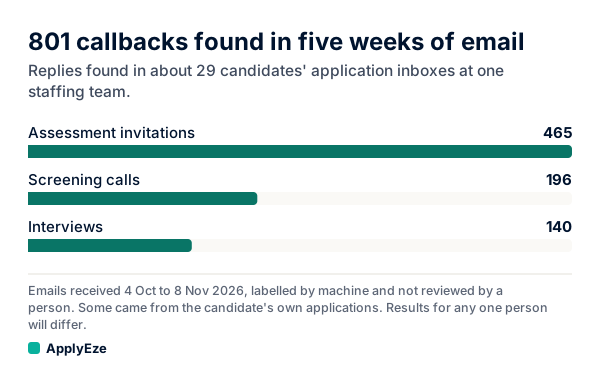
The chart shows what was found: 465 assessment invitations, 196 screening invitations and 140 interview invitations. That makes tests more than half of all 801.
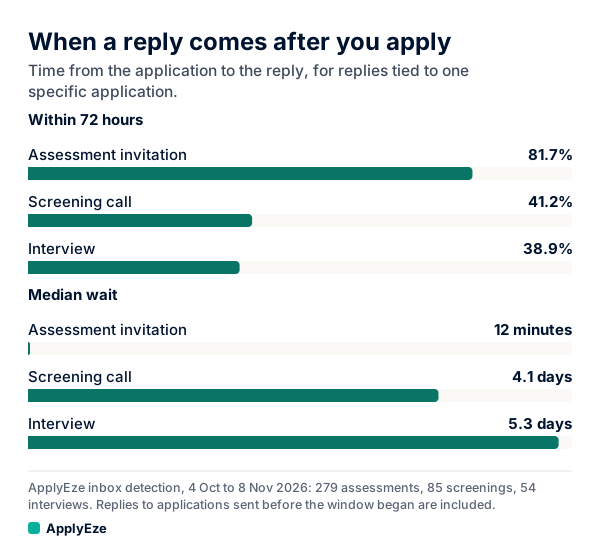
The second chart shows the wait. Among the 279 assessment invitations we could tie to one application, the median was 12 minutes, and 81.7% came within 72 hours. Screening took a median 4.1 days and interviews 5.3. These cover every kind of test, not Wonderlic alone. They are machine labels on emails, so found and not confirmed, from one staffing team, and results for any one person will differ. The timing runs from the application, not from an interview.
Two things follow. First, if you are applying now, do a timed practice run now. A link with a 14-day limit can arrive within minutes of applying. Second, do not read speed as interest. An invitation in 12 minutes points to software, and our post on assessment emails after applying explains the triggers. Nothing in these numbers rewards rushing, so start when you can do it well.
Where ApplyEze fits
ApplyEze does not take assessments for you, so the test stays yours. What it takes on is the form in front of it. On a self-serve account you queue the matches you want from a board that draws on more than 100,000 employer boards polled directly, and the desktop app fills and submits each form on your computer while it is on and awake. Workday and Oracle jobs need a connected application inbox. You record replies yourself.
So take the official drill today, before the next link lands. If you would rather spend your evenings on timed practice than on application forms, your first 50 applications are free, no card needed, and ApplyEze builds a resume for each posting.