

How long to hear back after applying? When an employer does reply with a next step, it commonly takes four to five days. In replies found at one staffing team from 4 October to 8 November 2026 and tied to one application, the median wait was 98.1 hours (4.1 days) for a screening invitation and 126.8 hours (5.3 days) for an interview invitation. For applications sent from 12 to 23 October, which had time to mature, 38% of those replies came within 72 hours and 74% within 7 days. So a silent first week is normal, and a silent second week is a strong hint.
Most pages on this question give "one to two weeks" with nothing behind it. Below is the rule we use, then the numbers it comes from.
The rule, by day count
| Time since you applied | What the count shows | What to do |
|---|---|---|
| Up to 3 days | 38% of replies have arrived | Nothing. Silence means nothing yet. Keep applying elsewhere. |
| Days 4 and 5 | About half have arrived (median 116 hours, or 4.8 days) | Nothing yet. For a role you badly want, find a named person now. |
| Days 6 and 7 | 74% have arrived by the end of day 7 | Draft your note. Do not send it yet. |
| Days 8 to 14 | The rest are thinning out, and the odds have dropped a long way | Send one follow-up, only on roles you would take. |
| Day 15 on | No clean figure yet | Treat it as closed in your plans. Leave it open in your tracker. |
These are clock hours, and weekends count in them. In a separate cut of the same inboxes, 90.5% of these emails arrive on a weekday, so a 4.8 day wait that spans a weekend is about three working days. If you applied on a Friday, the first two of those days are thin ones, so expect the early rows to run slow. Templates for the day 8 note are in how to follow up on a job application.
The median wait, by kind of reply
Here is how callback detection works where it is switched on. It is rolling out with staffing teams first and is not part of self-serve accounts yet. A scanner reads a candidate's application inbox, and code and an AI model label the likely replies. It first ran on 3 November 2026 and read back to 4 October, across about 29 candidates at one staffing team. These are machine labels that no person reviewed, so we say found and not confirmed.
| Kind of reply | Found | Tied to one application | Median wait | Within 72 hours | Within 7 days |
|---|---|---|---|---|---|
| Screening | 196 | 85 | 98.1 hours (4.1 days) | 41.2% | 60.0% |
| Interview | 140 | 54 | 126.8 hours (5.3 days) | 38.9% | 61.1% |
| Assessment | 465 | 279 | 0.2 hours (12 minutes) | 81.7% | 94.6% |
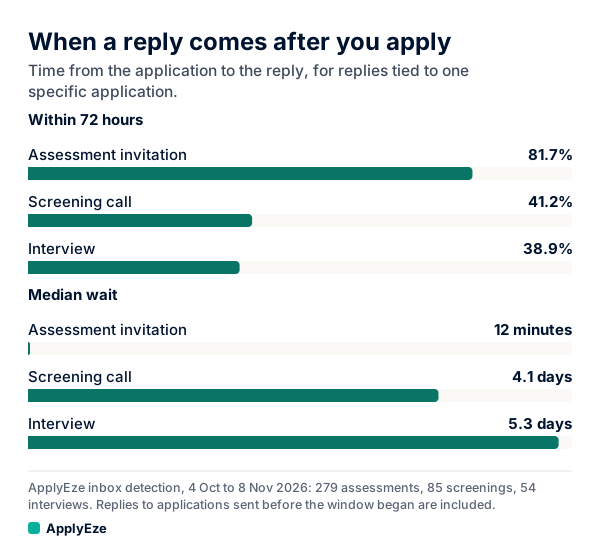
The chart shows how far apart these clocks run. Assessment invitations come in minutes, and most of them are sent automatically, so we count them apart. An assessment email minutes after you apply is not the reply this post is about. Screening and interview invitations, which we call human callbacks, take days.
Two details matter. The timing columns cover only replies tied to one application, which is 139 of the 336 human callbacks. The rest could not be tied, and some may have come from the candidates' own applications. And this count does not track rejections at all, so "hear back" here means a next step.
The fuller read: 74% within 7 days
The table above mixes applications of every age. So we also looked at one fixed group: applications sent from 12 to 23 October, with 58 human callbacks.
- Median wait: 116 hours, or 4.8 days.
- Within 72 hours: 38%.
- Within 7 days: 74%.
So about a quarter of the replies in this group took more than a week. That is why day 7 is the point to prepare a follow-up, and not the point to give up.
Why the two reads differ
The table says 60.0% and 61.1% within 7 days. The fuller read says 74%. They come from the same inboxes, and they agree at 72 hours. They split later on.
The table takes every tied reply found between 4 October and 8 November, and those applications had very different amounts of time on the clock. Applications sent before 4 October can show up only through their later replies, since anything quick arrived before the scan's start date (our reasoning, not a measurement). So the table's within-7-days columns run low.
The fuller read fixes the group instead. Every application in it was sent by 23 October, so each had at least 16 days before the window closed on 8 November, and at most 27 (our arithmetic).
A reply on day 30 cannot appear in that group, so 74% is the share of replies seen by 8 November, and the long-run figure would sit somewhat lower. We use 74%, on 58 callbacks, as the working number.
How this compares with Huntr's 5 days
Three separate sources have tried to measure this. They count different things.
| Source | What it measures | Median | How it was counted |
|---|---|---|---|
| ApplyEze, one staffing team | Application to interview email | 126.8 hours (5.3 days), 54 replies | Machine labels on inbox mail |
| ApplyEze, fuller read | Application to screening or interview email | 116 hours (4.8 days), 58 replies | Same, one fixed group |
| Huntr, Q3 2026 | Application to interview | 5 days | Users log their own searches |
| Careery, 2025 | First interview-related contact | 6.7 days | Vendor claim, "1,000+ anonymized job seekers", no exact sample given |
Huntr says its median was "unchanged for 4 quarters", and it warns that "users log their own applications, interviews and offers, and they don't log everything." Our 5.3 days and its 5 days come from different people and different methods, and they sit within a third of a day of each other. Two methods landing that close is useful reassurance.
All of these start from applications that got a reply. An application that never gets one has no wait to measure, and the next section deals with that.
What silence after two weeks means
Most applications never produce a reply, which is the fact the timing figures hide. In a United Way NCA survey of 1,000 recent and current US job seekers, fielded in February and March 2026, 94.3% said they had applied and never heard back, and on average they said 67% of their applications got no response at all. That is people's memory and not a count, but it sets the scale.
So the useful question is how much a silent stretch should change your odds. The fuller read lets us work that out. Say a role started with a 1 in 10 chance of a reply. After 7 silent days:
- Replies still to come: 0.10 x 0.26 = 0.026, because 26% of replies arrive after day 7.
- Applications that will never get a reply: 0.90.
- Chance a reply is still coming: 0.026 / (0.026 + 0.90) = 2.8%.
| Starting chance of a reply | After 3 silent days | After 7 silent days |
|---|---|---|
| 5% | 3.2% | 1.3% |
| 10% | 6.4% | 2.8% |
| 20% | 13.4% | 6.1% |
The starting chances are illustrations, not measurements. Only the 38% and 74% come from data. The pattern holds whichever you pick: seven silent days cut your odds to about a quarter of where they started.
The table stops at day 7 because the data has no clean 14-day figure. The direction is clear, though. Careery says "two weeks of silence is almost always no". Our math agrees on the direction, with one qualification: in the whole-window table about 4 in 10 tied replies took longer than a week.
Silence at two weeks is usually the absence of a decision reaching you. It is rarely a verdict on you. A posting may be paused, a status page may say "under review" for weeks, or nobody may have opened the file. So send your one follow-up, stop counting days, and put the time into the next application. If a reply comes in week five, it is a pleasant surprise.
How far these numbers travel
They measure waits among applications that got a reply, from one staffing team and about 29 candidates over five weeks in the fall, with no breakdown by industry or employer size. Slower sectors could run longer, and someone referred by an employee may hear on a different schedule. Machine labels can be wrong, and 58 callbacks is a small group. Results for any one person will differ.
What to do this week
- Write the date you applied beside every role. Without it, the rule above is no use, and your own log soon becomes your best timing data.
- Check it once a week. Pull the roles at day 8, and send one follow-up on the ones you would take. Let the rest go quiet.
- Close the role in your plans at day 15, and leave it open in your tracker.
- Keep the pipeline moving while you wait. The wait does not shorten, so what you control is how many applications are in play.
On a self-serve ApplyEze account you record employer replies yourself on each application, so those dates sit in one place. You queue the matches you want in the desktop app, keep the computer on and awake while they run, and connect an application inbox if you want Workday and Oracle roles. While you wait out the first week, your first 50 applications are free, no card needed, and ApplyEze fills and submits each form.